




 Table of Contents
- Third-Party Risk Management Frameworks: How to Build and Govern a TPRM Program
- What Is a Third-Party Risk Management Framework?
- TPRM Frameworks and Standards
- The TPRM Lifecycle
- Building a TPRM Program
- TPRM Governance
- TPRM Policy
- TPRM Metrics, KPIs, and a Program Checklist
- Key Takeaways
- TPRM Framework FAQs
Third-Party Risk Management Frameworks: How to Build and Govern a TPRM Program
A third-party risk management (TPRM) framework is the structure an organization uses to govern the security risks introduced by the vendors, suppliers, and service providers it depends on. Those dependencies are mostly invisible, right up until one of them fails.
A framework makes those dependencies governable. It turns scattered vendor questionnaires into a repeatable, defensible process by combining recognized standards with a defined vendor lifecycle, clear ownership, documented risk thresholds, and metrics that show whether the program is working.
The difference between an effective TPRM program and those that plateau is almost always structure. Yet many TPRM programs stop at collecting questionnaires.
This guide explores the structural layer of third-party risk management. It covers:
- TPRM frameworks like NIST CSF and ISO/IEC 27036 — and how they map to a vendor risk management program.
- The vendor risk management lifecycle.
- How to govern, document, and measure an effective TPRM program so it holds up under audit.
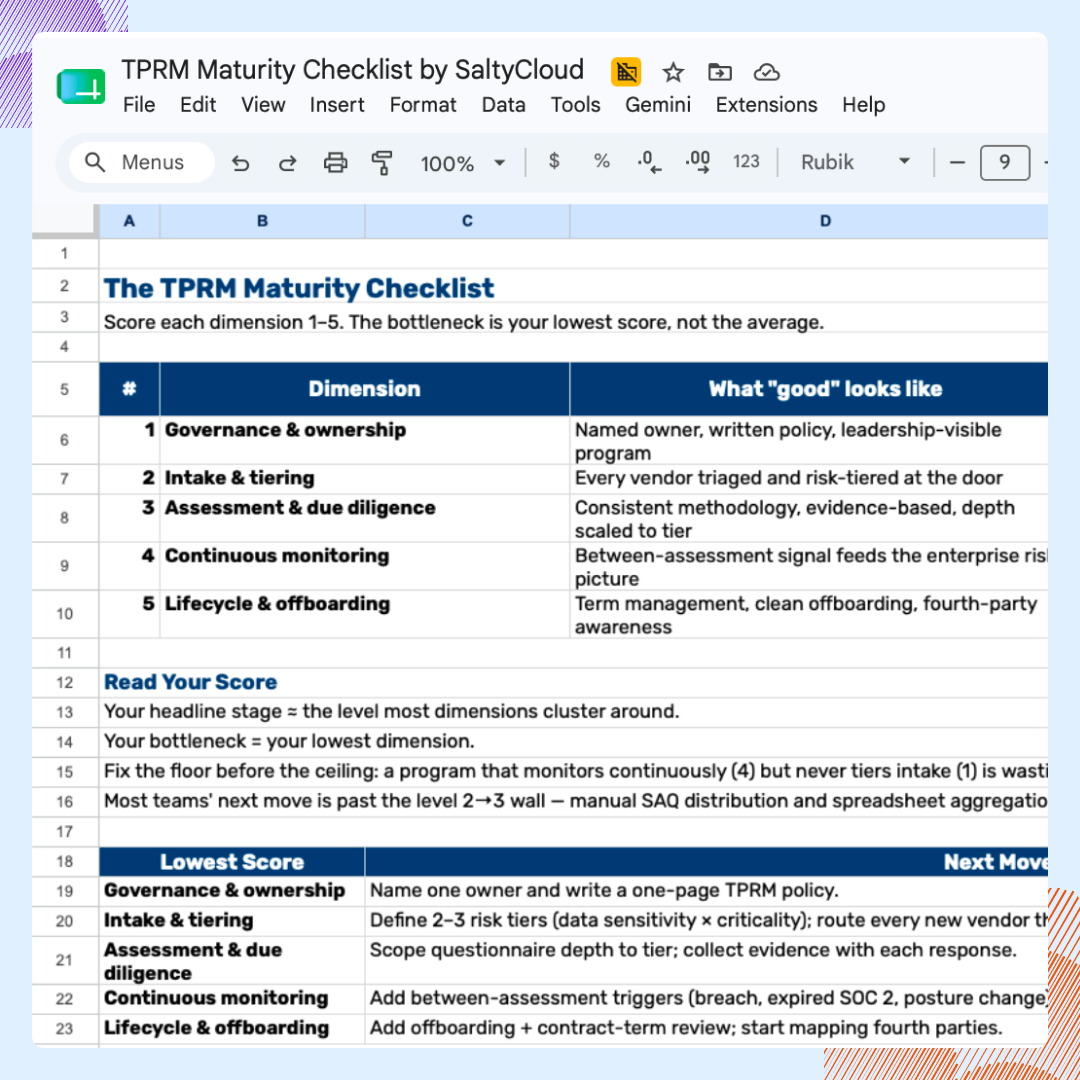
For the full picture, start with our broader third-party risk management guide. Then, use this page to give your TPRM program a backbone. Or, jump straight to our TPRM Maturity Checklist to score where your program stands today.
What Is a Third-Party Risk Management Framework?
Third-party risk management (TPRM) frameworks offers structure and guidance to govern the information security risks introduced by other organizations. It makes a third-party risk management program consistent by ensuring that similar vendors are evaluated using the same criteria, risk thresholds, and approval rules.
A TPRM framework is the governing structure that makes third-party risk decisions consistent, repeatable, and auditable. It maps program requirements to recognized standards, assigns ownership and accountability, and tracks risk across the vendor lifecycle.
Supply chain and third-party vulnerabilities ranks as the second-most concerning cyber risk for CISOs, according to the World Economic Forum’s Global Cybersecurity Outlook 2026. In fact, 65% of large organizations say third-party risk is the greatest barrier to cyber resilience, up from 54% the prior year. Meanwhile, third parties are now involved in 48% of breaches, up 60% year over year, according to Verizon’s 2026 DBIR.
TPRM establishes how those third parties are classified, what level of assessment they receive, who owns the resulting risks, and how those risks are tracked throughout the relationship.
TPRM Framework Structure and Purpose
An effective TPRM framework combines recognized standards such as NIST CSF, NIST 800-53, and ISO/IEC 27036 with the program’s own lifecycle, policy, roles, and performance metrics.
The standards provide a common foundation for what should be considered. An organization’s own policies determine how that guidance applies to its vendors, systems, data, regulatory obligations, and risk appetite. By documenting these rules in advance, the framework reduces case-by-case judgment and creates an audit trail showing what was assessed, which risks were identified, who approved the decision, and whether required remediation was completed.
How TPRM Relates to VRM and C-SCRM
TPRM overlaps with cybersecurity supply chain risk management (C-SCRM) and vendor risk management (VRM). All three determine whether third parties properly secure the networks and systems that protect the information flowing through their hardware, software, and managed services.
TPRM Framework vs. TPRM Program
A TPRM framework and a TPRM program are not one and the same.
- A framework is the structure: the standards a program aligns to and the lifecycle, policy, and governance built around them.
- A program is the operating function: the team, tools, and day-to-day work that runs inside that structure.
This guide is about TPRM frameworks. For instructions on the function itself, see our guide on how to build a TPRM program.
TPRM Frameworks and Standards
TPRM frameworks and standards are widely-recognized and industry-accepted references that define what good third-party risk management looks like. They give organizations a common vocabulary, defined outcomes, and traceable requirements for assessing program decisions.
Even so, the right framework depends on whether a program needs high-level direction, detailed practices, assessable controls, or an implementation process.
Today, there are several options available:
NIST CSF 2.0
NIST CSF 2.0 is an outcome-based cybersecurity framework that frames third-party risk in terms of the results a program should achieve. It sets direction rather than prescribing the specific controls needed to get there.
- The 2024 CSF update added a cybersecurity supply-chain risk management category inside its new Govern function.
- It describes a defined strategy and roles, suppliers prioritized by criticality, due diligence before onboarding, monitoring through the relationship, and managing the end of it.
- It maps almost one-to-one onto the lifecycle below.
Best for: Organizations starting from scratch. Because it’s outcome-oriented, NIST CSF is often the most accessible starting point. NIST’s C-SCRM Quick-Start Guide explains how to stand a program up around it.
NIST SP 800-53
NIST SP 800-53‘s Supply Chain Risk Management (SR) control family is the set of specific, assessable controls for managing third-party risk. Where a framework like CSF defines outcomes, 800-53 gives programs concrete requirements to measure against.
- The Supply Chain Risk Management (SR) controls provide the specific, auditable control language.
- For example, SR-02 (a supply-chain risk management plan) and PM-30 (an organization-wide SCRM strategy).
Best for: Teams that need control-level, audit-ready language. See NIST 800-53 vendor management for more information.
NIST SP 800-37 — the Risk Management Framework (RMF)
NIST SP 800-37, the Risk Management Framework (RMF), is the process for putting security controls into operation and keeping them under continuous monitoring. It is how a program operationalizes and sustains security controls, not a separate source of third-party requirements.
- It outlines a seven-step process (prepare, categorize, select, implement, assess, authorize, monitor) for putting security controls into operation and keeping them monitored.
- Other standards describe what good looks like, the RMF is how an organization operationalizes and sustains it.
Best for: Organizations ready to operationalize and sustain a complete control set.
ISO/IEC 27036 and ISO/IEC 27001
ISO/IEC 27036 and ISO/IEC 27001 are the international standards for managing security across supplier relationships within an information security management system (ISMS). They give organizations already aligned to ISO a certification-ready path for third-party risk.
- ISO/IEC 27036, “Cybersecurity — Supplier relationships,” addresses supplier-relationship security directly across its multi-part series.
- ISO/IEC 27001:2022 supplier controls (A.5.19—A.5.23) are widely used in certified environments.
Best for: ISO-certified organizations or those in ISO-heavy industries/regions.
| Framework or standard | Primary role | What it provides | Best for |
|---|---|---|---|
| NIST CSF 2.0, GV.SC | Defines program outcomes | Strategy, roles, supplier prioritization, due diligence, ongoing monitoring, incident planning, and off-boarding outcomes | Organizations establishing or restructuring a TPRM program |
| NIST SP 800-53 Rev. 5 | Establishes assessable controls | The Supply Chain Risk Management control family, including supplier assessments, acquisition practices, notification agreements, and SCRM plans | Teams that need specific, auditable control requirements |
| NIST SP 800-37 Rev. 2 | Operationalizes selected controls | A seven-step Risk Management Framework covering Prepare, Categorize, Select, Implement, Assess, Authorize, and Monitor | Organizations incorporating supply chain controls into system authorization and continuous monitoring |
| ISO/IEC 27036 and ISO/IEC 27001 | Governs supplier security within an ISMS | Supplier relationship guidance and controls for agreements, ICT supply chains, service monitoring, changes, and cloud services | ISO-certified organizations and those operating in ISO-aligned environments |
Selecting and Combining TPRM Frameworks
Most teams anchor on one framework and borrow from the others.
- NIST CSF is the best place to start for defining high-level outcomes.
- NIST SP 800-53 adds depth and audit-ready control language as a program matures, translating recognized outcomes into assessable controls.
- NIST 800-37 RMF incorporates those controls into system authorization and continuous monitoring, covered by the CA control family.
- ISO/IEC 27036 and ISO/IEC 27001 provide an alternative or complementary structure for supplier security within an information security management system (ISMS).
While these standards describe outcomes and practices and reference one another, they do not provide a one-to-one crosswalk to any specific vendor questionnaire.
The TPRM Lifecycle
The TPRM lifecycle is the repeatable path every third party follows from first contact to exit. It includes initial consideration, onboarding, ongoing oversight, and eventual off-boarding.
Naming these phases and assigning consistent activities, owners, and decision points at each one lets a program improve deliberately instead of reacting case by case. These stages can also be aligned with NIST CSF 2.0 outcomes and NIST 800-53 controls, as shown below:
| Phase | Core activities | Decision or output | Framework anchor |
|---|---|---|---|
| Intake and Scoping | Record the third party, service, business owner, data and system access, and operational dependency | Complete third-party record and defined assessment scope | CSF GV.SC-04 |
| Risk Tiering | Classify the third party by criticality, data sensitivity, access, substitutability, and business impact | Assigned tier, assessment depth, evidence requirements, and review cadence | CSF GV.SC-04 |
| Due Diligence | Collect and validate tier-appropriate questionnaires, documentation, and evidence across relevant risk domains | Complete evidence package ready for risk analysis | CSF GV.SC-06 |
| Risk Assessment | Analyze evidence, identify control gaps, and determine inherent and residual risk | Documented findings and risk rating | CSF GV.SC-07; 800-53 RA-3, SR-6 |
| Risk Approval and Mitigation | Approve, reject, or condition the relationship; assign owners; define remediation or compensating controls; and track treatment | Formal risk decision and time-bound treatment plan | CSF GV.SC-07; 800-53 RA-7, CA-5 |
| Continuous Monitoring | Monitor changes in controls, exposure, performance, criticality, and external risk signals | Updated risk posture, reassessment, escalation, or additional remediation | CSF GV.SC-07, GV.SC-09; 800-53 CA-7 |
| Offboarding | Revoke access, terminate integrations, recover or destroy data, confirm retention requirements, and close outstanding risks | Verified termination and closure record | CSF GV.SC-10 |
Because GV.SC-01 and GV.SC-02 establish the strategy, policies, roles, and responsibilities that govern every stage, they apply across the entire lifecycle.
Note: Our table only address the cybersecurity component of TPRM. Financial, legal, compliance, and operational reviews may require additional sector-specific frameworks.
Scaling the TPRM Lifecycle
Whether or not a program scales usually depends on tiering and continuous monitoring.
- Tiering directs diligence toward the third parties that can cause the most harm, so effort scales with risk instead of being spread evenly across every vendor.
- Continuous monitoring keeps that diligence current as a vendor’s risk posture changes.
Standardized questionnaires give the assessment phase a common baseline — the SIG across industries and the HECVAT in higher education. Each maps to underlying security controls rather than to each other, so a vendor’s SIG responses can’t be directly translated into HECVAT terms, or vice versa. The assessment phase itself — the questionnaire, evidence, and scoring — is covered in depth in our vendor risk assessment guide.
Building a TPRM Program
A TPRM program is the framework put into operation, built on three components that run the structure day to day:
- People: A named program owner and a clear model for who assesses, who decides, and who accepts risk.
- Process: The TPRM lifecycle turned into a documented, repeatable workflow.
- Technology: The tooling to run it at scale as the third-party population grows past what a spreadsheet can track.
The goal is consistency. Third-party risk should be handled the same way whether or not the right person happens to be in the room.
Our guide on how to build a third-party risk program covers the full build, including staffing, rollout, and operating the program week to week. ISACA’s guidance on building a TPRM program reinforces the same fundamentals — coverage, risk tiering, assessment depth, and reporting — from an independent industry source.
TPRM Governance
TPRM governance is the accountability layer of the program. It defines who is accountable, who does the work, who can accept risk on the organization’s behalf, and makes third-party risk visible to leadership.
Ownership and Decision Rights
Ownership and decision rights assign who is accountable for third-party risk, who runs the assessments, and who holds the authority to accept it. Setting them explicitly keeps risk from falling through the gaps between the business, security, and audit.
A workable governance model usually includes:
- A named program owner accountable for the TPRM program’s design, operation, and performance end to end (often within security, GRC, or risk).
- Clear roles across the lines of defense: the business owns the relationship, security/GRC runs the assessment and advises, and risk/audit provides independent assurance.
- A risk-acceptance path so accepting a third-party risk is a documented decision by someone with the authority to make it, not a gap that quietly persists because no one owned it.
- Leadership visibility through regular reporting that brings material vendor risks, overdue remediation, exceptions, and concentration concerns into the enterprise risk picture.
Common Pitfall: Fragmented Accountability
Fragmented accountability is the most common governance failure. When no single person owns third-party risk, it gets handled inconsistently — thoroughly by whoever happens to care, not at all when they’re busy.
Eventually, accountability evaporates the moment something goes wrong. Similar vendor risks receive different treatment, findings remain unresolved, and accepted risk becomes indistinguishable from risk that no one addressed.
The solution is a named owner and a documented risk-acceptance path.
The 2024 Change Healthcare ransomware attack illustrates why major third-party dependencies require executive visibility. The incident affected healthcare operations nationwide and prompted the HHS Office for Civil Rights to investigate Change Healthcare and UnitedHealth Group for potential HIPAA compliance violations.
By the end of 2024, UnitedHealth had restored or replaced most affected services, but not before absorbing roughly $3.09 billion in direct response and business disruption costs and extending more than $9 billion in interest-free loans to keep affected care providers operating. One concentrated dependency became a sector-wide operational risk.
Standards and Regulatory Alignment
Standards and regulatory alignment ties the governance model to recognized frameworks and to the regulators that examine it. The ownership, decision rights, and reporting described above map directly to NIST CSF and NIST 800-53.
Where third-party risk intersects regulatory obligations, governance also has to satisfy examiners.
Banking organizations are held to the 2023 interagency guidance on third-party relationships, which the FFIEC IT Examination Handbook turns into examiner-facing procedures.
Non-bank financial institutions answer to the Safeguards Rule and to CFPB service-provider expectations, and healthcare covered entities to HIPAA’s business-associate oversight requirements.
Recent enforcement actions show these expectations have teeth. The FTC’s 2025 order against GoDaddy mandated an independent security assessor, and HHS OCR’s 2025 settlement with a business associate turned on inadequate risk analysis. Public companies also face SEC incident-disclosure rules that apply even when a breach originates at a vendor, and critical-infrastructure operators face CISA’s CIRCIA reporting requirements for supply-chain compromises.
See our TPRM compliance guide for more sector detail.
TPRM Policy
A third-party risk management policy is the document that makes the program official. It states scope, defines roles and risk tiers, sets assessment and reassessment requirements, and establishes the risk-acceptance process.
Done well, a TPRM policy should be short enough to guide decisions without a manual, practical enough to use day to day, and a reference the team actually reaches for.
A solid TPRM policy typically covers:
- Scope: Which third parties are in scope, and the tiers that determine treatment.
- Roles and responsibilities: Who owns, assesses, approves, and accepts.
- Risk classification and assessment requirements: How third parties are tiered and how each tier affects assessment depth, evidence requirements, and review cadence.
- Due diligence requirements: What must be reviewed before a third party receives access to data, systems, or critical processes.
- Monitoring and off-boarding: Ongoing requirements and exit procedures.
- Risk acceptance and exceptions: How exceptions are documented and approved.
- Reporting and policy review: What leadership receives, who maintains the policy, and how often it is reviewed.
Access our free TPRM Maturity Checklist to see how your policy and program stack up before you start from scratch.
TPRM Metrics, KPIs, and a Program Checklist
TPRM metrics demonstrate whether the program is actually reducing risk, not just whether questionnaires went out. A few measures tell the real story:
- Coverage: What share of in-scope third parties have been assessed and tiered.
- Assessment cycle time: How long an assessment takes from kickoff to decision.
- Open risks by tier: Outstanding third-party risks, weighted by criticality.
- Reassessment adherence: Whether critical vendors are being reviewed on their cadence.
- Time-to-remediate: How long findings stay open before they’re resolved or accepted.
| Metric | What it measures | What it reveals |
|---|---|---|
| Program coverage | Percentage of in-scope third parties inventoried, tiered, and assessed | Whether material relationships are operating outside the program |
| Assessment cycle time | Time from assessment initiation to a documented risk decision | Where reviews are slowing onboarding or becoming stuck |
| Open risk exposure | Unresolved findings by severity and vendor criticality | Where the organization carries its greatest third-party risk |
| Reassessment adherence | Percentage of reviews completed within the required cadence | Whether oversight remains current after onboarding |
| Remediation time | Time from finding identification to remediation, acceptance, or closure | Whether identified risks are being addressed or allowed to persist |
| Exception aging | Number and age of exceptions approaching or exceeding expiration | Whether temporary risk decisions are becoming permanent by default |
That visibility becomes a bridge to maturity. Metrics show where a program stands, and the TPRM maturity model defines what “better” looks like and how to reach it.
How to Operationalize a TPRM Framework
Isora GRC, the GRC Assessment Platform™, operationalizes a TPRM framework by running the lifecycle, governance, and metrics as one connected workflow. It gives security teams one workspace where assessments, a connected vendor and asset inventory, the risk register, and exceptions share the same data.
Findings flow from an assessment into the risk register with full lineage, so every third-party risk carries an owner, a remediation plan, and a status the whole program can see, while audit-ready reports pull straight from that live data.
Run a TPRM program in Isora GRC →
Key Takeaways
A third-party risk management framework gives programs a recognized standard to anchor to, a lifecycle every third party follows, governance that fixes accountability, a policy that defines “managed,” and metrics that show whether it’s working.
Anchor on NIST CSF, document the lifecycle and policy, and measure a handful of things consistently — that’s a framework a team can actually run and defend.
From here: build the program with how to build a TPRM program, run the vendor risk assessment at its core, benchmark with the TPRM maturity model, or step back to the full third-party risk management guide.
TPRM Framework FAQs
What is a TPRM framework?
A third-party risk management framework is the structure used to govern third-party risk from intake through off-boarding. It combines recognized standards, such as NIST CSF GV.SC and the NIST 800-53 SR control family, with the program’s own lifecycle, policy, roles, and metrics, applied consistently across every third party in scope.
What are the stages of the TPRM lifecycle?
The TPRM lifecycle has seven stages: intake, due diligence, risk tiering, assessment, mitigation, continuous monitoring, and off-boarding, forming the repeatable path a third party follows from first contact to exit.
What frameworks and standards apply to TPRM?
The most widely used are NIST CSF 2.0’s GV.SC supply-chain category and the NIST 800-53 SR control family, with ISO/IEC 27036 and 27001 relevant in certified environments. Most programs anchor on GV.SC for direction, then use the SR controls for operational depth and audit-ready control language.
What should a third-party risk management policy include?
A third-party risk management policy should include scope and risk tiers, roles and responsibilities, assessment and reassessment requirements by tier, monitoring and off-boarding requirements, and a documented risk-acceptance and exception process.
What metrics measure a TPRM program?
The core metrics for a TPRM program are coverage, assessment cycle time, open risks by tier, reassessment adherence, and time-to-remediate. Coverage measures the share of in-scope third parties that have been assessed and tiered, while the other four track how efficiently and consistently the program is operating over time.
What’s the difference between a TPRM framework and a TPRM program?
A TPRM framework is the structure: the standards, lifecycle, policy, and governance a program aligns to, while a TPRM program is the operating function: the team, tools, and day-to-day work that runs inside that structure. In short, an organization designs the framework and runs the program.

This content is for informational purposes only and does not constitute legal or compliance advice. See our full disclaimer.
