





 Table of Contents
- TPRM Maturity Model: How to Score Third-Party Risk
- What Is a TPRM Maturity Model?
- What Is a TPRM Framework?
- TPRM Maturity Stages
- Why TPRM Programs Stall
- How to Score TPRM Dimensions
- How to Read a TPRM Maturity Score
- How to Improve TPRM Maturity
- Why TPRM Matters for Higher Ed
- How to Simplify TPRM
- Key Takeaways
- TPRM Maturity Model FAQs
TPRM Maturity Model: How to Score Third-Party Risk
A TPRM maturity model is a self-assessment framework to score how developed a third-party risk management program is — typically across a defined set of stages.
Third-party risk is the leading source of data breaches today. According to Verizon’s 2026 Data Breach Investigations Report, incidents involving a third party made up 48% of all breaches — a 60% jump in one year.
Yet most TPRM programs are stuck. When the same manual questionnaire goes out to every vendor, teams tend to waste valuable time before they can focus on actual risk.
This TPRM maturity model is free, anchored to NIST SP 800-53 and NIST CSF 2.0, and concise enough that any team can use it.
This article focuses on scoring vendor risk management maturity. See our third-party risk management guide for more information on the full program.
Score your program in one minute →
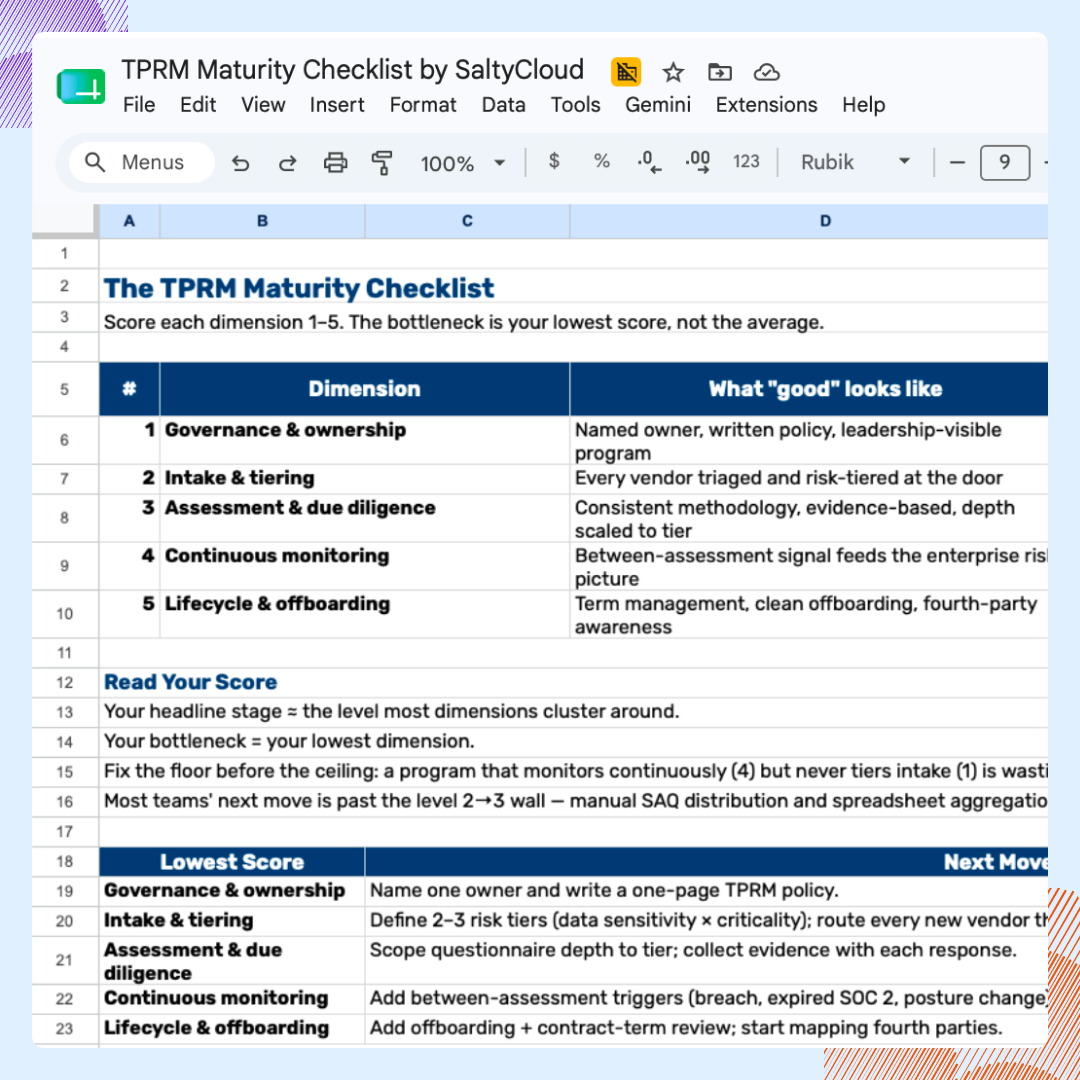
The TPRM Maturity Checklist is a one-page scoring exercise where the lowest score determines your next move.
What Is a TPRM Maturity Model?
A TPRM maturity model is a self-assessment framework that organizations use to evaluate the effectiveness of a third-party risk management program. As the risk introduced by vendors continues to rise, most organizations need a way to measure how well their existing controls are working to protect their information security.
A TPRM maturity model is a self-assessment framework for scoring an organization’s third-party risk management program. This article’s model anchors that scoring to NIST CSF 2.0 and NIST SP 800-53.
TPRM models often differ in their reference frameworks (NIST, FFIEC, ISO 27036, Shared Assessments, vendor-proprietary), the number of stages they use, and the dimensions they score. But their purpose is usually the same:
- Score the program today
- Identify the next improvement
- Translate that into a plan leadership can review
Yet most of the TPRM maturity models on the market come without real standards backing them, The model described in this article is totally free. It includes a ladder of stages, a set of dimensions to score, and a reference framework that defines what each stage looks like in practice.
More specifically, organizations can use the following model to score a TPRM program in two different ways:
- Headline stage: The one-line answer for leadership — where the program lives day-to-day.
- Five dimensions: Scored separately to show where the program is actually stuck. The dimension with the lowest score is the next move.
What Is a TPRM Framework?
TPRM frameworks are the recognized security standards that anchor a maturity model’s scoring. This model uses NIST SP 800-53 (controls catalog), NIST SP 800-161 Rev 1 (supplemental C-SCRM practices), NIST CSF 2.0 (supply-chain outcomes), and HECVAT (higher-ed vendor due diligence) — all put into practice through the NIST SP 800-37 Risk Management Framework (RMF).
- NIST SP 800-53 is the canonical catalog of security and privacy controls. Its SR (Supply Chain Risk Management) family and PM-30 (SCRM strategy) anchor the dimensions in this model.
- NIST SP 800-161 Rev 1 provides supplemental cybersecurity supply-chain risk management (C-SCRM) practices that elaborate the NIST 800-53 SR (Supply Chain Risk Management) control family — the detailed how-to layer on those controls, not a standalone program.
- NIST SP 800-37 (RMF) is the Risk Management Framework: the organization-wide, seven-step process for selecting, implementing, and monitoring these controls. It is the implementation framework the maturity dimensions ultimately roll up into.
- NIST CSF 2.0’s GV.SC category is the supply-chain outcomes layer inside the Govern function. The maturity dimensions reference these as conceptual anchors; no one-to-one crosswalk between any framework and a specific questionnaire is implied.
- HECVAT is the vendor due-diligence questionnaire most common in higher education.
Together, these frameworks provide the standards this maturity model is built on. NIST 800-53 for the controls catalog, 800-161 for supplemental C-SCRM practices, NIST CSF 2.0 for supply-chain outcomes, HECVAT for vendor due diligence in higher ed, and the NIST 800-37 RMF as the implementation framework that ties them together.
The next two sections introduce the model itself — the five maturity stages, followed by the five dimensions scored on the same 1–5 scale.
TPRM Maturity Stages
The following stages describe how third-party risk programs evolve, from ad-hoc questionnaires through risk-tiered reassessment to integrated lifecycle oversight.
To start, find the row that describes how your team’s week actually runs.
| Level / Stage | Indicator |
| L1 — Ad-hoc (SAQ) | Security questionnaires go out when someone remembers. Review is manual, one-off, and lives in emails and spreadsheets. |
| L2 — Structured intake & review | Every new vendor goes through a consistent intake and questionnaire, and the team still chases responses and aggregates answers by hand. |
| L3 — Risk-tiered & reassessed | Vendors are tiered by risk, and the tier drives reassessment depth and cadence on a risk-based schedule. |
| L4 — Continuously monitored | Signal lands between assessments — a breach, an expired SOC 2, a posture change — surfacing risk before the next annual review. |
| L5 — Integrated term management | Third-party risk follows the vendor across the whole relationship: contract terms, offboarding, and fourth-party exposure are all in scope. |
Two notes: Higher maturity brings more proportionate scrutiny.
- A low-maturity program tends to treat every vendor the same — often a full questionnaire regardless of risk.
- More mature programs right-size diligence to each vendor’s tier — lighter scrutiny for low-risk suppliers, deeper review where it matters.
Also, programs rarely sit cleanly on one rung — most straddle two, which is what the five dimensions below score.
Why TPRM Programs Stall
Most programs stall moving from “we assess everyone” to “we assess by risk, on a cycle.” The L2→L3 jump is a well-recognized plateau, and the cause is almost always the same: teams that have outgrown their tooling.
As the vendor population grows past what one person can track, manual questionnaire distribution and spreadsheet aggregation tend to cap out. A program stuck at L2 spends the same effort on a payroll platform and a font CDN — and runs out of hours before it gets to the vendors that matter.
L2→L3 is also where third-party risk management starts paying off. With tiering, teams can spend real diligence on the vendors that can actually hurt the organization and wave through the ones that can’t.
See the how to build a TPRM program guide for a closer look at the mechanics of tiering and reassessment cadence, and Conducting a Third-Party Security Risk Assessment for assessment methodology that scales as tiering matures.
How to Score TPRM Dimensions
Score the five dimensions independently — across governance, intake & tiering, assessment, continuous monitoring, and lifecycle — to see where the program bottlenecks live.
Start by assigning each dimension a score from 1 to 5 using the stage language above. To make scoring verifiable, each dimension is anchored to a recognized control reference.
Some teams weight dimensions to their own risk context — for example, prioritizing assessment over lifecycle. This model scores them equally by default.
| Dimension | Best Practice | Framework |
| Governance & ownership | A named owner, written policy, leadership-visible program | NIST CSF 2.0
GV.SC-01 (program/policy),
GV.SC-02 (supplier roles);
NIST 800-53
PM-30 (SCRM strategy);
supervisory anchor: 2023 Interagency Guidance on Third-Party Relationships
|
| Intake & tiering | Every vendor triaged and risk-tiered at the door | NIST CSF 2.0
GV.SC; NIST 800-53 SR-2 (SCRM plan);
proportionality examples in the FRB/OCC/FDIC Community Bank TPRM Guide (May 2024), useful beyond banks per the agencies
|
| Assessment & due diligence | Consistent methodology, evidence-based, depth scaled to tier | NIST 800-53 SR family;
supervisory blueprint in the FFIEC IT Examination Handbook — Outsourcing Technology Services booklet; HECVAT for higher-ed vendors |
| Continuous monitoring | Between-assessment signal feeds the enterprise risk picture | NIST CSF 2.0
GV.SC-03 (integrated into ERM & improvement);
NCUA Letter 07-CU-13 + Supervisory Letter 07-01 for ongoing-monitoring expectations still cited in exams
|
| Lifecycle & offboarding | Term management, clean offboarding, fourth-party awareness | NIST CSF 2.0
GV.SC-10 (post-partnership provisions);
OCC Bulletin 2023-17, which adopts the 2023 Interagency Guidance and rescinds OCC 2013-29, organizes oversight by lifecycle stage
|
Score the five dimensions in one place with the TPRM Maturity Checklist — a one-page scoring sheet built around this model. For the control-level detail, our NIST 800-53 vendor management guide goes deeper.
How to Read a TPRM Maturity Score
Reading a TPRM maturity score takes three moves that turn the grid into a decision.
First, identify the headline stage. Look across the five dimensions and find the level most of them cluster around. That headline level is what to share with leadership in one line (“a solid L2, working toward L3”).
Second, find the lowest dimension — that’s the bottleneck to fix. Averaging five dimensions produces a comfortable mid-number that hides the bottleneck. For instance, a program scoring L4 on continuous monitoring and L1 on intake and tiering has an un-triaged vendor list that sophisticated monitoring cannot fix. Fix the floor before raising the ceiling.
Third, take the next step for that dimension. Commit to one improvement that moves the lowest dimension up one stage.
How to Improve TPRM Maturity
Leveling up across the TPRM maturity model means one defined change per jump — and usually one specific blocker.
- Make it consistent (L1 → L2). Every new vendor goes through the same intake and the same questionnaire, every time. The blocker is usually that intake depends on someone remembering; the fix is a standing process that runs without depending on memory.
- Tier and reassess (L2 → L3). Sort vendors into risk tiers — data sensitivity times business criticality — and let the tier drive assessment depth and reassessment cadence. This is the high-leverage move and where manual tooling gives out: teams spending the week chasing spreadsheet responses are at this jump.
- Watch between assessments (L3 → L4). Add triggers that surface risk in real time — a vendor breach, a lapsed SOC 2, a downgraded security rating — so the program isn’t blind between annual reviews. The blocker is connection: monitoring signal has to land somewhere the team actually looks.
- Manage the whole term (L4 → L5). Extend risk management across the relationship: contract security terms, a real offboarding process that revokes access and recovers data, and awareness of the vendors’ vendors (fourth parties). The blocker is scope — risk has to stay attached to the vendor record from signature to termination.
Why TPRM Matters for Higher Ed
For higher-ed teams, TPRM maturity runs through a HECVAT lens — and the spring 2026 Canvas/Instructure breachmade the L4–L5 case directly. Attackers compromised the vendor directly, exposing usernames, email addresses, course names, enrollment information, and messages across K–12 and higher-ed institutions worldwide — every campus’s perimeter bypassed at once.
One vendor’s breach became everyone’s breach: a concentrated-vendor-risk pattern that the L4–L5 stages (continuous monitoring, fourth-party awareness, lifecycle controls) exist to address. HECVAT 4 is the assessment vocabulary institutions use at the intake and due-diligence dimension, and incidents like this are pushing programs toward tiering, continuous monitoring, and fourth-party awareness — exactly what this model’s upper stages describe.
The complete HECVAT guide goes deeper on HECVAT assessments, specifically.
How to Simplify TPRM
Isora GRC is the GRC Assessment Platform™ that gives security teams one connected workspace to run assessments, manage vendors and assets, track risks, and prove compliance. The L2→L3 wall is a tooling problem before it is anything else, and Isora is built to solve it with four capabilities that map directly onto the dimensions this maturity model scores.
Collaborative Questionnaires
Questionnaires are where most TPRM programs start, and where most stall. Isora’s questionnaire engine is designed for the people who actually complete them: control owners, department leads, and vendor contacts who will not attend training. Multi-contributor support lets several people work on a single questionnaire so the person closest to each control answers the question about it.
In Isora, a prebuilt library covers NIST, CIS, HIPAA, GLBA, and HECVAT, and a one-click HECVAT uploader handles higher-ed vendors without manual reformatting. Standardized, repeatable intake is the move from L1 to L2, and getting there without months of configuration is what keeps the next jump in reach.
Assessment Management
Assessment management is the operational core of the platform and the direct answer to the L2 stall point. Campaign-based targeting groups assessments by framework or compliance goal so multi-framework programs (NIST + HIPAA + GLBA) do not require parallel tracking systems. A unified dashboard surfaces completion, scoring, and outstanding evidence in real time, and automated reminders enforce deadlines without manual follow-up.
With Isora, tiering and reassessment-on-cadence — the L3 definition — become sustainable because the chase work no longer caps the program at what one person can track.
Vendor Inventory
Vendor inventory in Isora is the foundation the maturity model scores at the Intake & Tiering dimension. Each vendor record connects to its assessment history, associated risks, document evidence, and data classification, so the inventory stays current because it updates through the assessment workflow itself. That connection is what makes risk-tiering at L3 hold up between annual reviews: a tier set today is still meaningful in six months because the inventory record has not gone stale.
Risk Register
The L3 → L4 difference is whether assessment findings become tracked, owned risk or evaporate into a meeting note. Isora’s risk register auto-generates findings from assessment responses with full lineage — questionnaire item, mapped control, framework, and assessment objective preserved on every entry. Each risk carries an assigned owner, a remediation plan, milestones, and a status the whole team can see; an append-only audit log makes the entire trace defensible without manual assembly.
In Isora, assessments, risks, vendors, and inventory are connected by design — the system of record builds through the work itself.
See the GRC Assessment Platform in action. Book a demo.
Key Takeaways
A TPRM maturity model is most useful read as a map. Place the headline stage, find the lowest dimension, and take the one next move that raises the floor. For most teams, that next step is the same: clear the L2 wall by tiering vendors and reassessing on a risk-based cadence.
The stage is the story leadership wants. The lowest dimension is the work the program actually owes itself this quarter. Programs that treat the average as the answer keep raising ceilings on dimensions that don’t need them and leave the floor untouched — and the floor is what fails first when a vendor compromise hits.
Use the TPRM Maturity Checklist to score the program in one minute. It turns the five dimensions into a one-page exercise — score, find the lowest dimension, and start there.
TPRM Maturity Model FAQs
What is a TPRM maturity model?
A TPRM maturity model is a structured way to gauge how developed a third-party risk management program is, across stages from ad-hoc questionnaires to integrated, continuously-monitored oversight. It helps teams benchmark their current position and prioritize what to improve next.
What are the stages of third-party risk management maturity?
Third-party risk management maturity has five stages: L1 Ad-hoc (one-off questionnaires), L2 Structured intake & review (consistent but manual), L3 Risk-tiered & reassessed (tiering drives depth and cadence), L4 Continuously monitored (signal between assessments), and L5 Integrated term management (contracts, offboarding, and fourth parties in scope).
What’s the difference between a TPRM maturity model and the VRMMM?
The difference is licensing and scope. The VRMMM (Shared Assessments’ Vendor Risk Management Maturity Model) is the canonical named paid framework in this space (around $1,500/year). This model is a free, framework-grounded alternative built to be genuinely self-diagnostic — fewer criteria, anchored to public NIST references, and designed so teams can place their program without a license or a sales call.
How do I assess my program’s maturity?
To assess a program’s maturity, score the five dimensions — governance, intake & tiering, assessment, monitoring, and lifecycle — from 1 to 5, then act on the lowest one. The companion TPRM Maturity Checklist turns this into a one-page exercise.
Where do most programs get stuck?
At L2→L3 — moving from assessing every vendor the same way to assessing by risk, on a cycle. It’s usually a tooling limit: manual distribution and spreadsheet aggregation stop scaling as the vendor list grows.
How does NIST relate to TPRM maturity?
NIST relates to TPRM maturity through several documents: NIST CSF 2.0’s GV.SC (Cybersecurity Supply Chain Risk Management) category anchors the governance dimension, the NIST 800-53 SR control family anchors assessment and lifecycle controls, and NIST SP 800-161 provides the supplemental C-SCRM practices guidance behind both. Organizations implement and monitor those controls through the NIST SP 800-37 Risk Management Framework (RMF).

This content is for informational purposes only and does not constitute legal or compliance advice. See our full disclaimer.
 Other Relevant Content