




 Table of Contents
- Vendor Risk Assessment: How to Evaluate Third-Party Risk
- What Is a Vendor Risk Assessment?
- Vendor Risk Assessment vs Security Assessment vs Third-Party Risk Assessment
- The Vendor Risk Assessment Process
- Vendor Security Assessment Questionnaire
- Third-Party Cyber Risk Assessment
- Vendor Risk Assessment Tools and Software
- Vendor Risk Assessment Template and Report
- How to Simplify Vendor Risk Assessments
- Key Takeaways
-
Vendor Risk Assessment FAQs
- What is a vendor risk assessment?
- How do you conduct a vendor risk assessment?
- What’s in a vendor security assessment questionnaire?
- What’s the difference between a vendor risk assessment and a vendor security assessment?
- How often should you reassess vendors?
- What is a vendor risk assessment template?
Vendor Risk Assessment: How to Evaluate Third-Party Risk
A vendor risk assessment is the process of evaluating the security, financial, operational, and compliance risks a vendor or third party may introduce before and throughout the relationship.
With nearly half of breaches involving a third party in 2026, organizations need a way to evaluate vendor risk before trust becomes exposure. A vendor assessment does that by answering the question, “Can this vendor be trusted with our organization’s data, systems, operations, or customers, and under what conditions?” Done well, a vendor risk assessment can catch third-party risk before access is granted, a contract is signed, or a weak control becomes an incident.
This guide covers what a vendor risk assessment is and the step-by-step process behind it. It also covers the questionnaire at its core, the tools that run it at scale, and a template to adapt. A vendor risk assessment sits inside a broader third-party risk management program, and this article covers the assessment itself in depth.
What Is a Vendor Risk Assessment?
A vendor risk assessment is a structured evaluation of the security, financial, operational, and compliance risk a third party introduces. Security teams run it before contract signing to decide whether a vendor should receive access at all. They then repeat it throughout the relationship as the vendor grows, changes ownership, suffers an incident, or takes on a bigger role. The process combines a questionnaire scoped to what the vendor touches, evidence that supports its claims, and a risk score weighed against business criticality.
A vendor risk assessment is a third-party risk management control that measures the security, financial, and compliance exposure a vendor creates. It scopes a questionnaire, reviews evidence, and scores risk by vendor criticality to produce rated, owned findings before and during the engagement.
According to the World Economic Forum’s Global Cybersecurity Outlook 2026, 74% of highly resilient organizations assess supplier security maturity (vs. 48% of insufficiently resilient organizations). It also notes that these organizations increasingly recognize that their own resilience depends as much on the strength of their partners as on their internal defenses.
How to Score Vendor Risk
Every risk is a function of impact and likelihood. A vendor risk assessment measures both separately, then combines them into one score.
- Vendor criticality tiering measures impact. It sorts vendors into tiers (critical, high, moderate, low) based on what the vendor can reach: the type of data it touches, whether it connects to core systems, how many people or processes depend on it, and whether the organization has a fallback if the vendor goes down. It asks what would happen to the organization if the vendor failed, was breached, or could no longer deliver the service.
- Security assessment measures likelihood. Once a vendor’s tier sets how much exposure is at stake, the security assessment asks a different question: how well does this vendor actually protect what it has access to? It reviews the vendor’s controls, evidence, and track record to judge how probable a failure is, not what the failure would cost.
Tiering happens first, and unlike security assessments, this step doesn’t require anything from the vendor. Instead, it’s a judgment the organization makes internally, based on how it plans to use the vendor. During security assessments, by contrast, the vendor is required to produce evidence of its own security practices.
Tiering and assessments turn vendor risk into a decision-ready score. They help security teams prioritize high-impact, high-likelihood risks first, apply proportional due diligence, and avoid treating every relationship the same.
Without a risk score, a security team cannot decide which vendors need annual reassessment versus a lighter check-in. The team also cannot justify pushing back on a vendor that refuses to share evidence. Nor can it show an auditor or a board that vendor risk is being managed.
Vendor Risk Assessment Results
A vendor risk assessment should produce a documented answer to the question, “How much risk does this vendor introduce, and is it acceptable?” A strong assessment produces rated, comparable risks, and each one has an owner and a path to resolution. That path might be to fix the gap, add a compensating control, or walk away from the vendor.
The World Economic Forum’s Global Cybersecurity Outlook 2026 ranks inheritance risk as the top supply chain risk that organizations report. The term refers to the inability to vouch for a vendor’s own software, hardware, and service integrity. A documented risk assessment helps address that uncertainty.
Vendor Risk Assessment vs Security Assessment vs Third-Party Risk Assessment
The terms vendor risk assessment, security assessment, and third-party risk assessment tend to overlap and are often used interchangeably. But in reality, they differ in scope:
- A vendor risk assessment is the broadest of the three. It covers every risk type a vendor might introduce: security, financial, operational, compliance, and reputational.
- A vendor security assessment is narrower by design. It looks only at the security-specific slice — controls, data handling, access, incident response. Most of the work inside a full vendor risk assessment is security work, so the two terms end up describing largely the same activity in most organizations.
- A third-party risk assessment describes the identical process applied to any third party, not just vendors that sell a product or service. TPRM programs tend to default to this term because it covers contractors, partners, and other relationships a stricter definition of “vendor” would exclude.
The lines blur in everyday use, and that’s just fine. What matters is that the assessment covers the risk types that actually apply to the vendor in question. This article covers the broader assessment and how the pieces fit. Our third-party security risk assessment guide covers the deep, security-specific walkthrough.
The Vendor Risk Assessment Process
A repeatable vendor risk assessment moves through six steps, each mapped to a recognized control reference for defensible methodology. The first two steps happen inside the organization, before any vendor is contacted. The next two involve the vendor directly. The last two turn what was collected into a decision and keep watching for change.
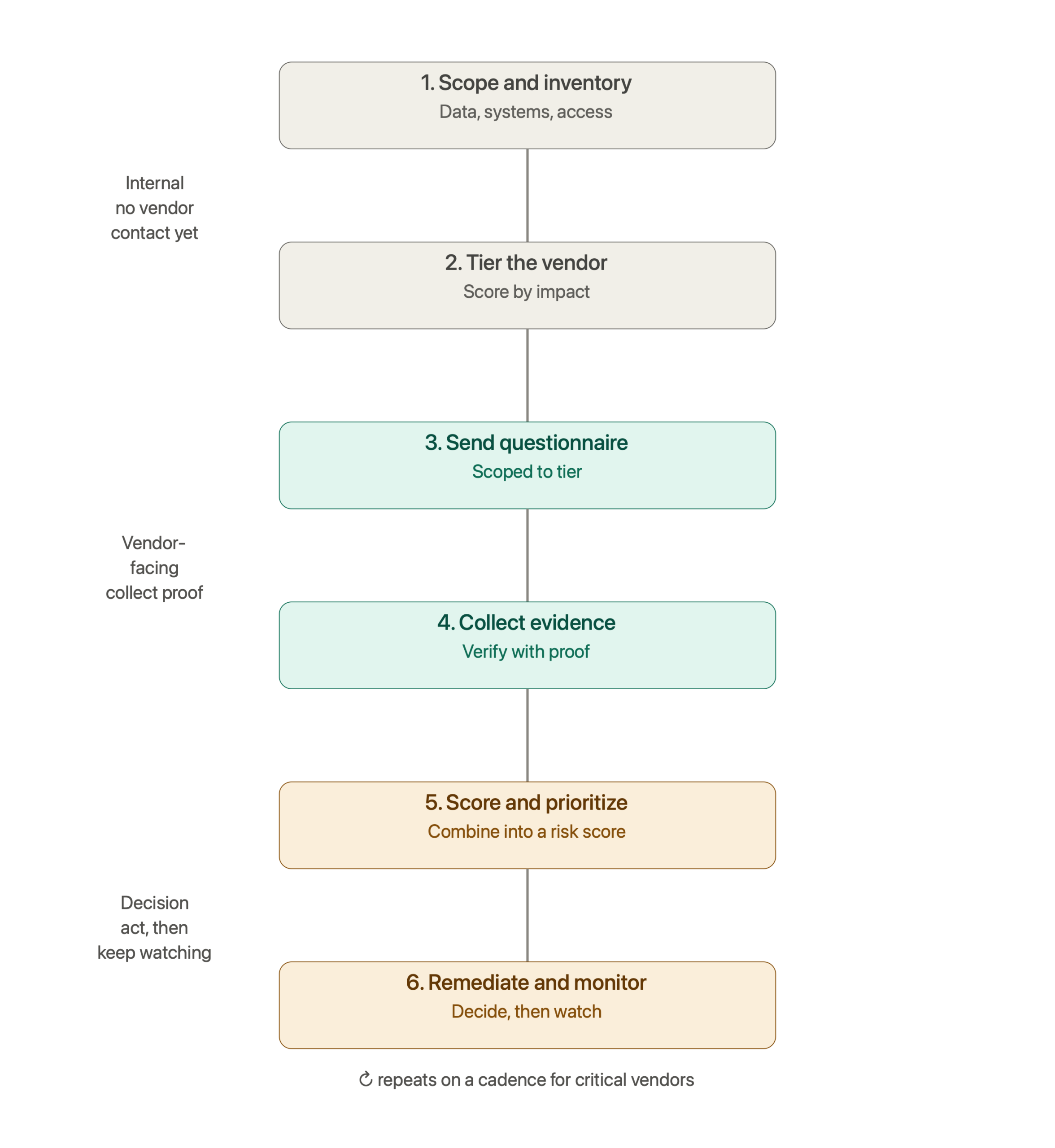
Step 1: Scope and Inventory
Start by establishing what the vendor will actually touch: data types, systems, access levels, business processes, and operational dependencies. This information should come from the internal relationship owner or process owner who requested the vendor, not procurement or IT alone.
Security teams often capture this through an Inherent Risk Questionnaire, or IRQ. The IRQ determines the vendor’s initial risk profile and drives the level of due diligence that follows. Without that scoping step, the organization cannot tell what is at stake or size the risk correctly.
Inventory completeness matters just as much. Ponemon Institute research finds the average organization tracks 2,643 third parties and assesses only 36% of them. A vendor that never enters the inventory never gets scoped, tiered, or assessed at all, no matter how strong the process is for vendors that do.
Step 2: Tier the Vendor
Classify the vendor by data sensitivity, access level, business criticality, and operational dependency. The tier should determine how much due diligence the vendor receives and how often the assessment is repeated.
Tiering is what makes vendor risk management scalable. A high-criticality vendor with sensitive data access requires deeper review, stronger evidence, and more frequent reassessment. A low-risk vendor with limited access may only need a lighter review. Without it, teams spend the same effort on every vendor and often miss the relationships that create the most exposure.
Step 3: Send the Questionnaire
Send a security or risk questionnaire matched to the vendor’s tier, access, and use case. High-risk vendors should receive deeper questions, while low-risk vendors should not be forced through the same exhaustive review.
Standardized questionnaires such as the Shared Assessments SIG provide a recognized baseline, but each one still needs scoping to what the vendor actually touches. The goal is to collect the right answers for the level of risk.
Step 4: Collect and Review Evidence
Validate questionnaire answers with evidence such as SOC 2 reports, penetration test summaries, certifications, security policies, and privacy documentation. This is the due-diligence core, since claims without supporting evidence amount only to a survey.
Scale the evidence requested to the vendor’s tier, and stay realistic about what a vendor will actually hand over. Most vendors will not disclose deep system-level evidence, and asking for it rarely produces a useful answer. High-level artifacts, such as a SOC 2 report or a security summary, are the realistic ceiling for most engagements.
Today, many larger vendors publish these materials through dedicated trust portals that buyers can check before or during the assessment. In these portals, buyers can review attestation reports, security summaries, privacy documentation, and related assurance materials.
Step 5: Score and Prioritize
Convert the assessment findings into a rated, comparable risk score. Steps 1 and 2 feed the impact side of that score by showing how critical the vendor is to the business. Steps 3 and 4 inform likelihood by showing how mature the vendor’s controls are and what evidence supports them.
This final risk score is not the same as the tier assigned in Step 2. Tiering sets the starting level of scrutiny, while the assessment score reflects what the questionnaire and evidence review actually found. A vendor may be high criticality but well controlled, or lower criticality but riskier than expected because of weak controls or missing evidence.
A consistent scoring method ensures that a “high” rating means the same thing across vendors. The result is a prioritized list which says what to fix, in what order, for which vendors.
Step 6: Remediate and Monitor
Drive each risk to a decision, whether that is remediation, a compensating control, a contract clause, or formal acceptance by a named approver. Keep watching after the decision is made, because a vendor’s posture changes between assessments. Reassess critical vendors on a cadence, and track for signal in the meantime.
The World Economic Forum’s Global Cybersecurity Outlook 2026 finds that 66% of organizations assess the security maturity of their suppliers. However, only 27% go further and simulate cyber incidents or conduct recovery exercises with their ecosystem partners.
A one-time assessment measures a vendor’s security at a single point in time. It cannot detect a control that lapses, a breach that occurs, or a scope expansion after that point. That gap is why reassessment cadence and monitoring matter as much as the initial score.
This approach aligns with established supply chain security guidance.
- NIST CSF 2.0’s supply-chain category, GV.SC — which calls for prioritizing third parties by criticality, performing due diligence before onboarding, and monitoring them over the relationship/
- The NIST 800-53 SR control family, formalizes supplier assessments and reviews under SR-6 (supplier assessments and reviews).
- NIST SP 800-161, elaborates these practices across the full acquisition lifecycle.
For the full security-assessment walkthrough, the deep version of steps 3 through 5, follow the third-party security risk assessment guide.
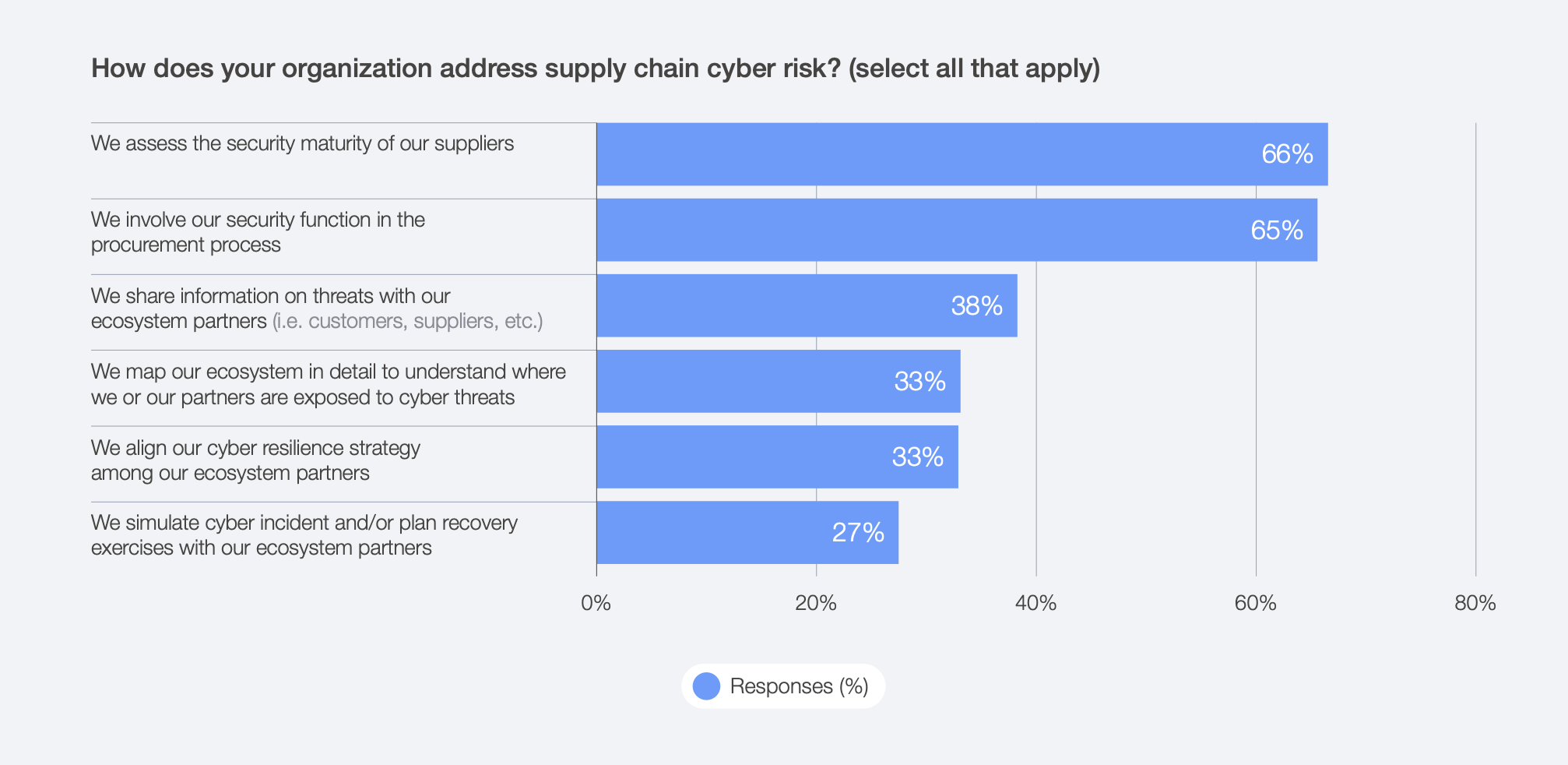
How organizations address supply chain risk, Global Cybersecurity Outlook 2026, World Economic Forum
Vendor Security Assessment Questionnaire
A vendor security assessment questionnaire is the engine of the assessment. It turns “can this vendor be trusted?” into specific, answerable questions about access controls, data handling, encryption, incident response, business continuity, and compliance posture.
Common pitfall: Sending every vendor the same massive questionnaire.
A 300-question form aimed at a low-risk vendor wastes the reviewer’s time and trains them to rubber-stamp answers instead of reading them. A critical vendor, on the other hand, may need more scrutiny than any standard form covers.
The fix: Scope the questionnaire to the vendor’s tier.
A recognized standardized questionnaire like the Shared Assessments SIG gives a consistent, defensible baseline that scales up or down rather than reinventing questions each time. Regulated or sector-specific contexts call for a domain questionnaire, such as HECVAT for higher-education vendors.
The goal: Review responses critically.
Answers are only the starting point, and real value comes from reviewing responses critically. That review checks for vague answers, gaps between what is claimed and what is evidenced, and the questions a vendor declines to answer.
- A questionnaire returned and filed without that review is theater.
- A questionnaire read closely, with follow-ups on the weak spots, is where real risk surfaces.
A vendor security review built on a scoped questionnaire plus evidence is the heart of the assessment.
Third-Party Cyber Risk Assessment
A third-party cyber risk assessment is the part of vendor risk evaluation most likely to be ongoing rather than point-in-time. While a vendor risk assessment looks at the full risk a vendor introduces, a cyber risk assessment narrows the lens to the vendor’s cybersecurity posture. It weighs the likelihood that the vendor could expose the organization to a breach, vulnerability, system compromise, or data loss.
The cyber exposure keeps shifting with every new vulnerability, breach, expired certification, or degraded security rating. A cyber risk assessment pairs the questionnaire with external signals that flag change between formal reviews: security ratings, attack-surface monitoring, and breach intelligence.
How much cyber scrutiny a vendor warrants should match how much access it has. A vendor with a live connection into the production environment or a copy of customer data sits in a different risk class than one that never touches sensitive systems. As vendors increasingly deploy AI and rely on their own subprocessors, the assessment needs to cover fourth-party exposure, the risk that a vendor’s vendors introduce.
Vendor Risk Assessment Tools and Software
Vendor risk assessment tools automate the parts of the process that stop scaling manually. They distribute scoped questionnaires, collect and store evidence, score findings consistently, and monitor vendors between assessments. For a handful of vendors, a spreadsheet and a shared drive will do. Past that, manual questionnaire distribution and evidence chasing plateau the program.
Strong vendor risk assessment software offers tier-based questionnaire scoping and a reusable question and standard library (SIG, CAIQ, HECVAT). It also offers evidence management, consistent risk scoring, continuous monitoring, and auditor-ready reporting.
One caution: software scales the process you already have. It makes the process repeatable, consistent, and easier to run at scale. For instance, automating a program with no tiering just sends the wrong questionnaire to more vendors, faster. So, the process has to come first.
See our TPRM software guide to compare tools and platforms in depth.
Vendor Risk Assessment Template and Report
A vendor risk assessment template is a reusable record that captures the same fields for every vendor, whether the assessment lives in a spreadsheet or a platform. Per vendor, it should capture:
| Field | Records |
|---|---|
| Vendor & Scope | Who they are and what they access (data, systems, process) |
| Risk Tier | Criticality rating that drove assessment depth |
| Findings | What the questionnaire and evidence surfaced |
| Risk Rating | Each finding scored consistently (e.g., high/medium/low) |
| Owner | The person accountable for the risk |
| Remediation | The treatment plan: fix, compensating control, contract clause, or accept |
| Status & Next Review | Where it stands and when you’ll reassess |
The assessment report turns this record into a decision-ready summary for stakeholders. It should explain the vendor’s risk posture, the key findings, and the open remediation items. It should also record the decision made, which may be to approve, approve with conditions, delay, reject, or monitor more closely. A good report answers one question on the first page, with supporting detail underneath: should we work with this vendor, and under what conditions?
How to Simplify Vendor Risk Assessments
The steps above might seem straightforward, but running them by hand at scale usually breaks. Isora GRC is the GRC Assessment Platform™ that gives security teams one connected workspace to run assessments, manage vendors and assets, track risks, and prove compliance.
With Isora GRC, security teams can:
- Scope vendors by risk tier: Connect each vendor to the data, systems, business process, and risk level that determine how much diligence they need.
- Send structured questionnaires: Launch repeatable assessments using standardized questionnaires, including framework-based templates for programs like NIST, CIS, HIPAA, GLBA, and HECVAT.
- Collect evidence in context: Keep supporting documents, questionnaire responses, comments, and approvals tied to the vendor record instead of scattered across email.
- Track assessment progress: Use a unified dashboard, reminders, and status tracking to see which assessments are complete, overdue, or waiting on a response.
- Turn findings into owned risks: Convert assessment gaps into risk records with owners, remediation plans, milestones, and status visibility.
- Report with audit-ready context: Preserve the link between the vendor, assessment, evidence, finding, and remediation decision so teams can show how vendor risk is being managed.
The result is a vendor risk assessment process that is easier to repeat, easier to defend, and easier to scale as the vendor inventory grows.
Simplify vendor risk assessments with Isora GRC →
Key Takeaways
A vendor risk assessment evaluates the security, financial, operational, and compliance risk a vendor introduces, before and throughout the relationship. A repeatable process works best. Scope it, tier the vendor, assess proportionally with evidence, score consistently, and keep monitoring.
Criticality tiering measures impact. It scales vendor assessments, concentrating real diligence where a vendor can actually cause harm. Security assessment measures likelihood.
A claim is not evidence. SOC 2 reports, penetration test summaries, and certifications are what convert a stated claim into a verified one. An assessment built on unverified answers is a survey.
A vendor’s risk profile is not fixed at onboarding. It changes as the vendor grows, changes ownership, gets breached, or expands its access. Reassessment cadence and monitoring are what keep the score accurate after day one.
From here, run the deep version with the third-party security risk assessment guide, or access the TPRM Maturity Checklist. You can also compare TPRM software or take a step back to the full third-party risk management guide.
Vendor Risk Assessment FAQs
What is a vendor risk assessment?
A vendor risk assessment evaluates the security, financial, operational, and compliance risk a vendor poses. It typically works through a questionnaire, evidence review, and risk scoring scaled to the vendor’s criticality. The output is a set of rated, owned risks that goes further than a completed form.
How do you conduct a vendor risk assessment?
The process takes six steps, starting with scoping and inventorying what the vendor touches, tiering the vendor by risk, and sending a scoped questionnaire. The team then collects and reviews evidence, scores and prioritizes the findings, and remediates and monitors on a cadence.
What’s in a vendor security assessment questionnaire?
It holds questions covering access control, data handling and encryption, incident response, business continuity, and compliance posture. These are based on a standardized questionnaire like the Shared Assessments SIG and scoped to the vendor’s risk tier.
What’s the difference between a vendor risk assessment and a vendor security assessment?
A vendor risk assessment covers all risk types (security, financial, operational, compliance, reputational). A vendor security assessment is the security-specific slice. The security assessment is usually the biggest part of a full vendor risk assessment.
How often should you reassess vendors?
Cadence should follow risk tier, so critical, high-access vendors warrant frequent reassessment plus continuous monitoring. Low-risk vendors can be reviewed far less often, so tie the schedule to tier rather than to a single annual date for everyone.
What is a vendor risk assessment template?
It is a reusable structure for recording each assessment, so that assessments stay consistent and comparable across vendors. It captures the vendor and scope, risk tier, findings, risk ratings, owner, remediation plan, and review status.

This content is for informational purposes only and does not constitute legal or compliance advice. See our full disclaimer.
