





 Table of Contents
- CMMC vs NIST 800-53: Key Differences for Defense Contractors
- CMMC Maturity Levels and the 800-53/800-171 Relationship
- Key Differences in Approach and Scope
- CMMC vs NIST 800-53: Side-by-Side Comparison Table
- If You Need CMMC, You Need to Understand NIST 800-53
- How to Simplify CMMC and NIST 800-53 Compliance
- Key Takeaways
- CMMC vs NIST 800-53 FAQs
CMMC vs NIST 800-53: Key Differences for Defense Contractors
The Cybersecurity Maturity Model Certification (CMMC) and NIST Special Publication 800-53 Revision 5 are both central to federal information security but they serve different functions in the compliance landscape.
- CMMC is a DoD-specific certification program that defense contractors must achieve to win and retain contracts. It prescribes a fixed set of security practices across three maturity levels, each tied to the type of information a contractor handles.
- NIST 800-53 is a comprehensive catalog of 1,196 security and privacy controls and control enhancements that federal agencies use to secure their information systems. It is the foundational source from which CMMC’s required controls are derived, particularly at Levels 2 and 3.
Defense contractors handling Federal Contract Information (FCI) or Controlled Unclassified Information (CUI) must achieve a specific CMMC level, while NIST 800-53 applies to all federal information systems. For contractors weighing both: CMMC is the certification target, and NIST 800-53 is the source of those controls.
This comparison is part of our NIST 800-53 framework comparisons resource. It covers the derivation chain from 800-53 to CMMC, key differences in scope and certification approach, and what defense contractors need to know about both frameworks.
CMMC Maturity Levels and the 800-53/800-171 Relationship
CMMC has three maturity levels, each tied to a different baseline that traces back to NIST 800-53. Level 1 covers basic safeguarding practices and protects Federal Contract Information (FCI). Levels 2 and 3 protect Controlled Unclassified Information (CUI) and require progressively more rigorous controls and assessment types.
CMMC (Cybersecurity Maturity Model Certification) 2.0 is a DoD-specific cybersecurity certification program with three maturity levels required for defense contractors. NIST 800-53 Rev 5 is a comprehensive federal catalog of 1,196 security and privacy controls and control enhancements across 20 families. CMMC is rooted in 800-53: Level 2 draws from NIST 800-171, and Level 3 draws from both NIST 800-171 and NIST 800-172.
Note: Proposed FAR changes may rename Federal Contract Information (FCI) to Covered Federal Information (CFI). This article uses FCI to refer to non-public information provided by or generated for the government under a contract.
For a complete overview of CMMC requirements, certification levels, and implementation steps, see our complete CMMC guide.
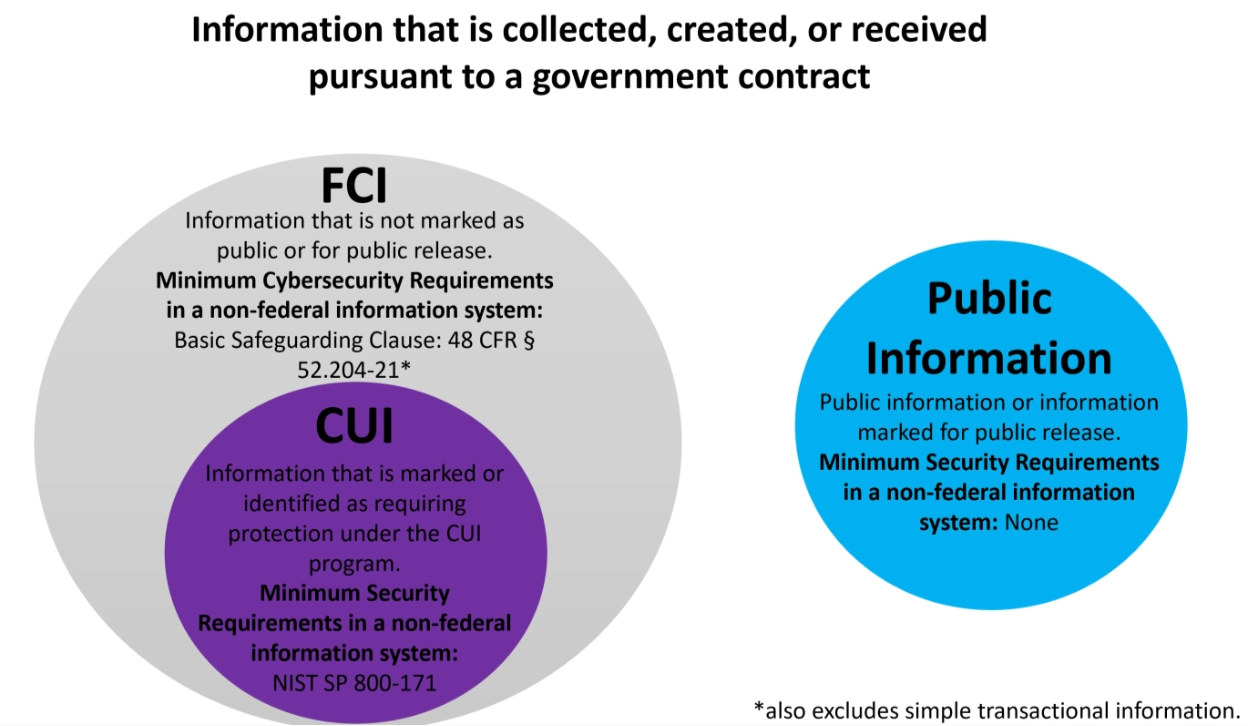
FCI and CUI, what is the difference? CUI Program Blog, National Archives
How CMMC Relates to NIST 800-53
CMMC connects to NIST 800-53 through two intermediate publications. Levels 2 and 3 directly implement NIST 800-171 and 800-172, both built from controls in the 800-53 catalog. NIST 800-53 itself catalogs 1,196 security and privacy controls and control enhancements across 20 families.
From that master catalog, NIST selected 110 controls for protecting Controlled Unclassified Information (CUI) and adapted them for nonfederal systems. It then published them as NIST SP 800-171 Rev. 2, and CMMC Level 2 maps directly to those 110 requirements. Level 3 adds 24 more from NIST 800-172, built for high-value CUI.
For a ready-to-use view, our NIST 800-53 Multi-Framework Crosswalk maps every 800-53 control across NIST 800-171, CSF 2.0, SOC 2, ISO 27001, and HIPAA. The single workbook shows which controls you already satisfy, so you don’t have to rebuild the mapping yourself.
For a detailed comparison of 800-53 and 800-171, see our NIST 800-53 vs 800-171 comparison. For guidance on scoping CUI and FCI for CMMC, see our dedicated guide.
How Each CMMC Level Maps to NIST Standards
Each CMMC level maps to a different baseline, with Level 1 implementing FAR 52.204-21 and Level 2 implementing NIST 800-171 Rev 2. Level 3 then adds NIST 800-172 requirements on top of the full 800-171 Rev 2 set.
- Foundational (Level 1): Covers 15 basic safeguarding requirements from Federal Acquisition Regulation (FAR) 52.204-21 to protect FCI and requires an annual self-assessment. These requirements apply to all federal contractors. FAR 52.204-21 shares common security themes with NIST 800-53 but has no direct connection.
- Advanced (Level 2): Covers 110 security requirements aligned to NIST 800-171 Rev 2, which was derived from NIST 800-53. It protects CUI and requires an assessment every three years, either a self-assessment or a third-party assessment, depending on the contract. Third-party assessments are performed by a Certified Third-Party Assessment Organization (C3PAO) under the Cyber AB’s CMMC Assessment Process (CAP) v2.0. The DoD CIO’s CMMC Assessment Guide – Level 2 defines the verification criteria, and the companion CMMC Scoping Guide – Level 2 covers POA&M and Enduring Exception handling. NIST has since published 800-171 Rev 3 and its companion 800-171A Rev 3 assessment procedures, but CMMC currently remains aligned with Rev 2; NIST’s official Rev 3 FAQ outlines what the transition will involve.
- Expert (Level 3): Covers 134 requirements. It builds on the full 800-171 Rev 2 control set and adds 24 requirements from NIST 800-172, a dedicated publication designed to protect high-value CUI against advanced persistent threats such as those documented in joint advisories from CISA, NSA, and FBI. Level 3 requires a government-led assessment by the Defense Industrial Base Cybersecurity Assessment Center (DIBCAC) every three years.
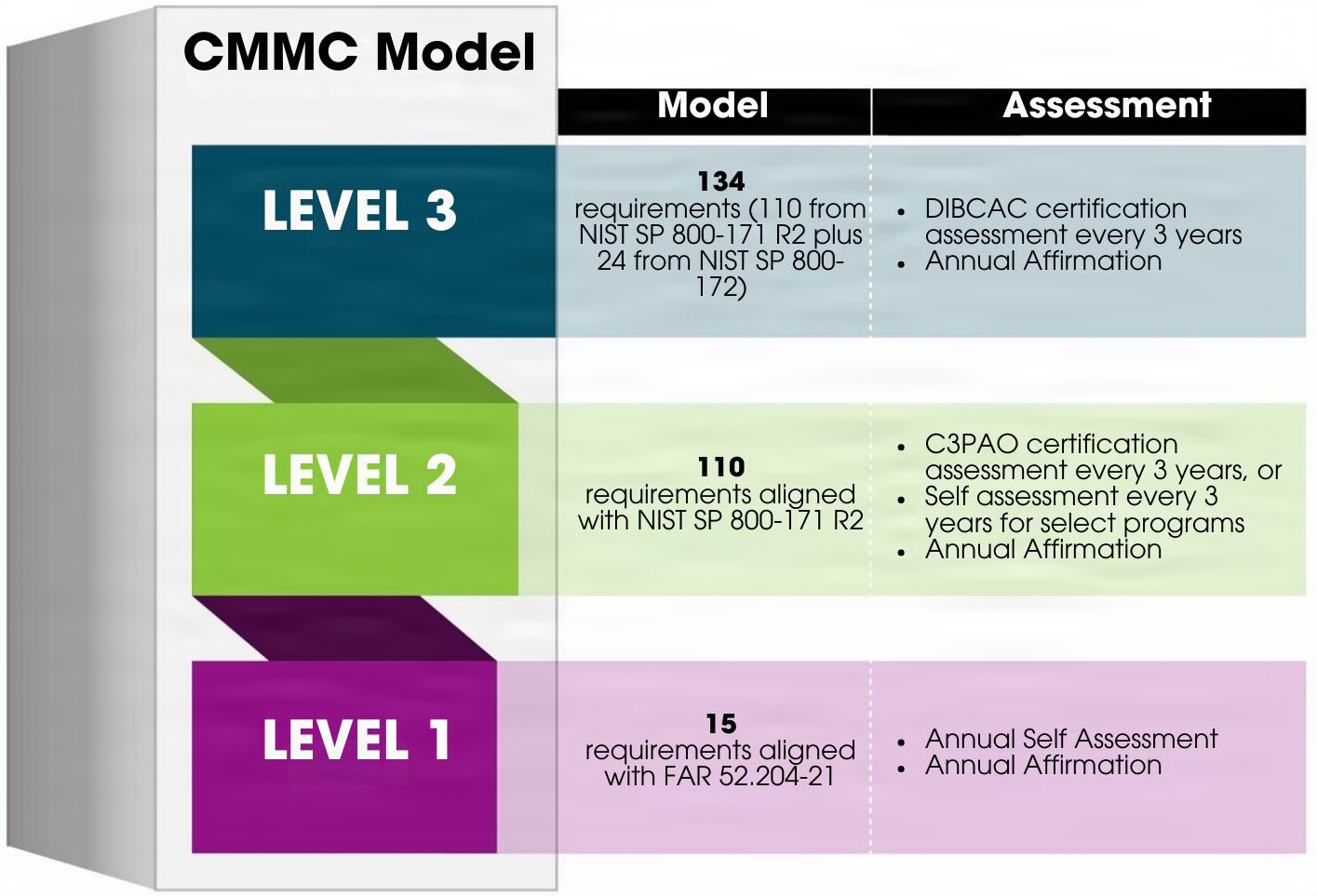
Overview of the CMMC Program, Department of War Chief Information Officer (DoW CIO)
For a broader view of NIST 800-53 and how its control families work, see our NIST 800-53 complete guide. You can also review the NIST 800-171 basic assessment guide for assessment-specific guidance.
Key Differences in Approach and Scope
CMMC and NIST 800-53 differ in scope, certification approach, and intended audience.
- CMMC is narrow and prescriptive, designed to certify DoD contractors.
- NIST 800-53 is broad and adaptable, designed as the master control catalog for all federal and federal-adjacent systems.
Scope and Audience
CMMC applies only to DoD contractors in the Defense Industrial Base (DIB). NIST 800-53, by contrast, applies to all federal information systems, organizations pursuing FedRAMP authorization, and those adopting it voluntarily as a security baseline.
Certification and Authorization
CMMC is a certifiable framework, while systems that implement NIST 800-53 receive an authorization to operate from an authorizing official instead. CMMC Level 2 requires a self-assessment or a C3PAO assessment, depending on the contract, and Level 3 requires a government-led assessment by DIBCAC. For NIST 800-53, organizations receive an authorization to operate through the Risk Management Framework (RMF) process. CMMC certification confirms a contractor meets a defined maturity level, while NIST 800-53 authorization confirms a system’s risks are understood and accepted.
Control Selection
CMMC prescribes a fixed control set per maturity level, while NIST 800-53 selects controls from impact-based baselines that organizations can tailor. CMMC contractors must implement all required practices for their level, with no tailoring permitted at Level 1 or Level 2.
Federal systems using NIST 800-53 pick controls based on impact level: Low (149 baseline controls), Moderate (287 baseline controls), or High (370 baseline controls). Non-federal organizations can also voluntarily adopt and tailor 800-53 controls, a flexibility CMMC does not offer.
Maturity Model
CMMC’s three-level model assesses whether required security controls are implemented, while NIST 800-53 has no maturity model and instead focuses on impact-based control selection. For a complete overview of CMMC requirements, see our complete CMMC guide. For a deeper read on the NIST 800-53 catalog, see our NIST 800-53 controls overviewand NIST 800-53 risk assessment guide.
CMMC vs NIST 800-53: Side-by-Side Comparison Table
The following table summarizes the key differences between CMMC and NIST 800-53 across purpose, scope, certification, and control structure.
| Attribute | CMMC 2.0 | NIST 800-53 Rev 5 |
|---|---|---|
| Purpose | DoD contractor cybersecurity certification | Comprehensive federal security and privacy control catalog |
| Scope | Defense Industrial Base (DIB) contractors only | All federal information systems; voluntary for others |
| Number of Controls | Level 1: 15 Level 2: 110 Level 3: 134 |
1,196 controls and control enhancements across 20 families |
| Certifiable? | Yes. Third-party (Level 2) or government-led (Level 3) assessment | No direct certification. Authorization to operate via RMF process. Authority to Operate (ATO) via FedRAMP |
| Required For | DoD contractors handling FCI/CUI | Federal agencies under FISMA; FedRAMP cloud service providers |
| Maturity Levels | Three levels | None. Uses impact-based baselines (Low, Moderate, High) |
| Assessment Type | Self (L1), C3PAO (L2), DIBCAC (L3) | Agency self-assessment or independent assessor via RMF; third-party assessment (3PAO) for FedRAMP authorization |
| Relationship | Draws controls FROM 800-53 (via 800-171 and 800-172) | Source catalog for NIST 800-171 and 800-172 controls |
If You Need CMMC, You Need to Understand NIST 800-53
Defense contractors pursuing CMMC certification at Levels 2 and 3 benefit from understanding NIST 800-53 because CMMC controls trace back to it. Specifically, contractors implement those controls through NIST 800-171 and 800-172, and the original control language and implementation guidance come from NIST 800-53.
The table below identifies the key NIST publications relevant to each CMMC certification scenario and what contractors should focus on during implementation.
| Scenario | Relevant Publication | What It Is | How It Helps | What to Pay Attention To |
|---|---|---|---|---|
| CMMC understanding | NIST SP 800-53 Rev 5 Moderate Baseline | Security control baseline for federal systems handling moderate impact data | Shows how NIST selected the controls that later became 800-171 requirements | Control intent, baseline tailoring, and requirement derivation |
| CMMC implementation | NIST SP 800-53 Rev 5 | Comprehensive catalog of federal security and privacy controls | Provides the original control language and guidance behind CMMC-derived requirements | Control descriptions, supplemental guidance, and control enhancements |
| Program rules and certification | 32 CFR Part 170 (CMMC Final Rule) | DoD regulation establishing the CMMC program | Explains how certification works and when it applies to DoD contracts | Certification scope, assessment structure, and C3PAO requirements |
| Level 1 compliance | FAR 52.204-21 | 15 basic safeguarding requirements for protecting FCI | Defines the baseline practices contractors must implement for Level 1 annual self-assessment | FCI scoping, annual self-assessment procedures, and basic safeguarding requirements |
| Level 2 preparation | NIST SP 800-171 Rev 2 | 110 security requirements across 14 control families protecting CUI | Helps contractors implement controls with proper context and depth | CUI system scoping, requirement implementation, and supporting policies |
| Assessment preparation | NIST SP 800-171A | Assessment procedures for each 800-171 requirement | Shows how auditors verify control implementation during assessments | Assessment objectives, evidence expectations, and testing methods |
| Level 3 requirement | NIST SP 800-172 | Enhanced security requirements for protecting CUI from advanced threats | Identifies additional protections required for CMMC Level 3 environments | Advanced monitoring, threat detection, and enhanced incident response |
| Future proofing | NIST 800-53, 800-171, and 800-172 | Three core NIST publications used in the CMMC ecosystem | Helps contractors anticipate future CMMC updates as NIST revises these standards | New revisions, changes to control language, newly derived requirements, and alignment between the three publications |
Universities with DoD-funded research face a unique challenge: they must meet CMMC requirements for CUI systems while also handling broader 800-53 compliance across the institution. Understanding the 800-53 foundation helps scope these obligations accurately. EDUCAUSE’s DFARS/CMMC implementation briefing covers fundamental research exclusions and other higher-education-specific nuances. For deeper guidance, see our CMMC compliance for higher education guide.
How to Simplify CMMC and NIST 800-53 Compliance
Isora GRC consolidates CMMC and NIST 800-53 compliance into one shared workspace, eliminating the duplicate assessment effort of managing both frameworks separately. Defense contractors can run assessments across the 800-53 to 800-171 to CMMC derivation chain from a single platform.
Assessment Management
Organize assessments by compliance goal, such as CMMC maturity level requirements or NIST 800-53 control implementation, and monitor progress across departments from a single dashboard. Assessment grouping by series allows defense contractors to separate CMMC Level 2 campaigns from broader 800-53 assessments while maintaining visibility into both.
Questionnaires & Surveys
Distribute framework-aligned questionnaires to unit owners and track completion in real time. Isora includes prebuilt questionnaires for NIST 800-53, NIST 800-171, and other frameworks, reducing the time defense contractors spend building and managing assessments across multiple standards.
Reports & Scorecards
Automated scoring and category comparisons free up time for strategic remediation instead of manual reporting. Defense contractors can drill down from summary scores to individual responses, identifying compliance gaps before formal C3PAO or DIBCAC assessment.
Explore NIST 800-53 compliance software and CMMC compliance software to see how Isora GRC supports defense contractors managing both frameworks, or request a demo to see Isora in action.
Key Takeaways
CMMC and NIST 800-53 are complementary frameworks, since CMMC is a DoD certification program built on controls derived from 800-53. Level 2 implements controls through NIST 800-171, and Level 3 extends them through NIST 800-172. Both trace back to 800-53 as the source catalog.
CMMC is certifiable through formal third-party or government-led assessment. NIST 800-53 has no direct certification pathway, so organizations receive authorization through the RMF process or an Authority to Operate via FedRAMP. Defense contractors benefit from understanding 800-53 because it provides the original control language and implementation guidance behind every CMMC requirement.
CMMC phased implementation began November 10, 2025. Full implementation is expected by November 10, 2028, when all applicable DoD contracts will require certification as a condition of award. Start by understanding the derivation chain from 800-53 to 800-171 to CMMC, then identify which controls apply at the target maturity level. From there, use NIST 800-53’s supplemental guidance to inform implementation depth beyond what 800-171 prescribes.
Explore more NIST 800-53 framework comparisons in our comparison guide. You can also see how Isora GRC helps defense contractors manage CMMC and NIST 800-53 compliance in one place.
CMMC vs NIST 800-53 FAQs
What is the difference between CMMC and NIST 800-53?
CMMC is a DoD-specific cybersecurity certification program with three maturity levels required for defense contractors. NIST 800-53 is a comprehensive catalog of 1,196 security and privacy controls and control enhancements used across all federal agencies. CMMC draws its controls from 800-53 (via 800-171 and 800-172), and adds a certifiable assessment framework on top.
Does CMMC replace NIST 800-53?
No. CMMC does not replace NIST 800-53. CMMC is built on controls derived from 800-53. NIST 800-53 remains the master control catalog for federal information systems, while CMMC specifically certifies DoD contractors. Organizations may need to comply with both depending on their contracts.
What CMMC level requires NIST 800-53 controls?
Both Level 2 and Level 3 are informed by NIST 800-53, but through dedicated publications. Level 2 aligns to NIST 800-171‘s 110 controls, which were derived from 800-53 and adapted for CUI and DoD contractor environments. Level 3 builds on 800-171 and adds requirements from NIST 800-172, which also draws from 800-53. Level 1 covers 15 basic safeguarding practices from FAR 52.204-21.
Do DoD contractors need NIST 800-53?
DoD contractors need CMMC, which draws its controls from NIST 800-53 through NIST 800-171 (Level 2) and NIST 800-172 (Level 3). Understanding the source catalog helps contractors implement requirements with proper context and depth.
How does CMMC relate to NIST 800-171?
CMMC Level 2 directly aligns to NIST 800-171’s 110 security requirements, which were derived from NIST 800-53’s moderate baseline. CMMC wraps 800-171 into a certifiable framework with third-party assessment requirements. Level 3 extends beyond 800-171 by adding controls from 800-172.
Is CMMC mandatory?
Yes. CMMC is mandatory for DoD contractors handling Federal Contract Information (FCI) or Controlled Unclassified Information (CUI). The CMMC Final Rule (32 CFR Part 170) became effective in December 2024, with phased implementation beginning November 10, 2025. CMMC requirements will be phased into DoD contracts, with full implementation expected by 2028.

This content is for informational purposes only and does not constitute legal or compliance advice. See our full disclaimer.
