





 Table of Contents
- NIST CSF Compliance: Governance, Implementation, and Assessment Readiness
- What Is NIST CSF Compliance?
- NIST CSF Certification
- Steps to NIST CSF Compliance
- NIST CSF Assessment Process
- NIST CSF Compliance for Small and Medium-Sized Businesses (SMBs)
- NIST CSF for Operational Technology and Industrial Control Systems (OT/ICS)
- How to Simplify NIST CSF Compliance
- Key Takeaways
- NIST CSF Compliance FAQs
NIST CSF Compliance: Governance, Implementation, and Assessment Readiness
NIST CSF compliance means aligning a cybersecurity program with the outcomes defined in the NIST Cybersecurity Framework (CSF). Organizations do this by mapping their cybersecurity program to the framework’s six core functions: Govern, Identify, Protect, Detect, Respond, and Recover. Each function defines cybersecurity outcomes that security teams implement through policies, controls, and operational processes.
The framework is voluntary and outcome-based, meaning it does not impose mandatory regulatory compliance requirements or issue certifications. The current framework version is NIST CSF 2.0, published by the National Institute of Standards and Technology (NIST) on February 26, 2024.
Regulators, government cybersecurity guidance, and industry security programs frequently reference CSF as a model for managing cybersecurity risk. Its widespread adoption has made CSF alignment a common organizational objective and, in some cases, a contractual or partner requirement for organizations that must demonstrate cybersecurity maturity to regulators, customers, and vendors.
This guide covers whether NIST CSF compliance is mandatory, available certification options, the steps organizations take to achieve alignment, assessment preparation, and how the framework applies to small and midsize businesses (SMBs) and OT/ICS environments.
What Is NIST CSF Compliance?
NIST CSF compliance is the process of aligning an organization’s cybersecurity practices with the NIST Cybersecurity Framework’s six core functions, including Govern, Identify, Protect, Detect, Respond, and Recover. Because CSF is voluntary, compliance means demonstrating measurable alignment through self-assessments, gap analysis, and continuous improvement.
NIST CSF compliance is an organization’s demonstrated alignment with a voluntary federal cybersecurity framework that defines expected outcomes across governance, risk identification, protection, detection, response, and recovery — measured through structured self-assessments and maturity tiers.
Each core function in the NIST CSF is organized into categories and subcategories that describe specific cybersecurity outcomes. These outcomes cover areas such as asset management, access control, vulnerability management, incident response, and recovery planning.
Organizations achieve CSF compliance by mapping their existing security policies, controls, and operational processes to these subcategories. This mapping shows how current security practices support the framework’s expected outcomes and helps security teams identify gaps that require remediation.
To see which of your existing controls already satisfy CSF 2.0, our NIST CSF 2.0 Multi-Framework Crosswalk maps all 106 subcategories across five frameworks in a single workbook, so you can spot your coverage and gaps without building the mapping yourself.
The framework is also designed to assess the maturity of an organization’s cybersecurity risk management program. NIST CSF defines Implementation Tiers (Tier 1–Tier 4) that describe how consistently cybersecurity risk management practices are applied across the organization. Higher tiers indicate stronger integration of cybersecurity into enterprise governance, risk management, and continuous improvement processes.
| Tier | Name | Description | Risk Management Characteristics |
|---|---|---|---|
| Tier 1 | Partial | Cybersecurity practices informal or reactive | Limited risk awareness; processes not documented; inconsistent implementation |
| Tier 2 | Risk-Informed | Risk management practices approved but not fully institutionalized | Management awareness of cybersecurity risk; policies exist but implementation varies |
| Tier 3 | Repeatable | Formal cybersecurity risk management policies and processes | Consistent implementation across the organization; regular monitoring and updates |
| Tier 4 | Adaptive | Cybersecurity practices continuously improved based on risk intelligence | Security integrated with enterprise risk management; proactive threat response and improvement |
Unlike regulatory frameworks such as HIPAA or GLBA, NIST CSF does not require organizations to implement a fixed set of controls. Organizations demonstrate CSF alignment through documented cybersecurity practices, internal assessments, and continuous improvement of risk management capabilities.
Is NIST CSF Mandatory?
For most private organizations, CSF adoption is voluntary. No federal law mandates it for private-sector entities. But “voluntary” doesn’t mean optional in every context. Depending on who you work with and what sector you operate in, CSF alignment may be expected or contractually required.
Federal agencies and contractors. Executive Order 13800 directed federal agencies to use CSF to manage cybersecurity risk. Federal contractors often face CSF alignment requirements written into their agreements.
Critical infrastructure. Presidential Policy Directive 21 and CISA’s Cross-Sector Cybersecurity Performance Goals (CPG 2.0), which align with CSF 2.0, establish CSF as the expected baseline for critical infrastructure operators.
Regulated industries. The HHS HIPAA-NIST CSF crosswalk maps HIPAA Security Rule safeguards to CSF outcomes, making it a practical implementation path for healthcare entities. Financial services organizations subject to GLBA compliance requirements will find significant overlap. FFIEC and OCC guidance also reference the framework.
Cyber insurance. Cyber insurance has become a standard part of risk management for most organizations. Increasingly, underwriters include CSF alignment questions in their application and renewal questionnaires. Organizations that can demonstrate compliance with CSF are in a stronger position at renewal than those that cannot.
| Context | Mandatory? | Driver |
|---|---|---|
| Federal agencies | Yes | Executive Order 13800, FISMA |
| Federal contractors | Often | Contractual requirements |
| Critical infrastructure | Expected | Presidential Policy Directive 21, CISA CPG 2.0 |
| Healthcare entities | Referenced | HHS CSF-to-HIPAA crosswalk |
| Financial services | Referenced | FFIEC, OCC guidance |
| Cyber insurance | Increasingly | Underwriting questionnaires |
| Private sector (general) | Voluntary | Best-practice adoption |
For a side-by-side comparison of how CSF relates to other frameworks, see NIST CSF vs other frameworks.
NIST CSF Certification
There is no official NIST CSF certification issued by NIST. Unlike ISO 27001, CSF does not have an accreditation body, a formal audit standard, or a certificate at the end of the process.
What exists instead are several options for demonstrating alignment:
- Third-party assessments. ISACA published the CSF 2.0 audit program, which covers all six core functions and provides structured evaluation worksheets that independent assessors can use to evaluate your program. The result is an alignment report rather than a certificate, but for most stakeholders, a well-documented third-party assessment carries real weight.
- Self-assessment. Organizations can use CSF profiles and implementation tiers to evaluate their current state against a defined target. This is the most common path, particularly for organizations using CSF as an internal risk management tool.
- FedRAMP authorization. For cloud service providers pursuing federal business, FedRAMP authorization requires implementing NIST 800-53 controls. Because 800-53 controls map directly to NIST CSF subcategories, a FedRAMP assessment effectively evaluates CSF alignment at the same time, making a FedRAMP Authority to Operate (ATO) one of the strongest demonstrations of CSF-aligned security posture available.
- Practitioner training. AICPA, ISACA, and SANS all offer training programs for security practitioners working with CSF. They don’t certify your organization’s compliance, but they build internal capability to manage it.
Steps to NIST CSF Compliance
Complying with NIST CSF follows a structured process aligned with the NIST CSF 2.0 Quick Start Guides.
- Define your organizational scope. Before anything else, decide what’s in scope. Which teams, systems, locations, and vendors your compliance effort applies to. This sets the boundaries for everything that follows.
- Establish governance. Assign responsibility for the cybersecurity program, set the organization’s risk appetite, and make sure leadership is informed and engaged. Without this, everything else stalls.
- Create a current CSF Profile. Take stock of where your organization stands today. For each of the six CSF functions, assess what’s working, what’s partial, and what’s missing entirely. This is your starting point. See our NIST CSF assessment guide for detailed implementation steps.
- Define a Target Profile and conduct a gap analysis. Document the outcomes you intend to achieve and identify what stands between your current and target state. To do this, compare the Current Profile with desired cybersecurity outcomes to identify missing or incomplete practices. The Carnegie Mellon SEI case study demonstrates this profile-based approach. See our NIST CSF risk assessment guide for methodology.
- Prioritize and plan. Not all gaps are equal. Build an action plan that tackles the highest-risk issues first, assigns clear owners, and sets realistic timelines.
- Implement improvements. Deploy controls, update policies, and fill the gaps identified in the previous steps.
- Monitor and reassess continuously. Maintain ongoing monitoring of cybersecurity practices, reassess CSF alignment regularly, and improve controls as threats, technologies, and organizational risks evolve.
The following table summarizes the workflow organizations follow to achieve NIST CSF alignment.
| Step | Objective | What Happens |
|---|---|---|
| 1. Define Organizational Scope | Establish program boundaries | Identify which systems, teams, locations, and vendors fall within the CSF cybersecurity program |
| 2. Establish Governance | Create leadership oversight | Assign responsibility for the cybersecurity program and define organizational risk management expectations |
| 3. Create a Current Profile | Understand current security posture | Assess how existing cybersecurity practices align with the CSF functions |
| 4. Define a Target Profile & Conduct Gap Analysis | Identify improvement areas | Compare current capabilities with desired cybersecurity outcomes |
| 5. Prioritize and Plan | Focus on the most critical risks | Develop a roadmap for addressing the most significant security gaps |
| 6. Implement Improvements | Strengthen cybersecurity practices | Deploy controls, update policies, and improve operational security processes |
| 7. Monitor and Reassess Continuously | Maintain alignment over time | Review cybersecurity practices regularly and adjust the program as risks evolve |
NIST CSF Assessment Process
A NIST CSF assessment evaluates the degree to which an organization’s cybersecurity program aligns with the outcomes defined across the framework’s six core functions: Govern, Identify, Protect, Detect, Respond, and Recover. Rather than verifying whether a fixed set of controls has been implemented, the assessment examines how effectively cybersecurity policies, controls, and operational processes align with the CSF’s categories and subcategories, and how consistently those practices are applied across the organization.
Who Conducts the Assessment
Assessments can be performed internally or by an independent reviewer. In practice, most organizations begin with a self-assessment during their CSF implementation process and may later engage third-party assessors to validate alignment. ISACA’s CSF 2.0 audit program provides structured evaluation worksheets that assessors use to review cybersecurity governance, operational controls, and risk management practices across all six functions.
What Assessors Evaluate
- Documented policies and procedures. Evidence that cybersecurity governance, risk management, and operational practices are formally defined.
- Current vs. Target Profile alignment. Documentation showing how the organization’s current cybersecurity posture compares with desired CSF outcomes.
- Implementation Tier justification. Explanation of the organization’s maturity level and how cybersecurity risk management practices are applied across the enterprise.
- Control effectiveness. Evidence that security controls operate as intended. These include logs, testing records, training completion data, and incident response documentation.
- Continuous monitoring. Processes for ongoing risk monitoring, vulnerability management, incident response readiness, and program improvement.
Typical Evidence Reviewed in a NIST CSF Assessment
| CSF Function | Examples of Evidence Reviewed |
|---|---|
| Govern | Cybersecurity governance policies, risk management framework documentation, defined security roles and responsibilities, leadership reporting |
| Identify | Asset inventories, risk assessment reports, third-party risk documentation, business impact analyses |
| Protect | Access control policies, identity and authentication mechanisms, security awareness training records, data protection controls |
| Detect | Security monitoring tools, SIEM alerts, anomaly detection procedures, log management practices |
| Respond | Incident response plans, incident handling documentation, communication procedures, incident response exercises |
| Recover | Disaster recovery plans, business continuity procedures, system restoration testing, lessons-learned reports |
What is a NIST CSF Assessment Report
A NIST CSF assessment does not produce a pass-or-fail certification. It provides a structured way to evaluate cybersecurity maturity, identify gaps in security capabilities, and guide ongoing improvements to the organization’s cybersecurity program.
NIST CSF Compliance for Small and Medium-Sized Businesses (SMBs)
NIST CSF 2.0 was explicitly designed for organizations of all sizes.
For smaller organizations, the framework offers a practical way to structure a cybersecurity program without the overhead of a full enterprise compliance initiative. NIST’s Small Business Cybersecurity Quick Start Guide (SP 1300) breaks down how smaller organizations can apply CSF concepts using a simplified, right-sized approach.
Rather than implementing the entire framework at once, start with the CSF subcategories that address your most critical risks: asset visibility, identity protection, vulnerability management, and incident response readiness. Build maturity gradually as resources allow.
A phased approach is more realistic and more sustainable than trying to achieve full alignment immediately. Use CSF profiles and gap analysis to identify where to focus first and sequence improvements over time. The Carnegie Mellon SEI case study illustrates how organizations implement the framework incrementally without trying to solve everything at once.
NIST CSF for Operational Technology and Industrial Control Systems (OT/ICS)
CSF 2.0 explicitly applies to operational technology (OT) and industrial control systems (ICS).
NIST SP 800-82 Rev 3 provides OT-specific security control baselines and implementation guidance that complement the CSF. It accounts for the unique constraints of OT environments, where availability takes priority over confidentiality, patching cycles are measured in years, and the consequences of misconfiguration can be physical.
CSF 2.0 applies to OT. NIST SP 800-82 Rev 3 provides OT-specific security control baselines. Start with Identify function for OT asset inventory, then prioritize Protect controls for network segmentation.
Implementing CSF in OT/ICS environments follows a similar structure to IT security programs, but priorities and sequencing differ due to operational constraints and safety requirements.
- Start with the Identify function. OT asset inventories are frequently incomplete or outdated. Establish full visibility of industrial devices, control systems, and network dependencies before attempting to manage risk.
- Move to Protect controls. Network segmentation between IT and OT environments is one of the most effective security measures. Separating corporate networks from industrial control networks helps prevent lateral movement, which is a common pathway in OT security incidents.
- Adapt Detect and Respond functions for OT contexts. Many OT protocols require specialized monitoring tools, and incident response procedures must account for the operational impact of disrupting industrial processes.
- Maintain separate but coordinated response plans. If your organization runs both IT and OT environments, each needs its own incident response plan, built to reflect its distinct risks, constraints, and recovery requirements.
How to Simplify NIST CSF Compliance
If you’re managing NIST CSF alignment across multiple teams and business units, you already know how quickly it gets unwieldy. Current and Target Profiles go stale, gap remediation gets tracked in spreadsheets, and maintaining visibility across six functions and 106 subcategories is harder than the framework itself.
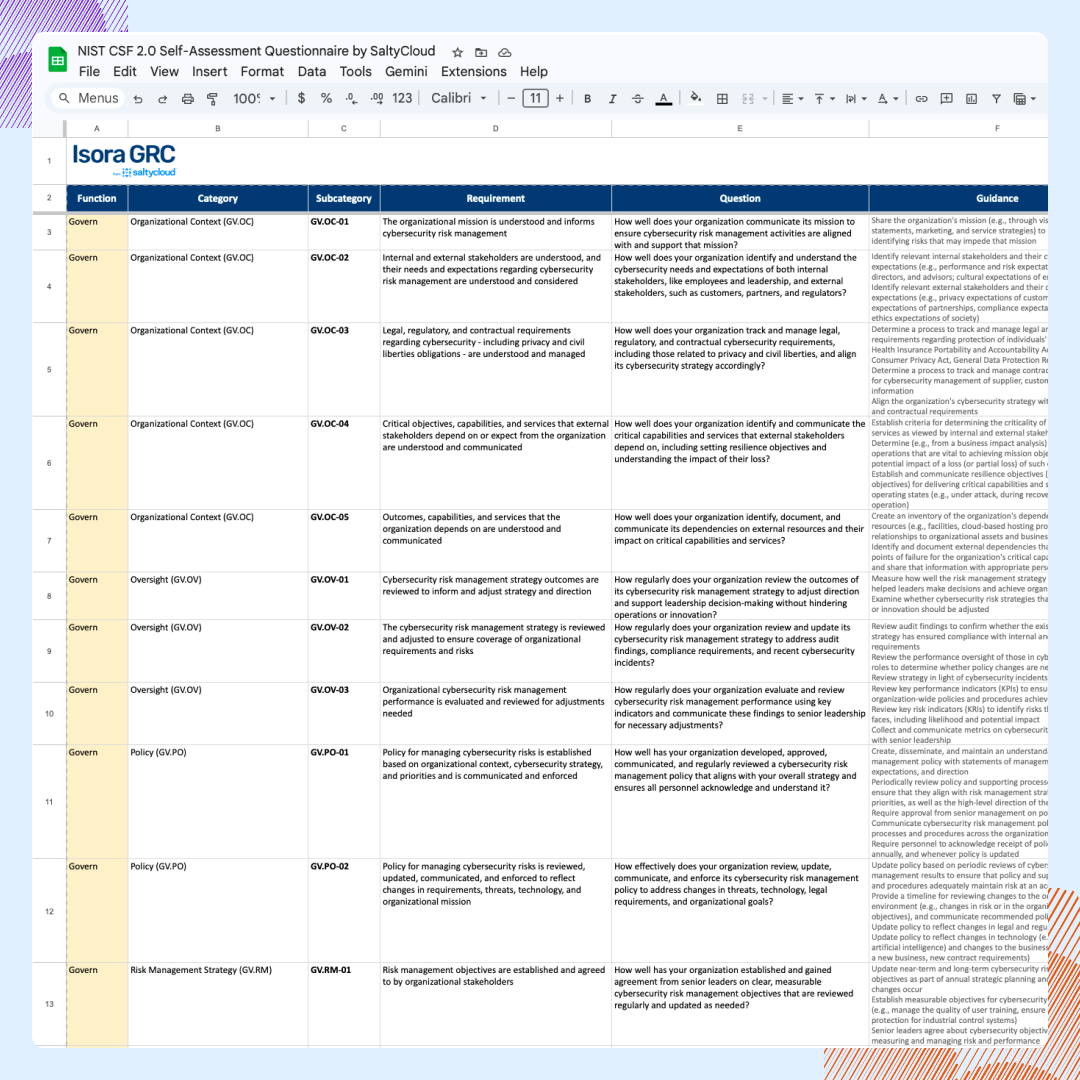
Isora GRC gives security teams a centralized workspace to manage the entire CSF workflow from assessment distribution to audit-ready reporting. With Isora, you can:
- Run CSF assessments at scale. Distribute CSF-aligned questionnaires across departments and track completion without chasing responses over email.
- Always know where you stand. Monitor how policies, controls, and operational practices align with each CSF function and surface gaps before they become audit findings.
- Keep evidence where it belongs. Attach policies, risk assessments, and monitoring reports directly to assessment responses, so documentation is organized, accessible, and ready when you need it.
- Report to leadership without the manual work. Generate dashboards and reports that summarize CSF alignment, maturity levels, and remediation progress in a format that makes sense to everyone in the room.
See how NIST CSF compliance software automates your assessment process
Key Takeaways
NIST CSF compliance is not a certification. It is a structured way to measure and improve your cybersecurity program against a set of defined outcomes provided in the NIST Cybersecurity Framework. The current version is NIST CSF 2.0, if you’re starting out, that’s the one to reference.
CSF adoption is growing across industries. Federal agencies, critical infrastructure operators, regulated industries, and cyber insurers all reference it. If you work with any of them, alignment is increasingly expected rather than optional. The question for most organizations is no longer whether to adopt CSF, but how to do it effectively.
The most common mistake organizations make is jumping straight to deploying tools and updating policies before they understand where they actually stand. Build your Current Profile, define your Target Profile, and let the gap analysis tell you where to focus. That is what makes everything else actionable.
Whether you’re an enterprise, an SMB, or managing an OT environment, phase your implementation. Prioritize your highest-risk gaps first and build maturity gradually. Trying to achieve full alignment in one go is how programs stall before they deliver value.
Finally, treat compliance as an ongoing program, not a project with an end date. Your risk environment changes, your business evolves, and your CSF profile needs to keep up. Build regular reassessment into your workflow from the start, and compliance becomes something your organization maintains rather than scrambles to demonstrate.
For a comprehensive overview, see our complete guide to NIST CSF. Ready to streamline compliance? See how Isora GRC automates CSF assessments.
NIST CSF Compliance FAQs
Is NIST CSF compliance mandatory?
For most private organizations, NIST CSF is voluntary. But today, that distinction matters less than it used to. Executive Order 13800 directs federal agencies to use CSF, and sector regulators in healthcare, financial services, and critical infrastructure increasingly reference it. If you work with the federal government or operate in a regulated industry, treat it as expected rather than optional.
Can you get NIST CSF certified?
No. NIST does not issue certificates, and there’s no accreditation body for CSF. What you can do is run the assessment internally using CSF profiles and NIST’s own resources, or engage a third-party assessor to produce a formal alignment report using ISACA’s CSF 2.0 audit program. It’s not a certificate, but a well-documented third-party assessment carries real weight with regulators, insurers, and partners.
What are the steps to NIST CSF compliance?
Follow these seven steps to achieve NIST CSF compliance: define your scope, establish governance, create a Current Profile, define a Target Profile and conduct a gap analysis, prioritize and plan, implement improvements, and reassess continuously.
The most common mistake organizations make is jumping straight to implementation. Deploying tools and updating policies before they’ve done the profile work. Don’t skip the gap analysis. That’s what tells you where to focus and in what order. Our NIST CSF complete guide provides a broader overview of implementing the framework.
What is a NIST CSF assessment?
A NIST CSF assessment is an evaluation of how well your cybersecurity program aligns with CSF’s six functions. Assessors look at your documented policies, your Current vs. Target Profile gaps, how consistently controls are implemented, and whether you have evidence of continuous monitoring. If you haven’t tested your incident response plan recently, that’s usually the first thing that comes up.
Does NIST CSF apply to small businesses?
Yes, and NIST built a free resource specifically for smaller organizations: SP 1300, the Small Business Cybersecurity Quick Start Guide. Don’t try to implement everything at once. Start with asset visibility, identity protection, and incident response readiness. Build from there.
What is the difference between NIST CSF and NIST 800-53?
CSF tells you what outcomes to achieve. NIST 800-53 tells you how to achieve them through a catalog of 1,196 prescriptive controls. Most organizations use CSF to define their target security posture and 800-53 as the control library to get there. If you’re pursuing FedRAMP, you’ll be working with both. For a full breakdown, see our NIST CSF vs NIST 800-53 guide.
What software tools help with NIST CSF compliance?
For help with NIST CSF compliance, look for a GRC platform with built-in CSF 2.0 mapping, assessment distribution, gap tracking, and reporting capabilities. The goal is to get off spreadsheets and into a workflow that keeps your Current Profile current, tracks remediation, and gives leadership visibility without requiring manual aggregation every time someone asks for a status update.

This content is for informational purposes only and does not constitute legal or compliance advice. See our full disclaimer.
