




 Table of Contents
- HECVAT Tools and Solutions: A Complete Guide for Procurement Officers
- What Is HECVAT Software?
- Why Organizations Need HECVAT Tools
- Types of HECVAT Compliance Tools
- What to Look For in HECVAT Compliance Software
- How to Compare HECVAT Compliance Tools
- Best HECVAT Compliance Tools by Organization Type
- How to Simplify HECVAT Compliance
- Key Takeaways
- HECVAT Compliance Software FAQs
HECVAT Tools and Solutions: A Complete Guide for Procurement Officers
HECVAT compliance software is a category of platforms that helps higher education institutions and their vendors operationalize the HECVAT (Higher Education Community Vendor Assessment Toolkit), a standardized vendor security questionnaire.
HECVAT 4, released February 10, 2025, consolidates the previous Full, Lite, and On-Premise versions into a single unified workbook. The current release, HECVAT 4.1.6, holds approximately 321 questions across 7 sections: Organization, Product, Infrastructure, IT Accessibility, Case-Specific, Artificial Intelligence, and Privacy.
This guide is written for VPs of Procurement, Directors of Sourcing, and Vendor Risk Managers, along with unit-level procurement officers. Those officers own day-to-day vendor decisions inside a school, college, or auxiliary. Information security GRC managers and analysts who partner with procurement to operationalize HECVAT review are part of the audience as well. It explains why procurement teams need HECVAT tooling, with platform categories, evaluation criteria, and organizational fit.
What Is HECVAT Software?
HECVAT software automates HECVAT vendor assessments for higher education procurement programs. These platforms handle questionnaire distribution, vendor response ingestion, risk-weighted scoring against EDUCAUSE importance-level defaults, cross-vendor comparison, and procurement-decision audit trails.
HECVAT software is a category of platforms that automate the Higher Education Community Vendor Assessment Toolkit (HECVAT). Higher education institutions use this standardized vendor security questionnaire to evaluate SaaS vendors.
Unlike generic vendor risk management platforms, purpose-built HECVAT software ships with the current unified-workbook library and tracks EDUCAUSE version updates. It also supports the decentralized procurement workflows that higher education institutions actually run.
Free download: Score your third-party risk program across five dimensions with the TPRM Maturity Checklist.
Why Organizations Need HECVAT Tools
Higher education institutions need HECVAT tooling because campus vendor evaluation creates more volume, decentralization, and regulatory exposure than typical enterprise procurement. Institutions buy from thousands of SaaS vendors annually and host sensitive student and research data. They also operate under decentralized procurement authority and answer to internal audit, state regulators, and federal funding agencies.
HECVAT standardizes the security questions every institution asks every vendor — that’s the easy part. Operationalizing those answers across a procurement program is more challenging.
Managing HECVAT at Scale
Often, scale is what turns HECVAT into a volume problem before anything else. For many higher education institutions, a single procurement cycle may require ingesting HECVAT responses from 5–20 competing vendors. With up to 321 questions per HECVAT 4 response, that’s roughly 6,400 question evaluations in a single sourcing event.
Procurement at R1 universities can be even more complex. Typically, these organizations maintain hundreds of active vendor relationships requiring HECVAT review across multi-year reauthorization cycles. In fact, Microsoft, Atlassian, and Zoom publish their HECVAT responses on trust portals to meet the institutional procurement demand at scale. Google Cloud makes its HECVAT self-assessments available through its account managers on request.
For procurement officers, the real question is how the institution will ingest those responses, compare them across vendors, surface gaps, and document decisions. Unfortunately, none of those activities will scale on email and spreadsheets beyond a couple of vendors.
Why Spreadsheets Break
Spreadsheets tend to break for HECVAT questionnaire distribution, response evaluation, and procurement-decision documentation.
- Email-based distribution loses thread continuity, drops attachments, and gives the procurement office no view of completion status across the vendor pool.
- Spreadsheet-based response evaluation has no risk-weighted scoring, no side-by-side vendor comparison, and no audit trail of the procurement decision.
- The gap between vendor claims and HECVAT requirements gets lost in version sprawl.
The same pattern shows up in community research. According to EDUCAUSE’s August 2024 Third-Party Risk Management QuickPoll, 63% of higher education institutions lack a formal TPRM process. TPRM responsibility is also spread across an average of five departments per institution. Further, managing volume and complexity of third-party relationships ranked as the top challenge.
For procurement teams running HECVAT, the overhead often lands on staff who are also managing RFPs, contract negotiation, and supplier diversity reporting.
Regulatory and Institutional Pressure
Community standards bodies, federal regulators, and state data residency laws are pushing institutions toward formal HECVAT review.
EDUCAUSE, alongside Internet2 and REN-ISAC, positions HECVAT as the standard expected by leading state university systems and Internet2 member institutions. U.S. state information security regulations in Texas, California, and New York make vendor data location a procurement-level decision. Because that decision has to be sourced from HECVAT responses, somebody has to be able to find that answer in the questionnaire, fast.
Federal regulators are reinforcing the same expectation. In December 2025, the FTC filed an enforcement action against Illuminate Education, a K–12 SaaS vendor serving 5,200 districts and 17 million students. The action alleged unencrypted student data storage, failure to disable former-employee credentials, ignoring third-party security warnings, and breach notification delays of nearly two years.
The FTC’s final order, approved June 5, 2026, also requires a comprehensive information security program and third-party security assessments. A HECVAT assessment can surface a vendor data-handling gap involving student PII. In that case, the Department of Education’s PTAC guidance on third-party service providers under FERPA determines whether the gap requires contractual remediation.
Decentralized Procurement Operations
Higher education vendor management runs on decentralized procurement: central, school-level, and department-level sourcing all happen at once. At R1 universities, HECVAT review can originate at any layer. A faculty member contracts with a new research collaboration tool through their department, a college signs a learning management add-on, and central procurement runs the SIS replacement. Each path triggers its own HECVAT review.
EDUCAUSE’s Top 10 IT Issues report confirms that decentralized IT and procurement remain a defining feature of higher education. A central team simply cannot conduct 200 vendor evaluations manually per year across schools.
Types of HECVAT Compliance Tools
HECVAT compliance tools usually fall into one or more overlapping categories. They include Enterprise GRC Suites, GRC Assessment Platforms, Continuous Monitoring Solutions, TPRM Point Tools, and Audit Management Platforms.
Best fit depends on whether the institution evaluates incoming vendor responses or a vendor responds outward. It also depends on how broad the rest of the compliance program runs. Procurement officers should understand the difference before evaluating vendors.
Enterprise GRC Suites
Enterprise GRC Suites bundle governance, risk, and compliance into one platform built for Fortune 500 multi-framework portfolios spanning SOX, ISO 27001, and industry regulations. HECVAT capability is bolted onto the platform rather than native to it. For higher education, these platforms are typically over-engineered and run 6–12 month implementations. They also carry $50K–$500K+ annual costs that exceed what a higher education procurement program can justify.
Examples: RSA Archer, MetricStream, ServiceNow GRC.
GRC Assessment Platforms
GRC Assessment Platforms target distributed assessment workflows directly, with faster deployment than enterprise GRC suites. Native HECVAT support varies within this tier, so it is worth confirming in each platform’s framework library. Industry analyst frameworks describe this tier as the modern alternative to enterprise GRC. It suits organizations that need fast deployment and native assessment capability without enterprise overhead.
Examples: Isora GRC, Optro, Hyperproof, LogicGate.
Isora GRC is the collaborative GRC Assessment Platform™ for security teams. Built by SaltyCloud specifically for higher education institutions running HECVAT vendor assessments at scale, Isora GRC pairs native ingestion of the HECVAT 4 unified workbook (with backward compatibility for legacy HECVAT 3 Full, Lite, and Triage responses) with procurement workflow integration.
Optro, rebranded from AuditBoard in March 2026, is broadly deployed across Fortune 500 enterprise compliance teams. Meanwhile, Hyperproof and LogicGate serve general-purpose IT compliance programs with assessment workflows.
See the HECVAT compliance software page to learn more →
Continuous Monitoring Solutions
Continuous Monitoring Solutions help vendors respond to HECVAT questionnaires by reusing SOC 2 evidence and trust portal content. These tools take a SOC 2-first approach built around the responding vendor, although Vanta, Drata, and Sprinto also offer third-party risk products for reviewing vendors.
Examples: Drata, Vanta, Sprinto, Conveyor.
Sprinto’s own pricing breakdown frames the platform around vendor-side compliance posture. Conveyor documents HECVAT v3 and v4 support on the response side, alongside SIG and CAIQ. Adoption signals on vendor trust portals show how this category gets used in practice — vendors publish their HECVAT responses for institutional procurement teams to download.
For institutional procurement officers, that means the core of these tools answers the vendor’s side of the question. Still, they’re useful to know about because incoming HECVAT responses often come from vendors using them.
See Hyperproof vs Vanta vs Isora GRC for a direct comparison →
TPRM Point Tools
TPRM Point Tools handle generic vendor questionnaires across industries. However, their broad coverage is not always higher-education-purpose-built. Coverage of HECVAT 4.x unified-workbook ingestion, EDUCAUSE version tracking, and decentralized institutional workflows varies significantly across this tier.
Examples: Whistic, UpGuard, BitSight, SecurityScorecard, Black Kite, Panorays, Prevalent, OneTrust Third-Party Risk Management.
Whistic’s TPRM Guide 2025 positions that platform as a horizontal TPRM tool rather than a higher-education vertical. Support in this tier splits two ways, and the difference matters at procurement time.
Several platforms ship HECVAT as a pre-built questionnaire in their own libraries. UpGuard lists HECVAT Full, Lite, and HECVAT 4. SecurityScorecard lists it under its original name, the Higher Education Cloud Vendor Assessment Tool. BitSight and Black Kite both name HECVAT in their published framework coverage.
Other platforms publish HECVAT guidance without shipping a HECVAT template. Panorays documents the questionnaire from a TPRM perspective, while its own questionnaire library lists SIG and CAIQ. Procurement teams should confirm that HECVAT appears in the questionnaire library itself rather than only in a vendor’s blog.
See RiskRecon vs SecurityScorecard for the external-attack-surface scoring category.
Audit Management Platforms
Audit Management Platforms document procurement-decision compliance reviews for institutional audit. But they do not ingest HECVAT responses directly. Instead, these tools tend to layer on top of whichever platform is actually doing the HECVAT review work. Some compliance automation tools, like Drata and Vanta, straddle continuous monitoring and audit management.
Examples: Workiva, Drata, Vanta.
A community-broker category exists historically through the Community Broker Index (CBI), which REN-ISAC retired on July 31, 2025. In its place, EDUCAUSE says its HECVAT Advisory Committee is exploring new ways to connect institutions with companies that use the HECVAT. Meanwhile, the EDUCAUSE Connect HECVAT Users Community Group functions as a peer-review and information-sharing channel rather than a software platform.
What to Look For in HECVAT Compliance Software
Key capabilities in HECVAT compliance software include HECVAT 4.x library currency, vendor response ingestion, risk-weighted scoring, procurement workflow integration, multi-vendor comparison, evidence management, and procurement audit trail. These criteria separate platforms that work for a higher education procurement program from platforms that look right in a demo and break in operation. Procurement officers should walk through each one with the vendor.
| Criteria | Why It Matters | Questions to Ask |
| HECVAT 4 Unified Workbook | HECVAT releases major versions on a roughly 2-year cadence. Platforms have to support the current unified HECVAT 4.1.6 workbook without manual re-import. | Does the platform include the current HECVAT 4.1.6 unified workbook with ‘Start Here’ conditional routing? Are EDUCAUSE version updates automatic? Can legacy HECVAT 3 Full, Lite, and Triage responses be backward-compared? |
| Vendor Response Ingestion | Vendors submit HECVAT responses in XLSX, PDF, email, and web-hosted formats on trust portals. The platform has to ingest cleanly without manual transcription, and ideally auto-refresh when vendors post updated responses. | Can the platform ingest XLSX HECVAT files directly? Does it parse PDF and web-hosted HECVAT responses from vendor trust portals? Does it auto-update when vendors publish new versions? Can it auto-flag missing sections? |
| Risk-Weighted Scoring | Questions in HECVAT 4 are not equal — EDUCAUSE assigns each a default importance level (Critical, Standard, Minor). Data handling and authentication questions carry more procurement risk than documentation questions. | Can the platform apply risk weights per question or section? Are higher-education-specific weights pre-configured? Can custom weighting reflect the institution’s full risk profile — so questions that matter most to its unique environment carry more weight? |
| Procurement Workflow Integration | HECVAT review is a procurement gate. The tool has to surface gating signals to procurement officers, not just to risk teams. | Does the platform integrate with procurement systems (Jaggaer, Workday, Coupa)? Can procurement officers see vendor risk status without learning a GRC tool? |
| Multi-Vendor Comparison | Procurement cycles evaluate 5–20 vendors simultaneously. Cross-vendor visibility is the central workflow. | Can the platform compare HECVAT responses across vendors side-by-side? Can it surface “best fit” recommendations? Does it support shortlist workflows? |
| Evidence and Document Management | HECVAT responses include uploaded evidence — SOC 2 reports, ISO 27001 certificates, penetration test summaries. Central evidence storage is required for audit defense. | How does the platform store vendor evidence? Can institutional staff drill into specific evidence per question? Is access controlled by procurement role? |
| Procurement Audit Trail | Institutions defend vendor-selection decisions to internal audit, state regulators, and federal funding agencies. | Does the platform maintain an append-only audit log of HECVAT reviews and procurement decisions? Can audit exports include reviewer identity, dates, and decision rationale? |
REN-ISAC’s HECVAT Services and HECVAT Hub record where the questionnaire came from and point readers to EDUCAUSE for the latest version. EDUCAUSE’s How to Use the HECVAT guidance lays out the recommended review workflow.
HECVAT 4 added a dedicated AI section and an expanded Privacy section, which is why current-version library support matters. HECVAT 3 first expanded vendor evaluation beyond cybersecurity into accessibility, and HECVAT 4 introduced a dedicated IT Accessibility tab aligned to WCAG 2.1 AA. For public universities and community colleges with ADA and Section 508 obligations, platforms that ignore the accessibility tab deliver an incomplete compliance picture.
EDUCAUSE’s May 2025 AI Procurement QuickPoll found that 63 percent of respondents’ procurement processes already account for AI products or will in the future. One respondent hoped HECVAT v4 would address some AI procurement issues, while noting that vendors had not yet started using it.
How to Compare HECVAT Compliance Tools
Organizations can compare HECVAT compliance tools by mapping platform categories side-by-side across the evaluation criteria above. For most higher education procurement programs, the GRC Assessment Platforms column is where the best fit lands.
| Criteria | Enterprise GRC Suites | Manual / Spreadsheets | GRC Assessment Platforms |
| HECVAT 4 Library | Manual import; not native | Manual download from EDUCAUSE | Native HECVAT 4.x unified workbook |
| Vendor Response Ingestion | Document upload (manual) | Manual transcription | Native XLSX ingestion + PDF parsing |
| Risk-Weighted Scoring | Configurable (extensive setup) | Manual Excel formulas | Native HECVAT scoring + customizable weights |
| Procurement Workflow Integration | API integration available (engineering required) | Email-based handoff | Native procurement workflow + system integrations |
| Multi-Vendor Comparison | Yes (custom dashboards) | Manual Excel pivots | Built-in side-by-side vendor comparison |
| Audit Trail | Extensive logging | Email thread + spreadsheet history | Append-only procurement-decision audit log |
| Implementation Time | 6–12 months | Immediate (low quality) | Weeks to months |
| Cost | $50K–$500K+/year | Staff time only | Moderate (varies by scale) |
| Best for | Multi-framework GRC programs | Very small institutions or pilot programs | Higher education procurement programs, distributed institutional risk |
Enterprise GRC carries the most capability and the most overhead. Manual workflows sit at the other extreme, with the least overhead and the least capability. GRC Assessment Platforms is the tier built for the institutional-procurement use case. It combines native HECVAT support, procurement workflow integration, and an implementation timeline that fits a procurement team’s calendar.
Best HECVAT Compliance Tools by Organization Type
The best HECVAT compliance tool for an institution depends on its organization type, procurement model, and regulatory overlap. For instance, features that fit an R1 university’s central procurement office may be wrong for a community college. The matrix below maps capability priorities by organization type rather than prescribing a single tool category. Fit depends on procurement structure, scale, and existing compliance program.
| Organization Type | Must-Have Features | What to Prioritize |
| R1 University | HECVAT 4.x unified workbook native, multi-school decentralized workflow | Adoption ease at unit-procurement level |
| R2 / Regional Public University | HECVAT 4 unified workbook with High Risk Evaluation view, procurement workflow | Cost-fit for a lean procurement staffing model |
| Community College | HECVAT 4 unified workbook with conditional routing, simple workflow | Fast deploy, minimal training requirement |
| Public University System Office | Multi-campus aggregation, federated procurement workflow | Cross-campus vendor inventory consolidation |
| Academic Medical Center | HECVAT + HIPAA Security Rule overlap mapping | Multi-framework support |
| Higher-Ed Affiliated Hospital | HECVAT + HIPAA OCR audit prep | OCR audit defensibility |
| Higher-Ed Adjacent | HECVAT 4 lightweight scope via High Risk Evaluation view | Minimum-viable deployment |
| Procurement Consortium | Multi-member aggregation, shared vendor library | Member-organization data isolation |
R1 Universities
R1 universities deserve a closer look because they run the broadest vendor portfolios and the most decentralized procurement structures. Procurement workflow has to handle a central VP Procurement seeing every vendor and a school-level procurement officer seeing the vendors in their school. It also has to handle a department sourcing lead seeing the vendor they sponsored.
EDUCAUSE’s HEISC Charter and Internet2’s NET+ vendor program both reflect this decentralized reality. R1 universities with federal research funding carry an additional layer, because NIST SP 800-161 Rev. 1 defines cybersecurity supply chain risk management practices. DOD, NSF, and other federal grant recipients are increasingly expected to apply those practices alongside HECVAT. A platform that maps HECVAT responses to SP 800-161 or SP 800-53 SR controls reduces the federal-compliance overhead for institutions subject to both.
Hospitals and AMCs
Academic medical centers and higher-ed-affiliated hospitals carry an additional load. HECVAT and HIPAA overlap, but neither covers the other completely. Platforms that map HECVAT sections onto HIPAA Security Rule requirements let a single vendor evaluation produce evidence for both. EDUCAUSE’s HECVAT FAQs note that the toolkit helps institutions meet various regulatory requirements while streamlining vendor assessment.
Compliance weight on AMCs is rising. HHS OCR’s December 2024 Notice of Proposed Rulemaking is the first proposed update to the HIPAA Security Rule since 2013. It would require mandatory annual written verification from business associates and a more prescriptive risk analysis, including technology asset inventory and threat-by-vulnerability risk ratings. MFA, encryption, and vulnerability scanning would also become mandatory.
The public comment period closed March 7, 2025, and HHS’s latest regulatory agenda lists a target final-rule date of July 2027. As of this writing, however, no final rule has been published. A HECVAT-integrated platform that automates evidence collection and attestation tracking maps directly to the workflow this would require.
Procurement Consortia
Procurement consortia, which are shared services groups that buy on behalf of multiple member institutions, need member data isolation as a baseline. Vendor libraries are shared, but institutional decisions are not. NAEP (National Association of Educational Procurement) and the EDUCAUSE Connect HECVAT Users Community Group are the relevant peer networks.
How to Simplify HECVAT Compliance
Streamline HECVAT compliance with Isora GRC, the collaborative GRC Assessment Platform™ for security teams at institutions managing HECVAT vendor assessments across decentralized procurement programs.
Assessment Management
Distribute the HECVAT 4 unified workbook to vendors directly and tracks completion across the procurement cycle. In Isora, reviewers see which vendors have responded, which are mid-completion, and which are overdue, with a single view across the full sourcing event. Eliminate email threads and maintain continuity with vendor-side response and institutional-side review in one workflow.
See assessment management →
Questionnaires & Surveys
Operationalize HECVAT 4.1.5 alongside backward compatibility for legacy HECVAT 3 Full, Lite, and Triage responses. In Isora, EDUCAUSE version updates flow through to the questionnaire library, so institutions always reviews against the most current version. Isora’s one-click HECVAT Uploader ingests vendor XLSX responses cleanly with logic flows that route HECVAT questions by section, and weighted scoring surfaces the high-risk gaps procurement officers need to see first.
See questionnaires and surveys →
Reports & Scorecards
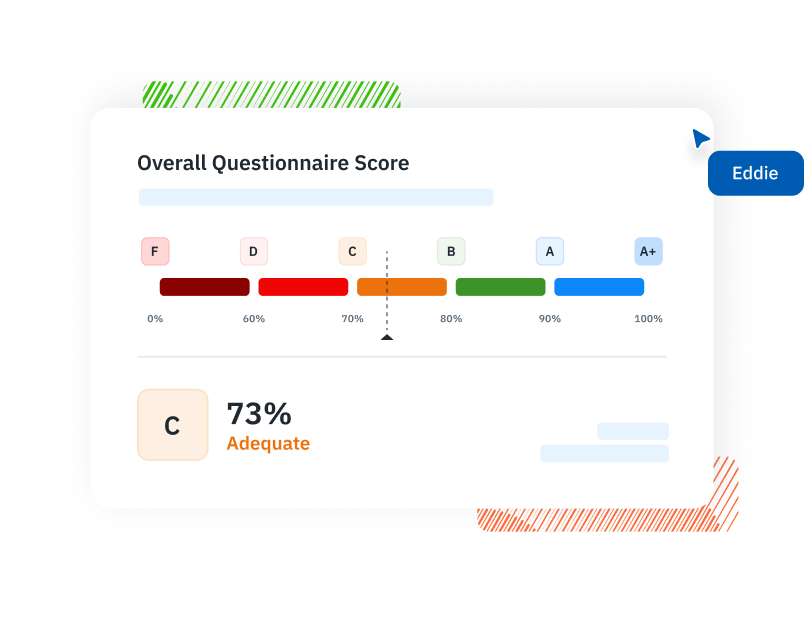
Surface HECVAT responses side-by-side with cross-vendor scorecards for procurement shortlists. Drill down per question to read the vendor’s answer, the supporting evidence, and the reviewer’s commentary, all in one view. An append-only procurement-decision audit log captures dated reviewer attribution, decision rationale, and an immutable record of the full review. One-click PDF and CSV exports cover procurement committee submissions and institutional audit requests.
See reports and scorecards →
Inventory Management
Vendors, applications, and assets live side-by-side in one inventory. In Isora, vendor-to-application linkage shows which institutional systems each vendor touches, which is the first question internal audit asks during a procurement review.
See inventory management →
Exception Management
Capture HECVAT gaps that procurement accepts with documented exceptions for the gap itself, the compensating control, the approver, and the reassessment date. This is the artifact internal audit asks for when a vendor with a known security gap shows up in the active vendor inventory.
See exception management →
Risk Management
Register every HECVAT-assessment risk with full context across HECVAT section ID, the question gap, the vendor’s supporting evidence, and the procurement decision in Isora’s unified vendor risk register. See which vendors carry residual risk that needs reassessment in the next cycle with a risk matrix that supports prioritization across the vendor portfolio.
See risk management →
Key Takeaways
A well-fit HECVAT compliance platform turns the HECVAT 4 questionnaire from a procurement bottleneck into a vendor-portfolio signal. That signal makes the security program more visible, more accountable, and more resilient. Four capabilities separate platforms that work for an institutional procurement program from platforms that look right in a demo and break in operation. They are native unified-workbook ingestion, risk-weighted scoring, multi-vendor comparison, and an append-only procurement-decision audit trail.
GRC Assessment Platforms are the tier most higher education institutions land on. Implementation timelines, procurement workflow integration, and higher-education-purpose-built design typically matter more for institutional fit than the depth of enterprise-grade GRC overhead.
For higher education procurement officers operationalizing HECVAT, the right tooling is the difference between a defensible vendor inventory and a stack of completed spreadsheets nobody reads.
Simplify HECVAT compliance with Isora GRC →
HECVAT Compliance Software FAQs
What is the best HECVAT compliance software for higher education?
For R1 and R2 universities managing 100+ vendor evaluations annually with distributed procurement officers across schools or departments, GRC Assessment Platforms like Isora GRC offer the best fit — native HECVAT 4.x unified-workbook support, multi-vendor comparison, and procurement workflow integration without enterprise GRC implementation overhead. Procurement maturity and decentralization determine the right category.
What’s the difference between HECVAT Full, Lite, and Triage?
Under HECVAT 4 (current version 4.1.6), the legacy Full, Lite, and On-Premise workbooks are consolidated into a single unified questionnaire. That questionnaire has approximately 321 questions across 7 sections. A ‘Start Here’ tab routes vendors through conditional sections, and a ‘High Risk Evaluation’ view aggregates critical-importance questions for lightweight reviews. Legacy HECVAT 3 Full, Lite, and Triage questionnaires still appear in older procurement records but are no longer the maintained version.
Do I need a software platform for HECVAT compliance?
Software is not strictly required at small scale. At 100+ vendor evaluations annually for R1 universities (30+ for R2), manual spreadsheet evaluation breaks down on version control, multi-vendor comparison, and procurement-decision audit trail. Most institutions outgrow spreadsheets within their first major procurement cycle.
How is HECVAT different from SOC 2?
HECVAT is a higher-education-specific vendor assessment questionnaire maintained by EDUCAUSE with Internet2 and REN-ISAC, covering FERPA, accessibility, and learning analytics data. SOC 2 is a general AICPA audit framework covering Trust Service Criteria. Vendors typically respond to both, and HECVAT vs SOC 2 covers the full distinction.
Does HECVAT have a current version?
Yes, the current version is HECVAT 4.1.6, and EDUCAUSE maintains it in partnership with Internet2 and REN-ISAC. HECVAT 4 itself was released on February 10, 2025, and institutions should require new vendor submissions on HECVAT 4.1.6. A year past release, older versions (HECVAT 3.x, 2.x) should not be accepted for active procurement. Backward comparison remains useful for reconciling legacy procurement records against the current questionnaire, not for accepting new submissions.
What is Isora GRC?
Isora GRC is the collaborative GRC Assessment Platform™ built by SaltyCloud for higher education institutions and security teams managing vendor risk at scale. Universities including UC Berkeley and the University of Chicago use Isora GRC to operationalize HECVAT 4.x vendor assessments across decentralized procurement programs.

This content is for informational purposes only and does not constitute legal or compliance advice. See our full disclaimer.
