




 Table of Contents
- GLBA Tools and Solutions: A Complete Guide for Community Banks and Credit Unions
- What Are GLBA Compliance Tools for Community Banks and Credit Unions?
- What GLBA Compliance Tools Do for Community Banks and Credit Unions
- Why Community Banks and Credit Unions Need GLBA Compliance Tools
- Types of GLBA Compliance Tools for Community Banks and Credit Unions
- Capability Requirements for GLBA Compliance Software (Community Bank + Credit Union)
- What to Look For in GLBA Compliance Software (Community Bank + Credit Union)
- How to Compare GLBA Compliance Tools for Community Banks and Credit Unions
- Best GLBA Compliance Tools for Community Banks and Credit Unions
- How to Simplify GLBA Compliance for Community Banks and Credit Unions
- Key Takeaways
-
GLBA Compliance Software FAQs (Community Bank + Credit Union)
- What is the best GLBA compliance software for community banks?
- What is the best GLBA compliance software for credit unions?
- What replaced the FFIEC CAT for community banks?
- Does NCUA require credit unions to use specific GLBA compliance software?
- How is GLBA compliance different for community banks vs. credit unions?
- How long does GLBA compliance software take to deploy at a community FI?
- Which examiners review GLBA compliance program documentation for community banks and credit unions?
- What is Isora GRC?
GLBA Tools and Solutions: A Complete Guide for Community Banks and Credit Unions
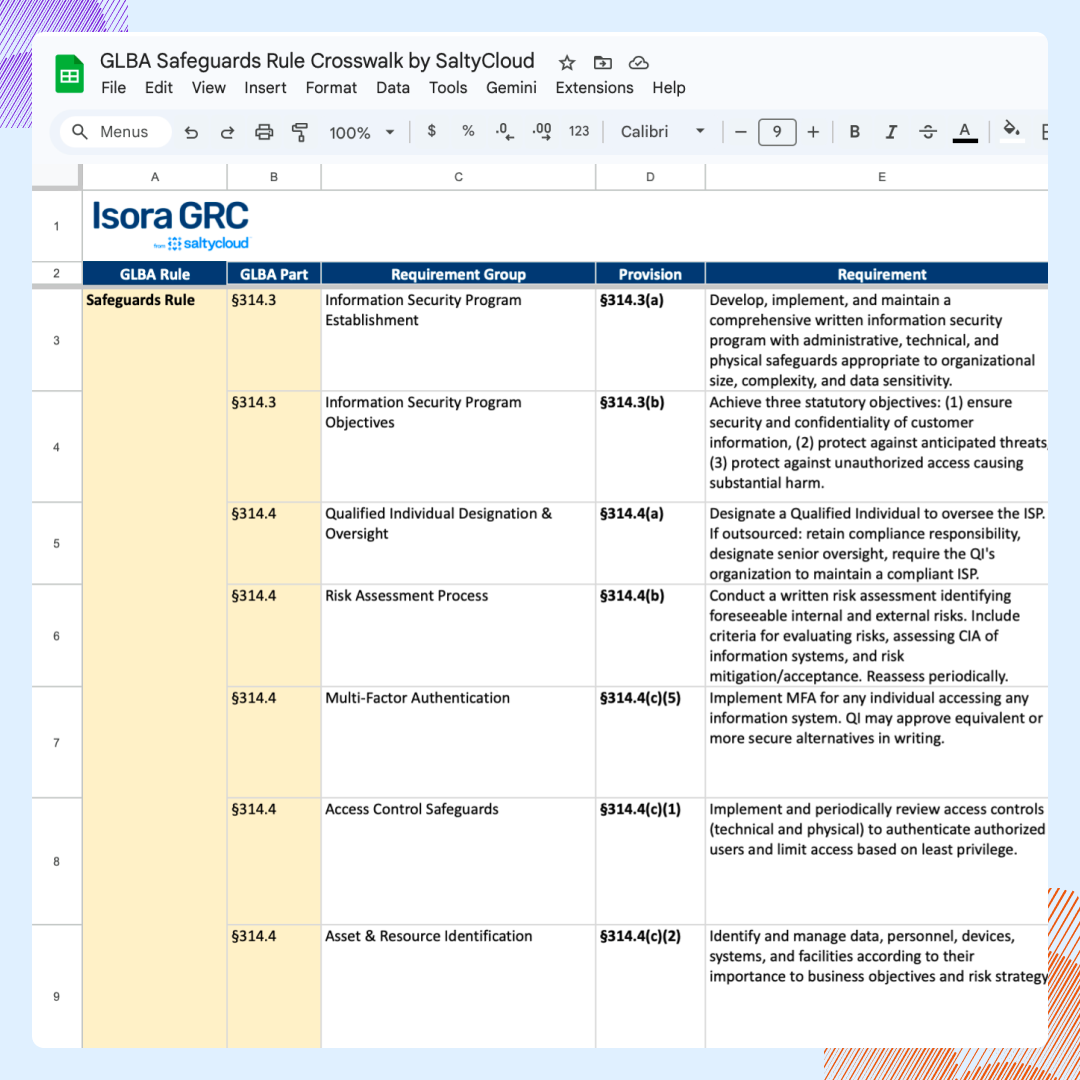
GLBA compliance tools for community banks and credit unions consolidate risk assessments, vendor oversight, training records, and examiner-ready reporting, mapped to the Safeguards Rule §314.4 structure. Today, most of these platforms are built for institutions with 0–2 dedicated risk staff. Those institutions run multi-regulator programs under FDIC, Federal Reserve, NCUA, and state regulator review.
Like Fortune 500 banks, community banks answer to the Interagency Guidelines, and credit unions answer to NCUA Part 748, both written under GLBA. A typical vendor portfolio runs 30–100 relationships, and the examiner stack adds FDIC or NCUA, often with a state regulator, on top of GLBA. At that scale the math simply doesn’t work on a spreadsheet. Meanwhile, the FFIEC retired the Cybersecurity Assessment Tool on August 31, 2025, after many community FIs had spent a decade configuring it.
This guide compares GLBA compliance tooling for community banks ($1B–$10B and below) and credit unions (federally and state-chartered). It explains what to evaluate, how the category breaks down, capability requirements, and which platform shape fits which organization type.
For a regulatory deep-dive on the rule itself, see the GLBA Complete Guide.
What Are GLBA Compliance Tools for Community Banks and Credit Unions?
GLBA compliance tools for community banks and credit unions are a category of governance, risk, and compliance (GRC) software. They help mid-market financial institutions meet GLBA safeguards standards under FFIEC, NCUA, and state regulator review. Banks and federally insured credit unions get those standards from their own regulators, while the FTC’s Safeguards Rule covers institutions under FTC jurisdiction.
The category consolidates the §314.4 workflows of written risk assessment, vendor oversight, training records, ongoing monitoring, and incident response. It brings them into one platform tuned to the lean-staffing realities of community FIs.
GLBA compliance software for community banks and credit unions consolidates GLBA risk assessments, vendor oversight, training records, and examiner-ready reporting. It serves financial institutions managing FDIC, Federal Reserve, NCUA, and state regulator obligations. The category fits institutions of 50–500 staff with 0–2 dedicated risk personnel.
The platform category fits community banks ($1B–$10B and below), federally and state-chartered credit unions, and adjacent regulated FIs. The differentiator from broader GRC platforms is staffing-model fit. Tools in this category configure in days rather than quarters and deploy without dedicated GRC engineering teams. They also survive ownership by a Compliance Officer or VP of Risk wearing four hats.
What GLBA Compliance Tools Do for Community Banks and Credit Unions
GLBA compliance tools operationalize the core safeguards workflows that bank and credit union programs require, labeled here by their closest Safeguards Rule §314.4 subsections. Often, that includes:
- Written risk assessment (§314.4(b)): Periodic identification and documentation of foreseeable risks to customer information, with version history examiners can follow across cycles.
- Vendor and TPRM oversight (§314.4(f)): Due diligence, contract review, and ongoing monitoring across the 30–100 vendor relationships a typical community FI runs, aligned to the 2023 Interagency Guidance on Third-Party Relationships.
- Training records (§314.4(e)): Completion tracking, attestations, and role-based curriculum mapping for branch and back-office personnel.
- Ongoing monitoring and incident response (§314.4(d), (g), (h)): Periodic safeguards testing, program adjustment based on monitoring findings, and an incident workflow that fits the NCUA 72-hour notification cadence and FDIC 36-hour Computer-Security Incident Notification Rule.
- Examiner-ready reporting: Reproducible artifacts for FDIC IT examination, Federal Reserve community-bank review, NCUA examination, and state regulator overlays — produced on demand, not reassembled from spreadsheets each cycle.
The category sits within broader financial services compliance software, and its differentiator is staffing-model fit. Its tools are built for 0–2-person compliance teams, with no-code configuration and prebuilt §314.4 plus NCUA Part 748 Appendix A workflows.
Why Community Banks and Credit Unions Need GLBA Compliance Tools
Community banks and credit unions need GLBA compliance tools because their GLBA safeguards requirements apply at every asset size. Meanwhile, 0–2-person compliance teams cannot scale spreadsheet-based programs to match. Four pressures drive the need: full safeguards scope at every asset tier, multi-regulator examiner cadence, spreadsheet failure modes, and decentralized operations across branches and departments.
Full safeguards scope at every asset tier
Full safeguards scope applies to every bank and federally insured credit union regardless of asset size. The Interagency Guidelines and NCUA Part 748 Appendix A both require a written information security program approved by the board. That program has to assess risk, manage and control it, oversee service providers, adjust over time, and report to the board.
The list of elements does not shrink with asset size, although each program must be appropriate to the institution’s size and complexity. A community bank with $800M in assets answers to the same risk assessment requirement as a $2T bank holding company. The FTC’s Safeguards Rule (16 CFR Part 314), which covers institutions under FTC jurisdiction, sets out overlapping elements in ten subsections, §314.4(a) through (j). This guide uses those subsection numbers as a working map for the workflows that follow.
What scales is staffing, and most community banks and credit unions run their compliance function with one person or a small team of two. That one person is often a Compliance Officer or VP of Risk wearing four hats. Per ICBA cybersecurity guidance and America’s Credit Unions, the typical community FI has zero full-time GRC analysts. The work happens between other priorities.
Multi-regulator examiner cadence
For community banks, multi-regulator examiner cadence layers FDIC or Federal Reserve IT examinations on top of state banking departments. For state-chartered credit unions, it adds state regulator overlays to NCUA exam cycles. Community banks see FDIC or Federal Reserve IT examiners every 18–36 months, and credit unions face NCUA exam cycles on a similar interval.
Every exam asks for the same documentation: program documents, assessment results, vendor reviews, incident records, training rosters, board reports. If those artifacts live in fifteen spreadsheets and four shared drives, exam prep becomes a multi-week scramble.
Regulatory pressure stacks on top of the cadence. For institutions under FTC jurisdiction, the FTC’s 2021 amendment specified §314.4 requirements at the subsection level. The May 2024 breach notification rule then added a 30-day reporting clock for non-banking FIs with no harm threshold.
The FFIEC CAT sunset in August 2025 reshaped how banks demonstrate cyber-risk posture. FFIEC pointed institutions to resources such as NIST CSF 2.0, CISA’s Cybersecurity Performance Goals, the CRI Cyber Profile, and CIS Controls. NCUA’s 72-hour cyber incident notification rule applies in parallel for credit unions. The FFIEC CAT replacement transition guide walks through the CSF 2.0 migration path.
Spreadsheet failure modes
Spreadsheet failure modes surface once multi-regulator evidence requirements stack. Spreadsheets carry a single-cycle risk assessment for a small institution. They break when a tab-per-framework approach collides with overlapping FDIC, Federal Reserve, NCUA, and state regulator controls that should not be re-collected three times.
A 0–2-staff compliance function cannot maintain spreadsheet-driven risk registers, vendor inventories, and assessment workflows simultaneously, so something falls behind. Most often it is the ongoing monitoring side of §314.4(f). That part of the rule expects more than collecting a SOC 2 at onboarding and forgetting the vendor exists until the next reassessment.
Decentralized operations and lean staffing
Decentralized operations and lean staffing make implementation timeline as decisive as feature depth. A platform that takes nine months to deploy will outrun the budget cycle that approved it. Community banks with multiple branches, or credit unions with separate departments handling membership, lending, and operations, cannot centralize every assessment to one person. The platform has to push work out to the people who hold the answer and pull it back into one record without anybody chasing email.
Vendor portfolios magnify the staffing gap, since a typical community FI runs 30–100 vendor relationships. The list starts with the core data processor (Jack Henry, Fiserv, FIS), a digital banking platform, and loan origination. It continues through payment processors, treasury management services, the BSA/AML vendor, document imaging, and marketing automation.
Each one needs due diligence at onboarding and ongoing monitoring under §314.4(f), plus, at banks, alignment to the 2023 Interagency Guidance on Third-Party Relationships. Federally insured credit unions also have to meet the cyber incident notification cadence under NCUA Part 748 in §748.1(c).
Types of GLBA Compliance Tools for Community Banks and Credit Unions
GLBA compliance tools for community banks and credit unions cluster into six categories. They are enterprise GRC suites, GRC Assessment Platforms™, community bank and credit union specialists, continuous monitoring solutions, TPRM and vendor risk platforms, and DIY spreadsheets. Buyer profile, deployment model, and depth of §314.4 evidence coverage separate them, and most institutions evaluate two or three before settling.
Enterprise GRC suites
Enterprise GRC suites are multi-module GRC platforms built for Fortune 500 banks, insurers, and capital markets firms. They cover GLBA alongside SOX, Basel III, FFIEC, NYDFS 23 NYCRR 500, and dozens of other frameworks at depth. Deployment timelines span quarters to a year, with significant professional-services investment and dedicated GRC headcount.
For a community bank with $1B–$10B in assets or a credit union of any size, enterprise GRC is usually over-built for the actual program scope. It means a multi-quarter implementation and a six-figure annual line item.
Examples: Archer (formerly RSA Archer), MetricStream, ServiceNow GRC, IBM OpenPages, OneTrust GRC.
GRC Assessment Platforms™
GRC Assessment Platforms™ purpose-build for IT and vendor risk assessment workflows at mid-market organizations. They focus on the questionnaire → control → framework → risk lineage that §314.4 evidence depends on, with no-code configuration and weeks-to-deploy timelines. Examiner-grade reporting on §314.4 subsections sits inside the workflow rather than as a separate reporting build. The category fits community banks ($1B–$10B), credit unions of any size, and non-banking GLBA-regulated entities running multi-framework programs across lean teams.
Examples: Isora GRC.
Community bank and credit union specialists
Community bank and credit union specialists are vertical-focused GRC platforms built specifically for community FIs. These platforms fit institutions that want deep FFIEC and NCUA vertical alignment, often paired with policy management and BSA/AML modules. The trade-off is multi-industry adaptability, because vertical specialists generally do not follow institutions outside the FI vertical. That matters when an institution adds a HIPAA-adjacent affiliate, a higher-ed financial services arm requiring HECVAT, or a research relationship requiring NIST 800-171.
Examples: WolfPAC Solutions, Quantivate, Predict360 by 360factors, Ncontracts.
Continuous monitoring solutions
Continuous monitoring solutions are SOC 2-first compliance automation platforms aimed at evidence collection against a single control set. These platforms help fintech-facing community banks and credit unions demonstrate SOC 2 readiness to their technology vendor partners.
Institutions sponsoring fintech partners typically run a continuous monitoring tool alongside a GLBA platform.
Examples: Drata, Vanta, Secureframe, Thoropass.
TPRM and vendor risk platforms
TPRM and vendor risk platforms are vendor-questionnaire and security-rating tools focused on §314.4(f) service provider oversight. These platforms cover §314.4(f) in depth and typically do not cover §314.4(b) written risk assessment or §314.4(e) training. Many community FIs run a TPRM platform alongside a broader compliance platform, and the TPRM tool feeds vendor evidence into the program of record.
Examples: Prevalent, ProcessUnity, Whistic, BitSight.
DIY spreadsheets and SharePoint
Spreadsheet- and SharePoint-based programs persist at the smallest community FIs, where vendor counts are low. They work for single-cycle assessments and low vendor counts, but they break under examination cycles that require reproducible evidence across multiple §314.4 subsections.
Examples: Excel, Google Sheets, SharePoint document libraries.
Capability Requirements for GLBA Compliance Software (Community Bank + Credit Union)
GLBA compliance software for community banks and credit unions needs six core capabilities. They are written risk assessment, vendor oversight, training records, ongoing monitoring and incident response, and multi-regulator alignment. The sixth is integration with the systems where customer information already lives.
Each capability maps to a §314.4 subsection and, for credit unions, to NCUA Part 748 Appendix A. Each also forms a baseline requirement for evaluating any platform.
Written risk assessment (§314.4(b))
Section 314.4(b) requires identifying reasonably foreseeable internal and external risks to the security, confidentiality, and integrity of customer information. The assessment must specify how those risks will be managed and must be updated as conditions change.
Platform requirements: a configurable risk register, control mapping to §314.4 safeguards, periodic review cadence, and version history showing when assessments were updated and by whom. See the GLBA risk assessment guide for the regulatory deep-dive.
Vendor oversight (§314.4(f))
Section 314.4(f) requires due diligence in selecting service providers, contractual safeguards for customer information, and ongoing monitoring throughout the relationship. The 2023 Interagency Guidance on Third-Party Relationships: Risk Management took effect in June 2023 and replaced prior agency-specific guidance. It applies a lifecycle-risk framework to the same vendor population.
The NCUA’s 2024 cybersecurity report to Congress logged 892 reported cyber incidents from September 1, 2023, through May 1, 2024. Roughly 73% of them were tied to third parties, a quantified signal of where examiner attention concentrates.
Platform requirements: a vendor inventory, due-diligence questionnaire workflow, contract review tracking, ongoing-monitoring cadence configured by risk tier, and termination evidence. For institution-type-specific TPRM considerations, see GRC software for banks and credit unions.
Training records (§314.4(e))
Section 314.4(e) requires security awareness training for personnel that is updated as necessary to reflect risks identified by the risk assessment. Platform requirements: completion tracking, attestation records, and role-based curriculum mapping so training assignments match each employee’s actual responsibilities across branches and back-office functions.
Ongoing monitoring and incident response (§314.4(d), (g), (h))
Section 314.4(d) covers periodic testing and monitoring of safeguards, and (g) covers program evaluation and adjustment based on monitoring results. Section 314.4(h) covers a written incident response plan, and §314.4(i) covers board reporting. The testing cadence sits in §314.4(d): annual penetration tests and biannual vulnerability assessments, unless continuous monitoring substitutes.
For credit unions, the NCUA 72-hour cyber incident notification rule (Letter 23-CU-07, effective September 1, 2023) overlays the response program in Part 748 Appendix B. The 36-hour Computer-Security Incident Notification Rule, which the FDIC, Federal Reserve and OCC each adopted, applies in parallel for community banks. See GLBA cybersecurity requirements for the underlying technical controls.
Platform requirements: a control-monitoring workflow, periodic-test scheduling, and a program-adjustment review cycle that captures monitoring findings and resulting program changes. The platform also needs an incident workflow with regulator-specific notification cadence.
Multi-regulator alignment
Community banks answer to FDIC, the Federal Reserve, OCC (for national charters), and state banking departments. Credit unions answer to NCUA plus state regulators for state-charters, plus additional CFPB oversight at larger institutions. NYDFS 23 NYCRR Part 500 layers CISO designation, MFA, third-party service provider policies, and 72-hour incident reporting on top of GLBA for NY-chartered institutions.
Platform requirements: pre-built mappings across GLBA × FFIEC IT Examination Handbook × NCUA Part 748 × state regulator frameworks in one workflow. The vendor should handle crosswalk maintenance as regulator guidance shifts.
Integration with existing systems
GLBA compliance software has to connect to the upstream systems where customer information already lives. Those include core banking (Jack Henry, Fiserv, FIS), HRIS, asset inventory, network monitoring, and contract management. Evidence for §314.4 depends on data drawn from each. Platforms that cannot sync force compliance staff into manual data entry that breaks under examination scale.
Platform requirements start with HRIS integration for training records and personnel data (§314.4(e)). Asset inventory and CMDB integration covers the technical scope of the program (§314.4(b), (c)). Network and security monitoring integration supplies control evidence (§314.4(d)), and contract lifecycle management integration supplies vendor oversight artifacts (§314.4(f)).
Where the FI is the sponsor, the platform also needs fintech partner connector support. Open APIs and pre-built connectors matter more than proprietary integrations that lock the program into a single vendor stack.
GLBA Software Capability Requirements Checklist
The capability requirements checklist below maps each platform capability to its Safeguards Rule subsection and the specific functionality the platform must support. It covers §314.4(b), (e), (f), (d), (g), and (h), plus the cross-cutting requirements for multi-regulator alignment, examiner-evidence reporting, and upstream system integration. It also serves as a baseline scoring rubric for vendor evaluation.
| Safeguards Rule Requirement | Capability |
| Written risk assessment – §314.4(b) | Configurable risk register, control mapping, version history |
| Vendor oversight – §314.4(f) | Vendor inventory, due-diligence workflow, ongoing monitoring, termination evidence |
| Training records – §314.4(e) | Completion tracking, attestations, role-based curriculum |
| Ongoing monitoring and testing – §314.4(d) | Control monitoring, periodic testing |
| Program evaluation and adjustment – §314.4(g) | Continuous program update based on monitoring findings, board reporting |
| Incident response – §314.4(h) | Incident workflow with regulator-specific notification cadence (NCUA 72-hour, FDIC 36-hour) |
| Multi-regulator alignment | GLBA × FFIEC × NCUA Part 748 × state regulator mappings in one workflow |
| Examiner-evidence reporting | Reproducible artifacts for FDIC, Federal Reserve, NCUA, and state regulator review |
| Integration with existing systems | Core banking, HRIS, asset inventory, network monitoring, and contract management connectors |
What to Look For in GLBA Compliance Software (Community Bank + Credit Union)
The most important evaluation criteria for community banks and credit unions fall into eight areas. They are §314.4 subsection coverage, multi-regulator alignment, examiner-ready reporting, vendor lifecycle workflow, cyber incident notification workflow, deployment timeline, staffing model fit, and core banking integration. Each maps to what FDIC, Federal Reserve, NCUA, and state examiners check during program review. Each also reflects the operational realities of running a GLBA program inside a 0–2-staff compliance team.
| Criteria | Why It Matters | Questions to Ask Vendors |
| §314.4 subsection library | The Safeguards Rule §314.4 has ten subsections (a–j), and each one requires distinct evidence. Platforms without subsection-level structure miss what examiners expect to see. | Does the platform map §314.4(a) Qualified Individual through §314.4(j) FTC notification? Are the mappings native or custom-built per customer? |
| Multi-regulator alignment | Community banks face FDIC plus the Federal Reserve plus state regulators. Credit unions face NCUA plus state regulators. A single-regulator platform misses half the actual obligation picture. | Does the platform map GLBA × FFIEC × NCUA Part 748 × state regulator requirements in one workflow? |
| Examiner-ready reporting | FDIC IT examiners, NCUA examiners, and state regulators review program documentation in specific formats. Reproducible reports without manual evidence assembly is the bar. | Can the platform produce reports formatted for FDIC IT examination? For NCUA examination? On demand or only on schedule? |
| Vendor lifecycle workflow (§314.4(f)) | Community FIs have 30–100 vendor relationships. Per-vendor due diligence plus ongoing monitoring plus annual reassessment plus incident reporting equals hundreds of artifacts per year. | Does the platform support the full vendor lifecycle (due diligence → contract review → ongoing monitoring → termination)? Does it align with the 2023 Interagency Guidance? |
| Cyber incident notification workflow | The NCUA 72-Hour Rule (effective September 2023) requires federally insured CUs to notify NCUA within 72 hours of a reportable incident. FDIC’s 36-hour rule applies in parallel. | Does the platform support an incident workflow with regulator-specific notification cadence? Does it align to NCUA Part 748 Appendix B? |
| Deployment timeline | Community FIs with 0–2 risk staff cannot absorb multi-quarter implementations. Days-to-weeks deployment is the expectation. | What is the actual implementation timeline? Does the platform require a dedicated consulting engagement to launch, or can a small team configure it? |
| Staffing model fit and ease of use | Many community FI GLBA programs are owned by non-GRC practitioners — Compliance Officers, controllers, ops leads — with zero to one dedicated compliance staffer. | Is the platform configuration-led or consulting-heavy? Can a non-specialist administer it without daily IT support? What does the learning curve look like for new users? |
| Core banking and partner integration | Community FIs run on shared infrastructure (Jack Henry, Fiserv, FIS). The platform has to fit the stack, including fintech partner ecosystems. | Does the platform integrate with core banking systems? With fintech partner workflows where the FI is the sponsor? |
| Regulatory currency | The Safeguards Rule was amended in 2021, breach notification took effect in May 2024, and the FFIEC CAT sunset in August 2025 — frameworks move. | How does the vendor surface regulatory updates in the workflow? What is the cadence for content refresh against framework changes? |
Two of the criteria above often get less attention than they deserve. First, staffing model fit and ease of use determine whether a platform survives the second year. Consulting-heavy implementations rebuild themselves into bottlenecks as the original integrator rolls off. Platforms that assume GRC-specialist users also break down once a controller or operations lead inherits the program.
Second, regulatory currency separates platforms that stay current from those that ship a 2021 baseline and expect customers to track changes themselves.
The May 2024 breach notification rule and the FFIEC CAT sunset in August 2025 both surfaced this divide in real time. The sunset pointed banks to resources such as NIST CSF 2.0, CISA’s Cybersecurity Performance Goals, the CRI Profile, or CIS Controls. Credit unions, meanwhile, continue to use the NCUA’s Automated Cybersecurity Evaluation Toolbox.
How to Compare GLBA Compliance Tools for Community Banks and Credit Unions
Most community banks and credit unions compare GLBA compliance tools across three reference categories: enterprise GRC suites, GRC Assessment Platforms™, and DIY spreadsheet approaches. For many institutions, the community bank and credit union specialist category sits alongside GRC Assessment Platforms™, and the note after the table addresses that fit.
| DIY Spreadsheets | Enterprise GRC Suites | GRC Assessment Platforms™ | |
| §314.4 subsection library | Manual setup per cycle | Built-in, often paired with non-FI module bloat | Native §314.4 + FFIEC + NCUA Part 748 mapping |
| Vendor lifecycle workflow | Email + spreadsheet collection | End-to-end with extensive customization | End-to-end in one inventory system |
| Cyber incident notification | Manual tracking | Configurable workflow | Native NCUA 72-hour and FDIC 36-hour workflow |
| Examiner-ready reporting | Manual report assembly | Yes, configuration-heavy | Reproducible regulator-grade reports on demand |
| Multi-regulator mapping | Manual crosswalks | Broad (10+ frameworks, FI subset) | Focused (GLBA + FFIEC + NCUA + state) |
| Implementation time | Immediate, low quality | 6–12 months | Days to weeks |
| Cost | Staff time only | $50K–$500K+/year | Moderate, varies by scale |
| Best for | Very small institutions, initial program exploration | Large bank holding companies, multi-state regional banks | Community banks ($1B–$10B), credit unions (federally and state-chartered), mid-market FIs |
On community bank and CU specialists: WolfPAC, Quantivate, Predict360, and Ncontracts are valid alternatives for institutions that prioritize FFIEC and NCUA vertical depth. They also suit buyers who want bundled BSA/AML or policy management modules. The trade-off is multi-industry adaptability, and institutions with adjacent obligations outside the FI vertical typically find that GRC Assessment Platforms™ adapt more cleanly. Those obligations include a HIPAA-adjacent affiliate, HECVAT-relevant relationships, or NIST 800-171 research scope.
Compliance automation suites (Drata, Vanta, Secureframe) sit out of the primary comparison set because they operate under a different audit model (SOC 2, ISO 27001).
Best GLBA Compliance Tools for Community Banks and Credit Unions
Isora GRC, Archer, WolfPAC Solutions, and Drata lead the GLBA compliance software market for community FIs, with each vendor fitting a different institution profile. Institution type, asset size, charter, staffing model, vendor count, and regulatory framework portfolio determine which platform category and which specific vendor fits. The table below maps recommended platforms to the institution profiles most often shopping for GLBA software in the community bank and credit union segment.
| Organization Type | Best GLBA Tool | Rationale |
| Community banks ($1B–$10B) | GRC Assessment Platforms™ | Community bank GLBA programs split between FFIEC IT examination and §314.4 subsection evidence under lean staff. The GRC Assessment Platform™ category consolidates both into one workflow — vendor inventory, risk register, and examiner-ready reports in one system of record — without the enterprise GRC implementation overhead that stalls in mid-market deployments. |
| Community banks (under $1B) | GRC Assessment Platforms™ or community bank specialist | Sub-$1B community banks need days-to-weeks deployment and minimal training overhead. The GRC Assessment Platform™ category fits if adjacent obligations are likely; a community bank specialist fits if FFIEC depth is the only priority and BSA/AML bundling matters. |
| Federally chartered credit unions | GRC Assessment Platforms™ | NCUA Part 748 layers onto GLBA, with the 72-hour cyber incident notification rule and ACET continuing in use after the FFIEC CAT sunset. Isora ships pre-built GLBA, NIST CSF 2.0, and NCUA Part 748 Appendix A questionnaires, an incident workflow that fits the 72-hour clock, and a non-GRC-practitioner UX that survives ownership by a controller or operations lead. |
| State-chartered credit unions | GRC Assessment Platforms™ | State-chartered CUs carry NCUA plus state regulator overlay. One risk register crosswalks GLBA, NCUA Part 748, and state regulator frameworks in one workspace, eliminating the tab-per-framework spreadsheet pattern. |
| Multi-branch credit unions ($1B–$5B) | GRC Assessment Platforms™ | Vendor lifecycle depth covers 100+ relationships, and distributed assessment delivery pushes work to the branch and department owners who hold the answer. |
| Regional banks | GRC Assessment Platforms™ | Multi-regulator overlay (FFIEC + state banking departments + NYDFS 23 NYCRR 500 where applicable) with multi-hundred vendor populations. One risk register crosswalks GLBA, NIST CSF 2.0, NYDFS, and state regulator frameworks, and vendor lifecycle depth covers due diligence through termination across the full vendor count. |
Best Tool for Community Banks ($1B–$10B) and Credit Unions: Isora GRC
Isora GRC is the GRC Assessment Platform™ — purpose-built for community banks and credit unions running GLBA, FFIEC, NCUA, and state regulator obligations in one shared workspace. Its configuration-led deployment is often the best fit for mid-market FIs and lean compliance teams.
In Isora, assessments, vendor inventory, asset inventory, risk register, exceptions, and examiner-ready reports are all connected. Findings from §314.4(b) written risk assessments flow directly into the risk register with full lineage. Vendor due-diligence under §314.4(f) sits in the same system of record as ongoing-monitoring evidence. The platform fits the FDIC FIL-29-2023 lifecycle-based TPRM expectations, the FFIEC CAT-to-NIST-CSF-2.0 transition, the NCUA 72-hour cyber incident notification rule, and the FDIC 36-hour rule — in one workspace.
Where it fits: community banks ($1B–$10B), federally and state-chartered credit unions, regional banks running multi-regulator programs, and non-banking GLBA-regulated entities.
Best Tool for Fortune 500 Multi-Framework Programs: Archer
Archer is an enterprise GRC platform built for Fortune 500 banks, insurers, and capital markets firms. Those firms run dozens of frameworks at depth, including SOX, Basel III, FFIEC, NYDFS, GLBA, and beyond. Its strength is framework portfolio breadth and configurability, and the cost is multi-quarter implementations with significant professional-services investment.
Many community banks and credit unions who do buy Archer never fully deploy it. The stalled enterprise GRC pattern surfaces at peer benchmarking sessions across both segments. For institutions where GLBA sits inside a broader enterprise program with 5+ FTE running it, Archer is a category fit. For everyone else, the GRC Assessment Platform™ category fits the workflow better — and Isora GRC supplements Archer or replaces it where the staffing model cannot support enterprise implementation timelines.
Best Tool for FFIEC and NCUA Vertical Depth: WolfPAC Solutions
WolfPAC Solutions (Wolf & Company) is a community bank and credit union specialist with deep FFIEC and NCUA vertical alignment. It is often paired with policy management and BSA/AML modules in one bundle. WolfPAC fits institutions that want vertical specialization and do not anticipate adjacent obligations outside the FI vertical. Adjacent specialists in the same category, such as Quantivate, Predict360 by 360factors, and Ncontracts, sit alongside WolfPAC as valid options for institutions with similar shape.
Where it fits: community banks and credit unions that want FFIEC and NCUA vertical depth without multi-industry adaptability, and want bundled BSA/AML or policy management.
Best Tool for SaaS-Adjacent GLBA Programs: Drata
Drata is a compliance automation suite built for SaaS companies pursuing SOC 2, ISO 27001, and HIPAA reports. It offers continuous control monitoring against pre-built control libraries and auditor-facing dashboards. Its audit model is the differentiator and the limit, because SOC 2 attestation differs from FDIC, Federal Reserve, and NCUA examination. The differences lie in evidence structure, subsection mapping, and what regulators look for during program review.
For community banks and credit unions sponsoring fintech partners, Drata can supplement adjacent SOC 2 controls and CI/CD-tied evidence. It does not substitute for the §314.4 subsection evidence categories examiners check during a Safeguards Rule review. Most institutions pair Drata for SOC 2 with a GRC Assessment Platform™ like Isora GRC for GLBA, rather than treating either as the single source of truth.
How to Simplify GLBA Compliance for Community Banks and Credit Unions
Isora GRC’s GRC Assessment Platform™ consolidates §314.4 written risk assessments, vendor oversight, training records, and examiner-ready reporting into one workspace. Isora is purpose-built for information security teams to run and operationalize assessments as the foundation of GLBA risk and compliance. It fits community banks and credit unions managing GLBA alongside adjacent obligations (FFIEC, NCUA Part 748, state regulators) under lean headcount. Its no-code setup goes live in days or weeks.
Assessment Management
Assessment Management organizes the §314.4(b) written risk assessment and NCUA Part 748 Appendix A information security program review as campaigns. Campaigns cover questionnaire scoping, participant assignment, progress tracking, and series grouping by compliance goal. A single compliance owner can run the assessment across branches and departments without rebuilding the workflow each cycle. Series grouping lets an institution run §314.4(b) alongside vendor due-diligence (§314.4(f)) and personnel training (§314.4(e)) campaigns in one view.
Questionnaires & Surveys
Questionnaires & Surveys ships with prebuilt §314.4 subsection questionnaires, FFIEC IT Examination Handbook alignment, and NCUA Part 748 Appendix A coverage out of the box. Logic flows route subsection (a) through (i) to the right organizational owner without somebody re-routing by hand every cycle. That means IT for technical controls, HR for training records, and BSA officers for service provider review. The built-in acknowledgment workflow captures the §314.4(e) personnel attestations examiners look for.
Reports & Scorecards
Reports & Scorecards produces examiner-grade reporting for FDIC IT examination, Federal Reserve community-bank review, NCUA examination, and state regulators — reproducible on demand. The reporting library maps directly to the FFIEC’s named successor to CAT (NIST CSF 2.0) for community banks transitioning programs after the August 2025 sunset.
Risk Management
Risk Management centralizes a unified risk register that receives published findings from §314.4 assessments with full subsection traceability. Risks publish directly from assessments with full context, including owner, unit, severity, and custom fields tied to §314.4 subsections. Monitoring findings then feed the §314.4(g) program-adjustment loop without manual reassembly. The risk matrix and score distribution widgets support the §314.4(i) board reporting requirement without a standalone report build.
Inventory Management
Inventory Management is the spine of §314.4(f) oversight — a single source of truth for vendor relationships and the assets tied to them. For community FIs running 30–100 vendor relationships, the inventory cross-references core banking systems (Jack Henry, Fiserv, FIS), payment processors, and fintech partners. Each one is linked to the §314.4 subsections that bring them into scope. Asset-to-subsection linkage shows which controls each asset is in scope for, so when an examiner asks where a control applies, the answer is one query away.
Exception Management
Exception Management tracks §314.4 subsection exceptions where compensating controls apply. Examiner review accepts exceptions with documented rationale. What fails review is undocumented gaps.
The exception log keeps the rationale, the approver, the review cadence, and the closure plan in one append-only audit log. That log is surfaced in §314.4(i) board reporting rather than living in a side document. Exceptions can be created manually or pushed in through the API as upstream systems flag deviations.
Customizable assessments, configurable categories, and framework mapping happen without heavy setup. As a result, a GLBA program built on Isora GRC scales as the institution adds vendors, expands business lines, and layers FFIEC, NCUA, or state regulator obligations onto §314.4.
Learn more on the Isora GRC GLBA compliance software solution page, or book a demo to see how Isora GRC fits your Safeguards Rule program.
Key Takeaways
Community banks and credit unions face the same GLBA safeguards standards as Fortune 500 banks, with roughly 1/100 the compliance staff and 30–100 typical vendor portfolios. The regulator stack layers FDIC or NCUA on top of the rule and adds state regulator overlays. It also demands examiner-ready evidence on a cadence that does not account for lean staffing.
Tool category fit follows institution shape. To recap:
- Enterprise GRC suites fit large bank holding companies running 5+ FTE GRC programs across dozens of frameworks. They rarely fit community FIs running lean.
- Community bank and credit union specialists fit institutions that want FFIEC and NCUA vertical depth with bundled BSA/AML or policy management, and do not anticipate adjacent obligations outside the FI vertical.
- SOC 2 automation suites supplement adjacent controls for fintech-sponsoring FIs but do not substitute for §314.4 subsection evidence under a different audit model.
- GRC Assessment Platforms™ like Isora GRC are purpose-built for the questionnaire-to-evidence lineage GLBA examination depends on, with configuration-led deployment and ease of use that survives non-GRC ownership at community banks, credit unions, and mid-market FIs.
When evaluating GLBA compliance software for a community bank or credit union, prioritize a §314.4 subsection library and multi-regulator alignment (FDIC, Fed, NCUA, state). Examiner-ready reporting, vendor lifecycle workflow under the 2023 Interagency Guidance, and a deployment timeline measured in days to weeks complete the list.
For broader institution-type fit including regional banks and mid-market FIs, see GRC software for banks and credit unions.
Book a demo to see how Isora GRC fits your Safeguards Rule program.
GLBA Compliance Software FAQs (Community Bank + Credit Union)
What is the best GLBA compliance software for community banks?
The best GLBA compliance software for community banks ($1B–$10B) consolidates Interagency Guidelines requirements, FFIEC alignment, and vendor lifecycle workflow in one platform. That platform deploys in days to weeks. GRC Assessment Platforms™ like Isora GRC are purpose-built for community FIs with 0–2 dedicated risk staff — distinct from Fortune 500-scaled enterprise GRC suites and from single-regulator continuous monitoring tools.
What is the best GLBA compliance software for credit unions?
For federally and state-chartered credit unions, the best GLBA compliance software supports NCUA Part 748 Appendix A information security program requirements. It also supports a 72-hour cyber incident notification workflow under the NCUA’s 2023 rule. GRC Assessment Platforms™ fit credit unions with 0–2 risk staff because configuration-led deployment means assessments launch in days, not quarters.
What replaced the FFIEC CAT for community banks?
The FFIEC retired the Cybersecurity Assessment Tool effective August 31, 2025. It announced the sunset in its FFIEC CAT Sunset Statement of August 29, 2024. The agencies transmitted the statement via FDIC FIL-61-2024, Federal Reserve SR 24-7, and OCC Bulletin 2024-25.
FFIEC pointed institutions to resources such as NIST CSF 2.0, CISA’s Cybersecurity Performance Goals, the CRI Cyber Profile, and CIS Controls. Community banks transitioning from CAT need platforms that natively support CSF 2.0 Subcategory workflow alongside FFIEC IT Examination Handbook obligations.
Does NCUA require credit unions to use specific GLBA compliance software?
No. NCUA Part 748 does not mandate any specific software. Still, three obligations are practically infeasible without platform support for credit unions managing 30–100 vendor relationships with 0–2 dedicated risk staff. They are the Appendix A written information security program, the 72-Hour Rule’s cyber incident notification timeline (effective September 1, 2023), and ongoing vendor oversight expectations.
How is GLBA compliance different for community banks vs. credit unions?
Both meet GLBA through their own regulators’ safeguards standards, but the regulator stack differs. Community banks answer to FDIC, the Federal Reserve, and state regulators under the Interagency Guidelines. Credit unions answer to NCUA plus state regulators for state-charters. Their safeguards standard is NCUA Part 748 Appendix A, and they also face the 72-Hour Cyber Incident Notification Rule.
Most modern GLBA compliance platforms support both regulator stacks in one workspace.
How long does GLBA compliance software take to deploy at a community FI?
Configuration-led, no-code platforms typically deploy in days to weeks. Legacy enterprise platforms span quarters. Community banks and credit unions with 0–2 risk staff rarely have the bandwidth or budget to absorb the longer timeline.
Which examiners review GLBA compliance program documentation for community banks and credit unions?
FDIC, the Federal Reserve, and OCC examine banks under the FFIEC Information Security booklet. NCUA examines credit unions under Part 748, with continued use of the Automated Cybersecurity Evaluation Toolbox after the FFIEC CAT sunset. State regulators layer additional reviews for state-chartered institutions. The platform should produce reproducible artifacts for each.
What is Isora GRC?
Isora GRC is the collaborative GRC Assessment Platform™ built by SaltyCloud for community banks, credit unions, and mid-market financial institutions managing GLBA, FFIEC, NCUA, and adjacent regulator obligations. Teams launch §314.4 assessments, manage vendor inventories, maintain a live risk register, and publish examiner-ready reports — without the chaos of spreadsheets or the drag of legacy GRC tools.

This content is for informational purposes only and does not constitute legal or compliance advice. See our full disclaimer.
