




Hyperproof vs Vanta vs Isora GRC: Compare GRC Platforms for IT Risk Management
Hyperproof, Vanta, and Isora GRC all list IT risk management capabilities, and each is organized around a different job. This page compares how each one supports the workflows of an IT risk management program, what each platform is for, and when Isora GRC is the wrong choice. For a single-vendor view, see Hyperproof alternatives and Vanta alternatives.
Choosing the Right Platform for IT Risk Management
The right platform depends on whether the main job is a certification, such as a SOC 2 report, or an assessment program that runs across departments, systems, and vendors. Hyperproof and Vanta are security compliance automation platforms, built around controls and the evidence that proves them to an auditor. Isora GRC is a GRC assessment platform, built around recurring assessments that people across the organization answer.
Hyperproof and Vanta both list risk management alongside compliance. Hyperproof lists products for compliance, risk management, audit, third-party risk management, and policy management. Vanta lists Risk Management and Third Party Risk Management products alongside its compliance automation.
Isora GRC was purpose-built for IT and third-party risk management. It runs structured, repeatable assessments of departments, applications, and vendors, and connects them to inventories, exception tracking, and risk registers. SaltyCloud states no-code deployment, operational in days to weeks, and a WCAG-compliant interface built for respondents outside security.
The Workflow That Matters: Managing IT Risks and Compliance
IT risk management is an ongoing, collaborative process. Security teams assess internal departments and vendors, collect responses, manage inventories, identify risks, and track remediation across business units.
Compliance automation proves the organization’s own posture to an auditor. An assessment program asks questions of departments and vendors the security team does not operate, which is a different population.
Time matters too. According to Hyperproof’s SOC 2 guide, a SOC 2 Type 1 audit looks at the design of security controls at one point in time, and a Type 2 audit assesses how successful those controls are over time. Compliance automation is built for that audit. An assessment program repeats on its own cadence, because it answers to a mandate and a board more than to an audit calendar.
In Isora GRC, inventory, findings, risks, exceptions, and reports all attach to assessment data.
How Each Platform Supports IT Risk Management Workflows
| Workflow Area | Hyperproof | Vanta | Isora GRC |
| Assessment Management | Hyperproof’s Risk Management product lists risk assessments and risk scoring. Its Third-Party Risk Management product lists automated, AI-powered assessments and vendor reassessments triggered by thresholds or timeframes. | Vanta’s SOC 2 page says it automatically pulls evidence, maps it to controls, and runs 1,200+ tests hourly. Its help center describes vendor assessments whose frequency, questionnaire, and evidence requirements follow each vendor’s inherent risk score. | Unified assessment dashboard across departments, applications, and vendors, with live completion tracking, automated reminders, and findings that flow into the risk register. |
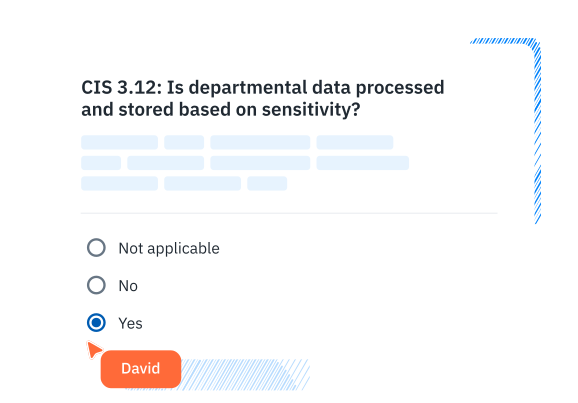
| Questionnaire Delivery & Completion | Hyperproof’s help center documents risk assessment surveys sent to risk owners and contacts. Its Third-Party Risk Management product lists vendor questionnaires built from templates or customized per vendor, with conditional logic and scoring models. | Vanta’s help center describes building vendor questionnaires from scratch, from a template created by Vanta’s Security team, or from a spreadsheet. Its pricing page lists AI-powered Questionnaire Automation for security questionnaire responses. | Prebuilt questionnaires for frameworks such as NIST, CIS, HIPAA, GLBA, and HECVAT, plus custom questionnaires for SIG and CAIQ. Multiple contributors can work on one questionnaire, with evidence uploaded alongside each answer. |
| Inventory Tracking | Hyperproof’s Risk Management page lists a central source of truth for third-party vendors, with key documents and renewal dates. Its Third-Party Risk Management product lists a vendor catalog of every vendor, assessment, and contract. | Vanta’s features page lists a live, comprehensive inventory of all software, hardware, or custom resources. Its Third Party Risk Management product lists a centralized vendor inventory with automated vendor discovery. | One inventory of departments, applications, vendors, and assets, each with an owner and connected to assessments, risks, and exceptions. API and CSV import handle bulk updates. |
| Risk Register & Exception Management | Hyperproof lists a risk register that evaluates tolerance, inherent risk, likelihood, and impact on customizable scales, and it links control health data to multiple risk registers. Its Policy Management product tracks policy exceptions, including who requested and who accepted each one. | Vanta’s Risk Management product lists a risk register where teams “assign an owner, score inherent risk, set a treatment plan, and score residual risk.” Its ISO 27001 page lists routing exceptions for approval. | Risk register with findings generated from assessment responses, a 5×5 likelihood-by-impact matrix, owners, and remediation plans. Exceptions carry justification, compensating controls, and expiration dates with review reminders. |
| Scoring, Reporting & Risk Visualization | Hyperproof’s Risk Management page lists built-in exportable dashboards and reports that show how risk posture changes in real time, plus an exportable vendor dashboard. | Vanta’s Continuous GRC page lists a unified Report Center and reports customized for stakeholders. Its pricing page describes its Professional package as compliance, risk, and reporting all in one package. | Scorecards and reports generated from live assessment data, with drill-down to responses and evidence, risk matrix visualization, and PDF and CSV export. Reports roll up CMMC readiness and SPRS scores. |
| Collaboration & User Experience | Hyperproof’s Risk Management page lists a customizable intake survey that collects risk signals from employees, partners, and vendors. Its Third-Party Risk Management product lists collaborating with vendors and stakeholders through remediation. | Vanta’s Continuous GRC page lists Workspaces that let individual business units segment, customize, and automate compliance from one account. Its pricing page lists questionnaire collaboration with question assignment and commenting. | WCAG-compliant, award-nominated interface built for respondents outside security, with multi-contributor questionnaires and participation tracking. |
| Implementation & Setup | Hyperproof’s Customer Success page lists an implementation manager and a customer success manager, and says programs are up and running in weeks, not months. | Vanta’s SOC 2 page says it integrates with tools like AWS, Azure, Okta, GitHub, and Wiz, and Vanta lists a Vanta API for building custom integrations and workflows. Its pricing page names its tiers and asks buyers to request personalized pricing, as of October 2026. | SaltyCloud states no-code deployment, operational in days to weeks, with minimal IT lift. |
What Each Platform Is For
Hyperproof
Built for multi-framework programs that write controls once and reuse them everywhere. A common control set maps into each framework, and evidence (which Hyperproof calls proof) uploaded once links across all of them. Connectors called Hypersyncs pull proof on a schedule the customer sets. Its continuous controls monitoring page says it can automatically test and monitor internal controls continuously. Hyperproof Gov runs in what Hyperproof calls a FedRAMP Certified Class C (Rev5) environment, as of October 2026.
Vanta
Built for companies pursuing and maintaining certifications. Vanta connects to a customer’s cloud and SaaS systems and runs automated tests against what it finds, so most evidence collection happens without manual uploads. Its inventory pre-populates from connected services, and items outside them can be added manually or by bulk upload. Vanta acquired Riskey and integrated its third- and fourth-party risk monitoring into Vanta’s Vendor Risk Management product. For federal buyers, the FedRAMP Marketplace lists Vanta Government Cloud as a FedRAMP Certified 20x offering at Class C (Moderate), as of October 2026.
Isora GRC
Built for information security teams running assessments across their own departments, systems, and vendors. Isora GRC runs recurring internal security assessment programs in organizations where most of the people being assessed do not work in security. A central team keeps an inventory of departments, systems, and vendors, each with an owner, and the owners answer questions about what they run. Inventory, findings, risks, exceptions, and reports all attach to that assessment data, and the cycle repeats against a changed inventory.
When Isora GRC Is the Wrong Choice
- The team needs a SOC 2 report. Isora does not name SOC 2. Compliance automation is built for this. Read Vanta, Drata, and Secureframe.
- The main problem is vendors rather than internal units. A dedicated vendor risk platform adds continuous external monitoring, larger questionnaire libraries, and portfolio reporting. Read UpGuard, Whistic, Bitsight, and SecurityScorecard.
- The program needs continuous, telemetry-driven monitoring. Isora repeats on an assessment cadence.
- The program needs a separate coverage report for every framework it maps. Isora tags questions across frameworks, but its framework rollups cover CMMC readiness and SPRS scores.
- The team wants AI-assisted authoring. Isora ships no AI features.
Who Each Platform Is Best For
| Platform | Who It’s For |
| Hyperproof | Multi-framework compliance programs that write controls once and reuse them everywhere, with risk, third-party risk, and policy management products alongside. |
| Vanta | Companies pursuing and maintaining certifications such as SOC 2 and ISO 27001, with Risk Management and Third Party Risk Management products alongside. |
| Isora GRC | Information security teams running recurring assessments across their own departments, systems, and vendors, where most respondents do not work in security. |
What Customers Say About Isora GRC
Security teams use Isora GRC to replace manual processes with intuitive workflows and actionable insight.
SaltyCloud makes Isora GRC, one of the products compared here. The assessments are our own, so confirm current features and pricing with each vendor before you decide.
FAQs
What is the difference between Hyperproof and Vanta?
Both are security compliance automation platforms, and each puts its weight on a different part of the work. Hyperproof is built for multi-framework programs that write controls once and reuse them everywhere: a common control set maps into each framework, and Hypersyncs pull proof on a schedule the customer sets. Vanta is built for companies pursuing and maintaining certifications: it connects to cloud and SaaS systems, and its SOC 2 page says it runs 1,200+ tests hourly. Both also list risk management and third-party risk management products.
Does Vanta do risk management?
Yes. Vanta’s Risk Management product lists a risk register where teams assign an owner, score inherent risk, set a treatment plan, and score residual risk, and a pre-built risk library with 100+ common risk scenarios. Vanta’s help center says Core Risk Management is included on all plans, and Advanced Risk Management features are available as an upgrade or add-on. For vendors, Vanta integrated Riskey’s third- and fourth-party risk monitoring into its Vendor Risk Management product, and its March 2026 release added Multiple Assessments for evaluating vendors across risk domains such as privacy, legal, AI, and ESG.
Is Hyperproof a GRC platform?
Yes. Hyperproof describes itself as an AI-powered GRC platform, with products for compliance, risk management, audit, third-party risk management, and policy management. Its compliance page says it scales a single, standardized control set across products, legal entities, operating divisions, or countries.
Does Isora GRC replace platforms like Hyperproof or Vanta?
Isora GRC runs alongside Hyperproof or Vanta. Hyperproof and Vanta prove the security team’s own posture to an auditor, and Isora GRC runs assessments across the departments and systems the security team does not operate, so the two cover different populations. Isora does not name SOC 2, so a team that needs a SOC 2 report should keep a compliance automation platform such as Hyperproof or Vanta.
What are the alternatives to Hyperproof and Vanta for IT risk management?
It depends on the job. For a SOC 2 or ISO 27001 program built on automated evidence, other security compliance automation platforms include Drata, Secureframe, and Sprinto. For a recurring assessment program across departments, systems, and vendors, where most respondents do not work in security, GRC assessment platforms include Isora GRC, Apptega, and Centraleyes. For single-vendor views, see Hyperproof alternatives and Vanta alternatives.
What is the difference between SOC 2 Type 1 and Type 2?
According to Hyperproof’s SOC 2 guide, a SOC 2 Type 1 examination evaluates the design of an organization’s controls at a specific point in time. A Type 2 report also assesses that the controls were consistently performed throughout a period. In both cases an independent CPA conducts the assessment before the report is issued.
Which platform is best for IT risk management?
It depends on the job the program is organized around. A program that writes controls once and reuses them across many frameworks fits Hyperproof. A company pursuing and maintaining certifications such as SOC 2 with automated tests against its cloud and SaaS systems fits Vanta. A security team running recurring assessments across departments, systems, and vendors, where most respondents do not work in security, fits a GRC assessment platform.
For a framework to evaluate GRC platforms before a demo, download our GRC Buyer’s Guide for Information Security Teams.

This content is for informational purposes only and does not constitute legal or compliance advice. See our full disclaimer.
 Other Relevant Content
