





 Table of Contents
- HIPAA Security Officer: Role, Responsibilities, and Requirements
- Is a HIPAA Security Officer Required?
- HIPAA Security Officer Responsibilities
- HIPAA Security Officer Qualifications
- Reporting Structure and Authority
- Privacy Officer vs. Security Officer
- Required Positions to Administer the Safeguards
-
How to Create a HIPAA Security Officer Job Description
- Step 1 — Summarize the position
- Step 2 — Define the reporting relationship
- Step 3 — Set decision-making authority
- Step 4 — Assign core responsibilities
- Step 5 — List required qualifications
- Step 6 — Describe preferred qualifications
- Step 7 — Allocate working time
- Step 8 — Specify screening requirements
- Step 9 —Set a compensation range
- How to Simplify HIPAA Security Officer Responsibilities
- Key Takeaways
- HIPAA Security Officer FAQs
HIPAA Security Officer: Role, Responsibilities, and Requirements
A HIPAA Security Officer develops and implements an organization’s HIPAA Security Rule policies and procedures. Under the Health Insurance Portability and Accountability Act (HIPAA), every covered entity and its business associates (BAs) must identify an official to oversee the protection of electronic protected health information (ePHI). More specifically, the designation requirement appears in 45 CFR § 164.308(a)(2).
The appointment needs defined responsibilities, time, and authority. Otherwise, security teams may identify risks without a clear decision-maker to approve corrective action.
This guide explains the HIPAA Security Officer designation requirement and responsibilities. It also covers role qualifications, reporting structure, and job description, including how the Security Officer typically works with the Privacy Officer.
Map Security Officer duties to specific HIPAA requirements.
See which policies and safeguards are within a security officer’s scope with citation-level assessment questions and help text, all in one place.
Is a HIPAA Security Officer Required?
A HIPAA Security Officer is required for every covered entity and business associate under the Assigned Security Responsibility standard at 45 CFR § 164.308(a)(2). The U.S. Department of Health and Human Services (HHS) uses the term “security official.”
The officer oversees the security program, while other staff can implement specific safeguards, investigate incidents, and provide evidence that the organization is addressing security risks.
Other teams may manage facility or network security, while overall responsibility for the security program remains with the designated official.
Which Organizations Must Designate a HIPAA Security Officer?
Covered entities and business associates subject to the Security Rule must identify a security official. These include:
- Healthcare providers: Doctors, clinics, psychologists, dentists, chiropractors, nursing homes, and pharmacies that bill insurance or handle other standard transactions electronically.
- Health plans: Health insurers, health maintenance organizations (HMOs), group health plans, Medicare, and Medicaid.
- Healthcare clearinghouses: Organizations that convert health information from one format into the standard electronic format, or back again.
- Business associates: Vendors that create, receive, maintain, or transmit ePHI for a CE or another BA. The 2013 Omnibus Final Rule implemented the Health Information Technology for Economic and Clinical Health (HITECH) Act’s direct Security Rule obligations for BAs.
Under 45 CFR § 164.306(b), organizations may consider their size, complexity, and capabilities when implementing safeguards.
As of October 2026, HHS states that the current Security Rule remains in effect during its proposed rule making. Organizations should assign responsibilities against current requirements.
HIPAA Security Officer Responsibilities
The HIPAA Security Officer’s primary job is to protect the confidentiality, integrity, and availability of ePHI.
- The HIPAA Security Officer coordinates corrective actions
- Technical teams operate controls and provide evidence
The officer develops and implements policies that meet the Security Rule’s administrative, physical, and technical safeguard requirements. That includes activities such as:
- Managing risk: Lead the HIPAA risk assessment, coordinate treatment of the risks it identifies, and audit the program through system activity reviews and audit logs.
- Controlling access: Define who can reach ePHI and how, from workforce clearance and termination to system access controls, authentication, and facility and workstation protections.
- Preparing for incidents: Coordinate incident response and contingency planning, including backup and recovery, emergency operations, and protections against ePHI being altered, destroyed, or intercepted in transit.
- Managing people and partners: Coordinate workforce training and written agreements with the organization’s business associates or PHI-handling subcontractors.
- Documenting the program: Document who performs each task and who approves risk-treatment decisions. Retain required policies, procedures, and records of actions and assessments for six years from creation or last effective date, whichever is later.
The following table maps the main Security Rule requirements to recommended oversight duties, including the business associate agreement (BAA) program.
| Safeguard Category | CFR § | Recommended Security Officer Oversight |
|---|---|---|
| Administrative — Security Management Process | 164.308(a)(1) | Coordinate risk analysis, risk treatment, sanctions, and information-system activity review |
| Administrative — Assigned Security Responsibility | 164.308(a)(2) | Develop and implement Security Rule policies and procedures |
| Administrative — Workforce Security | 164.308(a)(3) | Review workforce authorization, clearance, and termination procedures |
| Administrative — Information Access Management | 164.308(a)(4) | Oversee access authorization, establishment, and modification procedures |
| Administrative — Security Awareness and Training | 164.308(a)(5) | Coordinate security training for workforce members, including management |
| Administrative — Security Incident Procedures | 164.308(a)(6) | Coordinate incident response, mitigation, and outcome documentation |
| Administrative — Contingency Plan | 164.308(a)(7) | Oversee backup, recovery, emergency operations, and appropriate testing |
| Administrative — Evaluation | 164.308(a)(8) | Coordinate periodic technical and nontechnical program evaluation |
| Administrative — Business Associate Arrangements | 164.308(b)(1)–(3) | Coordinate business associate and subcontractor assurances and written agreements |
| Physical — Facility, Workstation, Device and Media | 164.310 | Review facility access, workstation protections, and device and media handling |
| Technical — Audit Controls | 164.312(b) | Oversee mechanisms that record and examine activity in systems handling ePHI |
| Technical — Access Control and Authentication | 164.312(a), (d) | Review access controls and person or entity authentication |
| Technical — Integrity | 164.312(c) | Oversee protection against improper alteration or destruction of ePHI |
| Technical — Transmission Security | 164.312(e) | Oversee safeguards against unauthorized access to ePHI during transmission |
| Documentation | 164.316 | Retain required policies, procedures, and documented actions, activities, or assessments for six years from creation or last effective date, whichever is later |
For more on the HHS papers, see our HIPAA Security Series guide, which links to their guidance on administrative, physical, and technical safeguards.
HIPAA Security Officer Qualifications
The HIPAA Security Rule defines the officer’s responsibilities in 45 CFR § 164.308(a)(2), but organizations set hiring criteria. To determine those qualifications, consider both relevant credentials and experience with the systems and risks the officer will oversee.
Security Officer Credentials
Security Officer credentials demonstrate an individual’s knowledge of cybersecurity, privacy law, or healthcare compliance.
Examples include:
- Certified Information Privacy Professional/United States (CIPP/US): The International Association of Privacy Professionals (IAPP) credential covers U.S. privacy laws and regulations.
- Certified Information Systems Security Professional (CISSP): The ISC2 credential covers designing, implementing, and managing cybersecurity programs.
- Certified Information Security Manager (CISM): The ISACA credential covers security governance, risk management, program management, and incident management.
- Certified in Healthcare Privacy and Security (CHPS): The American Health Information Management Association (AHIMA) credential covers healthcare privacy and security program management.
The ISC2 HealthCare Information Security and Privacy Practitioner (HCISPP) credential becomes inactive on December 1, 2026. So, make sure to account for that change when setting hiring criteria.
Security Officer Experience
Security Officer experience should include policy development, risk assessment, incident response, and remediation oversight.
Ask candidates to explain their responsibilities and results in those areas, including work with healthcare systems and business associates. Match the required experience to the organization’s complexity.
NIST Special Publication 800-66 Revision 2 offers specific questions for assessing the official’s qualifications and access to leadership.
Reporting Structure and Authority
The Security Officer’s reporting structure should provide access to leaders who can approve budgets, priorities, and risk decisions. NIST SP 800-66 Revision 2 asks whether the official has adequate access to senior leadership.
- Small practices: An existing leader can take the role with defined security duties, allocated time, and technical support.
- Larger organizations: Define how the officer works with information technology (IT) and compliance teams, which decisions need executive approval, and how unresolved risks reach leadership.
Record these responsibilities in the job description and supporting organizational policies.
Privacy Officer vs. Security Officer
HIPAA defines two officer roles, one under the Privacy Rule and one under the Security Rule.
- Privacy Officer: Governs how PHI in any form, whether electronic, oral, or paper, is used and disclosed, and how patients exercise their rights. Covered entities generally must designate one under 45 CFR § 164.530(a)(1), with applicability limits in § 164.500 and the group-health-plan exception in § 164.530(k)(1).
- Security Officer: Oversees the administrative, physical, and technical safeguards that protect ePHI. Every CE and BA must designate one under 45 CFR § 164.308(a)(2).
An organization can assign both roles to one person, as long as responsibilities across both scopes are clearly documented and the person has enough time and expertise to carry them out.
When a breach of unsecured PHI occurs, CEs must notify affected individuals and HHS, and sometimes the media, while BAs must notify the CE. When assigning breach-response duties, consider having the Security Officer support the technical investigation and the Privacy Officer assess privacy implications and notification obligations.
| Dimension | Privacy Officer | Security Officer |
|---|---|---|
| CFR anchor | 45 CFR § 164.530(a)(1) | 45 CFR § 164.308(a)(2) |
| Regulatory source | Privacy Rule (Subpart E) | Security Rule (Subpart C) |
| Scope of PHI | All PHI (electronic, oral, paper) | ePHI only |
| Primary focus | Use, disclosure, patient rights, complaints | Confidentiality, integrity, availability of ePHI |
| Suggested oversight responsibilities | Notice of Privacy Practices, access requests, authorizations, complaints, breach-notification policy | Risk analysis, technical-safeguard oversight, audit controls, incident response, BAA program |
| Relevant credentials | CIPP/US, CHPS | CISSP, CISM, CHPS |
| Required for | Covered entities, subject to §§ 164.500 and 164.530(k)(1) | Every covered entity and business associate |
Required Positions to Administer the Safeguards
The Security Officer is the designated position required by the Security Rule at § 164.308(a)(2). According to HHS guidance, other individuals may receive specific security responsibilities.
Supporting work can include:
- Training: Maintain security-awareness materials and participation records.
- Incident response: Investigate incidents, coordinate mitigation, and document outcomes.
- System administration: Operate access controls, logging, and technical safeguards.
- Vendor oversight: Review safeguards and coordinate required agreements.
- Risk assessment: Document threats, vulnerabilities, and potential impacts.
Organizations can combine or distribute these duties according to their size, capabilities, and technical environment.
How to Create a HIPAA Security Officer Job Description
A HIPAA Security Officer job description should define responsibilities, reporting relationships, authority, and qualifications appropriate to the organization’s systems and risks. Documenting designation and responsibilities also supports review under the HHS Office for Civil Rights (OCR) Audit Protocol.
For combined privacy and security roles, define responsibilities for each program. Name the leadership decision-maker for escalated risks and allocate time for the work.
Step 1 — Summarize the position
State the officer’s responsibility for developing and implementing Security Rule policies and procedures.
Step 2 — Define the reporting relationship
Identify who the officer reports to, how issues escalate, and any leadership or board reporting.
Step 3 — Set decision-making authority
Specify the approvals and reviews the officer owns, with detailed decision rights set through organizational policy.
Step 4 — Assign core responsibilities
Distinguish the officer’s oversight duties from tasks assigned to technical, privacy, compliance, and procurement teams.
Step 5 — List required qualifications
Name the education, experience, and credentials the organization considers essential.
Step 6 — Describe preferred qualifications
Identify healthcare-technology, clinical-environment, or prior security-program experience that strengthens a candidate’s fit.
Step 7 — Allocate working time
Allow enough time for the role, especially when it is combined with another position.
Step 8 — Specify screening requirements
Document any background checks or access conditions for a role handling sensitive health information.
Step 9 —Set a compensation range
Work with human resources (HR) to match compensation to the role’s scope and seniority.
Review HIPAA requirements before assigning oversight duties.
Identify the requirements your job description needs to account for with assessment questions and help text, all in one place.
How to Simplify HIPAA Security Officer Responsibilities
HIPAA Security Officers need current assessment responses, supporting evidence, and records of unresolved security gaps across teams and vendors.
A GRC platform brings those records together so the officer can review progress and coordinate follow-up.
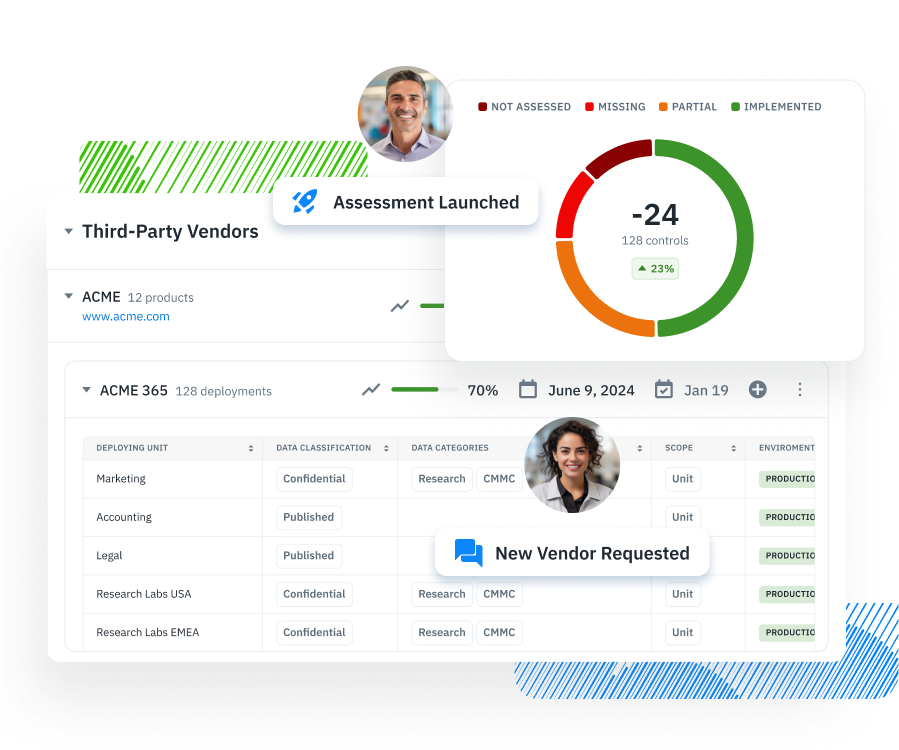
Isora GRC is the GRC Assessment Platform™ that connects assessments, collaborative questionnaires, inventory records, and a risk register, all in one place.
See the GRC Assessment Platform™ in action →
Assessment Management
Organize security assessments by compliance goal, track completion across systems and vendors, and review progress in one dashboard. In Isora, assessment series help Security Officers coordinate HIPAA evaluations alongside other framework assessments.
Learn more about Assessment Management with Isora GRC →
Questionnaires and Surveys
Distribute HIPAA questionnaires, collect responses from control owners and business associates, and attach supporting evidence. In Isora, contributors can complete questionnaires together, with each control owner providing their answer. Approval routing and sign-off workflows support consistent review.
Learn more about Questionnaires and Surveys with Isora GRC →
Inventory Management
Record systems and business associates, classify the information they handle, and track their assessment history. In Isora, inventory records link vendors, assets, and applications to assessments and risks. Security Officers can use this context to review HIPAA assessment scope.
Learn more about Inventory Management with Isora GRC →
Risk Management
Review assessment findings, assign risk owners, and track remediation through closure. In Isora, risks retain links to assessment responses, mapped controls, and affected systems or vendors. Owners, milestones, and status updates help Security Officers coordinate follow-up.
Learn more about Risk Management with Isora GRC →
Key Takeaways
Every covered entity and business associate must identify a security official responsible for developing and implementing Security Rule policies and procedures. Supporting teams can perform specific duties, with responsibilities documented clearly.
Select the officer for the organization’s systems and risks, then define decision-making authority, executive access, and working time. Relevant credentials support an assessment of practical experience with risk analysis, incident response, and remediation.
A written job description helps document those decisions. Isora GRC supports the officer’s coordination work by connecting assessments, evidence, inventory records, and risk treatment.
See how Isora GRC supports HIPAA Security Rule compliance →
HIPAA Security Officer FAQs
What is a HIPAA security officer?
A HIPAA Security Officer is the individual responsible for developing and implementing an organization’s Security Rule policies and procedures. Covered entities and business associates identify that official under the Assigned Security Responsibility standard at 45 CFR § 164.308(a)(2).
Is a HIPAA security officer required?
A HIPAA Security Officer is required for every covered entity and business associate under 45 CFR § 164.308(a)(2). A solo practitioner who is a covered entity has the same designation obligation as a covered hospital system.
What are the responsibilities of a HIPAA security officer?
HIPAA Security Officer responsibilities include developing and implementing security policies and coordinating the organization’s protection of ePHI. Recommended oversight covers risk analysis, training, incident response, contingency planning, business-associate arrangements, and periodic evaluation, with implementation duties documented across supporting teams.
What’s the difference between a HIPAA privacy officer and a security officer?
A Privacy Officer oversees policies for PHI in electronic, oral, and paper forms, while a Security Officer oversees safeguards for ePHI. An organization can assign both roles to one person, with responsibilities documented for each program.
Does a HIPAA security officer need to be certified?
The Security Rule sets the officer’s responsibilities without prescribing a certification. Organizations choose credentials that match the work, such as CISSP, CISM, CIPP/US, or CHPS; HCISPP becomes inactive on December 1, 2026.

This content is for informational purposes only and does not constitute legal or compliance advice. See our full disclaimer.
 Other Relevant Content
