






 Table of Contents
- Regulatory & Compliance Updates
- GRC Strategies
-
Cyber Incidents & Risk Implications
- Attackers used Meta’s AI support bot to hijack Instagram accounts
- Shai-Hulud poisons 73 Microsoft GitHub repos in expanded supply chain campaign
- Mid-year breach roundup catalogues eight cross-sector incidents
- ServiceNow patches an actively exploited API flaw two months after disclosure
- CISA flags active exploitation of LiteLLM AI gateway flaw
- SaltyCloud Research
Welcome back to the InfoSec GRC Brief from SaltyCloud, your go-to source for curated insights on governance, risk, and compliance (GRC) in information security. This edition covers the GRC news worth sharing from the first half of June 2026.
Let’s get into it.
Regulatory & Compliance Updates
CISA cuts federal patch deadlines to 3 days for actively exploited internet-facing flaws
CISA replaced blanket patch-everything mandates with tiered remediation deadlines tied to vulnerability risk level. Issued on June 10, Binding Operational Directive 26-04 requires actively exploited, automatable flaws on internet-facing systems to be remediated within 3 days. Non-automatable exploited flaws get 2 weeks. Federal agencies have until August 9 to update procedures and until December 7 to begin applying the new timelines.
Acting Director Nick Andersen framed the shift around four prioritization factors:
- Internet exposure
- KEV catalog listing
- Exploitability
- Level of system control a flaw grants
CISA is also moving toward granular conversations with critical infrastructure operators in place of broad blanket designations.
Private-sector programs can use the directive as a benchmark. Regulators and cyber insurers already judge remediation by risk level, and the four-factor model gives GRC teams a clear structure to bring to audits and board reviews.
Vulnerability management teams can map current patch SLAs against the 3-day and 2-week tiers, identify which exceptions now fall outside the federal benchmark, and document the prioritization logic before the next audit cycle.
SECURE Data Act faces bipartisan criticism at first congressional hearing
The latest attempt at federal privacy legislation, the SECURE Data Act drew bipartisan criticism in its first congressional hearing on June 4. Critics flagged missing data minimization standards and a safe harbor weaker than most state laws.
Democrats, California’s Privacy Protection Agency, and 18 state attorneys general argued the bill would preempt stronger existing state protections. One federal standard would replace the current state-by-state patchwork and cut compliance work. But a weak federal standard that overrides stronger state laws would leave most privacy programs with less protection than they have now.
Privacy officers can track amendments through committee, model both preemption scenarios against current state-by-state obligations, and flag the budget implications either path would create in FY27 planning.
White House issues NSPM-11 to accelerate AI adoption in national security
National Security Presidential Memorandum 11 directs military and intelligence agencies to accelerate AI adoption under a four-pillar framework:
- Adoption
- Adaptation
- Assurance
- Accountability
The directive sets 90-day and 120-day implementation deadlines, requires baseline AI security standards across national security agencies, and mandates expanded vendor diversity away from single-provider dependence.
The vendor diversity mandate is the part contractors will feel first. The directive pushes agencies to stop relying on a single AI provider, a requirement that will show up in the next round of contract language.
Defense contractors and critical infrastructure operators can review existing AI procurement contracts for single-provider exposure, identify which clauses will need to flex under the new baseline, and confirm that vendor security obligations match the assurance and accountability pillars before the next renewal.
GRC Strategies
ISACA’s 2026 North America Conference puts security debt on the GRC agenda
ISACA‘s June newsletter distills five conference themes around AI governance and digital trust, paired with a new practitioner guide for measuring and reducing security debt. A concurrent AI Pulse Poll found that 90% of organizations use AI but only 45% actively prioritize AI risks.
The security debt guide is the practical takeaway. Most GRC programs track technical risk informally, and a structured method for quantifying and prioritizing the backlog gives risk committees a defensible view of what’s accumulating between audits.
GRC teams can pilot the security debt methodology against one business unit, score the existing backlog against the AI Pulse Poll benchmarks, and bring the combined view to the next risk committee.
15 cybersecurity questions every CISO can answer for the board
CSO Online published a structured diagnostic of 15 questions security leaders can answer about their programs. The list covers third-party risk visibility, nonhuman identity controls, AI governance accountability, business continuity alignment, and real-time posture transparency. Several questions reference regulatory obligations under EU DORA and related frameworks.
The diagnostic functions as a board-readiness gap analysis. Each question maps to a control area regulators and auditors are already probing, which makes the list a faster path to identifying weak spots than a full program audit.
Security and compliance teams can run the 15 questions internally before the next risk committee, document the gaps, and use the results to prioritize Q3 and Q4 investments.
AI coding adoption hits 97% while governance lags at 30%
A Black Duck developer survey found that 97% of developers use AI coding tools, only 30% operate within a fully governed oversight approach, and 25% have no defined AI coding policy. Governed programs report 90% efficiency gains versus 44% in ungoverned environments, alongside new code review and vulnerability remediation bottlenecks.
The governance gap pairs with the Shai-Hulud campaign in this edition’s Cyber Incidents & Risk Implications section. AI-generated code is moving into production faster than review cycles can catch problems, and attackers are already targeting the same toolchain.
Risk and compliance teams can treat AI coding governance as an audit-ready control domain, define policy for tool selection, code review, and disclosure, and add AI-generated vulnerabilities to the standing vulnerability management program.
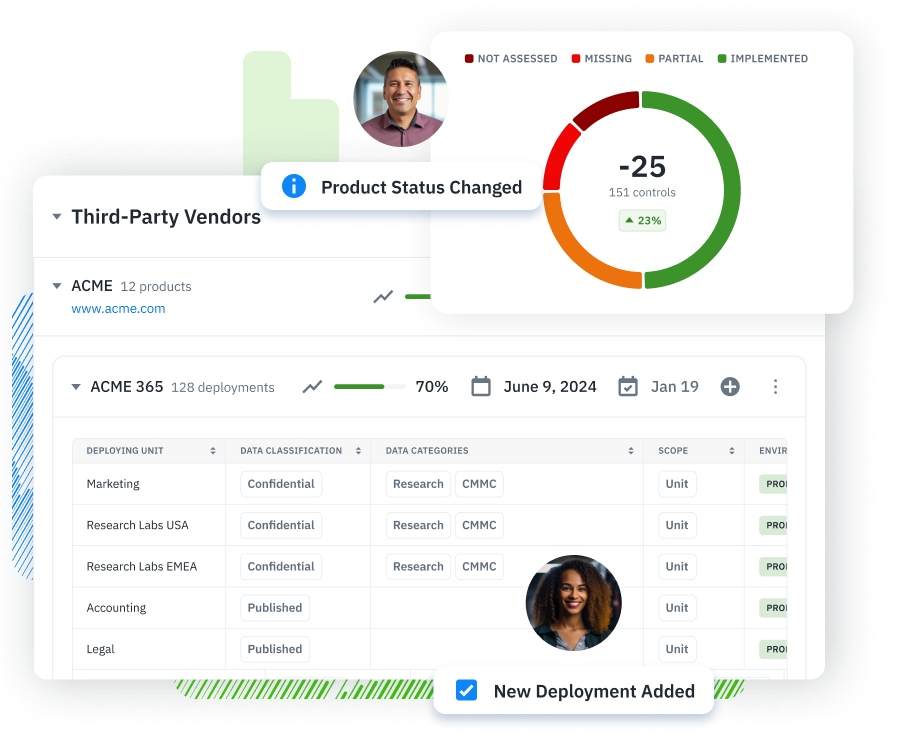
Contract-based TPRM is no longer keeping pace with vendor risk
Contract-based third-party risk management no longer works, according to legal expert Jonathan Armstrong in BankInfoSecurity. Vendors add new AI tools and subcontractors after signing, and they rarely tell their customers. A questionnaire answered at onboarding says nothing about what a vendor changed six months later.
The argument lands in the same week as the ServiceNow disclosure delay. A contract and a one-time review only capture a vendor on the day you assessed them. Most of the risk shows up later.
TPRM owners can check whether their current program catches mid-contract changes, including new AI tools, and add contract language that requires vendors to report material changes, AI use, and new subprocessors as they happen.
Cyber Incidents & Risk Implications
Attackers used Meta’s AI support bot to hijack Instagram accounts
Pro-Iranian threat actors exploited Meta’s AI customer support chatbot to take over high-value Instagram accounts, including those of the Obama White House and US Space Force. Attackers manipulated the bot to add attacker-controlled email addresses during password reset flows, then used geolocation-spoofed VPN connections to pass location checks. AI support systems lack the authorization controls of human-reviewed workflows, which is the gap the campaign exploited.
The pattern matters for any organization that puts AI in a support or account-recovery path. A customer service AI agent gets the same permissions as the workflow it runs, and a well-crafted prompt can walk straight around the usual access controls.
Organizations can audit AI support deployments for authorization guardrails, require MFA as a non-bypassable recovery gate, and define which actions an AI agent can never take without human review.
Shai-Hulud poisons 73 Microsoft GitHub repos in expanded supply chain campaign
The Miasma/Shai-Hulud supply chain campaign compromised a Red Hat employee’s GitHub account, then injected malicious OIDC token-harvesting workflows into 73 Microsoft repositories across Azure, Azure-Samples, and MicrosoftDocs. The campaign also pushed three poisoned versions of the durabletask PyPI package. The widely used Azure/functions-action GitHub Action was among affected assets, which broke CI pipelines for downstream organizations.
The campaign follows the same supply chain pattern seen this year in Trivy, Bitwarden, and Checkmarx. Attackers are systematically targeting the toolchain defenders use to build and ship software, and a single compromised maintainer account now scales into hundreds of downstream pipelines.
Security and identity teams can work from a clear checklist:
- Lock dependency versions across all CI/CD pipelines
- Enforce a multi-day delay before consuming new package releases
- Audit workflow files for unauthorized orphan commits
- Rotate any secrets visible to compromised runners (GitHub tokens, cloud credentials, Docker configs, SSH keys)
- Apply phishing-resistant MFA to every maintainer account with publish rights
Mid-year breach roundup catalogues eight cross-sector incidents
TechCrunch‘s mid-year roundup documents eight major 2026 incidents across healthcare, government, education, entertainment, and critical infrastructure. The list covers alleged Social Security database exposure tied to DOGE, Russian attacks on European energy infrastructure, Iranian wiping of Stryker employee devices, the ShinyHunterscampaign affecting 30M+ Canvas students, supply chain backdoors in Trivy, Bitwarden, and Checkmarx reaching OpenAI and Vercel, a Chinese breach of FBI wiretap systems, weeks of Hasbro downtime, and 2M+ passport exposures.
The breadth of attack surfaces is the real story. Cross-sector threat intelligence integration is no longer optional for any GRC program. Threats moving through education, manufacturing, and federal supply chains in the same six months share enough TTPs that single-sector threat models miss the pattern.
GRC programs can map current threat intelligence sources against the eight incidents, identify which sectors and TTPs they currently underweight, and add cross-sector reporting to the standing risk register inputs.
ServiceNow patches an actively exploited API flaw two months after disclosure
ServiceNow disclosed on June 10 that an unauthenticated API endpoint flaw, which allowed overprivileged database table queries, was actively exploited against a subset of customers before a June 5 patch. The company knew about the issue since April 7 and did not assign a CVE, leaving 59 days between internal awareness and customer-facing remediation. Impacted customers are being notified individually.
The two-month gap matters more than the flaw itself. It shows how long a major vendor will sit on an exploited bug before telling customers, which is the number to build your vendor notification SLA around.
GRC and IT operations teams using ServiceNow can confirm patch status against the Australia platform release, review anomalous API logs since April, and rewrite vendor notification SLA language in TPRM templates to require disclosure within a defined window rather than at vendor discretion.
CISA flags active exploitation of LiteLLM AI gateway flaw
CISA warned of active exploitation of CVE-2026-42271, a command injection flaw in BerryAI’s LiteLLM open-source AI gateway affecting MCP test endpoints. Chained with authentication bypass CVE-2026-48710, attackers execute arbitrary commands without credentials, exfiltrate stored model-provider API keys, and pivot laterally into connected AI infrastructure.
LiteLLM sits in the middle of many enterprise AI deployments as a proxy to multiple model providers, and a single compromise gives attackers credentials for every downstream model API. The LiteLLM and Meta AI bot stories together show two distinct AI attack surfaces in the same week. The gateway and the agent.
Organizations running LiteLLM can work through a four-step remediation:
- Upgrade to v1.83.7+
- Block MCP test endpoints if immediate patching is not feasible
- Rotate all stored model-provider API keys held by the proxy
- Update Starlette to v1.0.1+
SaltyCloud Research
NIST CSF 2.0 Multi-Framework Crosswalk
A free crosswalk mapping all 106 CSF 2.0 subcategories to NIST 800-53 Rev 5, 800-171 Rev 3, ISO 27001:2022, CIS Controls v8, and SCF at the individual control level, with a Coverage Summary tab showing per-Function coverage at a glance.
Third-Party Security Risk Management (TPSRM): Complete Guide
How to build or optimize a TPSRM program at any team size, including vendor tiering, assessment cadence, evidence collection, and connecting third-party findings back to a live risk register.
NIST 800-53 Vendor Management: Complete Guide [2026]
How the SA and SR control families govern third-party risk across the vendor lifecycle, including a tiered vendor model, SR-6 assessment cadence, and continuous monitoring expectations under SA-9 and SR-3.

This content is for informational purposes only and does not constitute legal or compliance advice. See our full disclaimer.
 Past Editions
