




 Table of Contents
- HECVAT Compliance: Requirements, Certification, and Getting Started
- What Is HECVAT Compliance?
- What Is HECVAT Certification?
- HECVAT Compliance Requirements
- How to Download the HECVAT
- How HECVAT Aligns with Other Regulatory Frameworks
- How to Simplify HECVAT Compliance
- Key Takeaways
- HECVAT Compliance FAQs
HECVAT Compliance: Requirements, Certification, and Getting Started
HECVAT compliance is the voluntary completion of the Higher Education Community Vendor Assessment Toolkit and alignment of a vendor’s responses with the reviewing institution’s risk and procurement standards. HECVAT is not a regulation, and no “HECVAT certification” exists.
EDUCAUSE developed HECVAT to help higher education institutions evaluate vendor security. The toolkit sets realistic procurement expectations for institutions and gives vendors a structured format to communicate their security posture.
This guide explains what HECVAT compliance means, how requirements are organized by assessment section, how the toolkit maps to regulatory frameworks, and how to access HECVAT 4.
For a beginner-level introduction, see What Is HECVAT? The Complete Guide for Higher Education.
What Is HECVAT Compliance?
HECVAT compliance means a vendor seeking to work with a higher education institution has completed the HECVAT questionnaire. The reviewing institution must also find those responses sufficient against its security, privacy, accessibility, and operational standards. It is not a formal legal status.
HECVAT compliance is the voluntary completion of the Higher Education Community Vendor Assessment Toolkit questionnaire and alignment of a vendor’s responses with the reviewing institution’s risk and policy expectations.
HECVAT is not a regulatory mandate, certification, or audit standard. It is a standardized assessment framework developed by EDUCAUSE that institutions use to evaluate third-party vendors’ cybersecurity, privacy, accessibility, and related practices.
HECVAT Compliance Requirements
HECVAT compliance has two requirements:
- Completion of the applicable workbook. A vendor works through the HECVAT 4 assessment tool containing 321 questions across 7 primary sections, completing only the tabs that apply to their solution. The process involves gathering internal documentation, attaching supporting evidence, and coordinating across security, legal, privacy, and IT teams. Most organizations require 8 to 20 hours to complete the workbook.
- Alignment with institutional review requirements. The reviewing institution uses HECVAT’s evaluation tabs (Institution Evaluation, High Risk Evaluation, Privacy Analyst Evaluation) to assess responses against its own policies, risk tolerance, and procurement standards. Institutions may request follow-up evidence, override vendor answers, or adjust the importance of specific questions based on their own risk appetite.
What Does HECVAT Compliance Mean?
HECVAT-compliant vendors share four characteristics:
- Complete responses: Provide complete, credible, and well-documented proof across all applicable sections
- Institutional alignment: Satisfy the reviewing institution’s risk and policy expectations
- Follow-up readiness: Respond to follow-up questions and supply additional evidence on request
- Institution-specific acceptance: No centralized HECVAT authority exists, so each institution determines acceptance based on its own standards
Free download: Score your third-party risk program across five dimensions with the TPRM Maturity Checklist.
What Is HECVAT Certification?
HECVAT is not a formal certification program. The process resembles a compliance audit, but there is no third-party auditor, no “HECVAT credential,” and no universal scoring system. EDUCAUSE provides the workbook and guidance, but it does not certify vendors.
Is HECVAT a Procurement Requirement?
HECVAT completion is a de facto procurement requirement across higher education. Even though completion is voluntary, most institutions treat the completed workbook as a baseline expectation before engaging a vendor. In fact, EDUCAUSE’s FAQ for vendors describes the HECVAT as higher education’s “preferred evaluation framework” for showcasing data protection practices.
Vendors that skip the assessment risk additional scrutiny or rejection during an institution’s review process. Kent State University, for example, requires vendors whose products access or host university data to complete a HECVAT in all Request for Proposal (RFP) processes.
HECVAT compliance does not mean:
- Mandatory requirement: HECVAT is voluntary, not a regulatory mandate
- Third-party audit: HECVAT is a self-assessment, not an external certification
- Universal score: Acceptance is institution-specific, not centrally determined
- EDUCAUSE credential: EDUCAUSE provides the tool, not a certification
| HECVAT Requirement / Claim | HECVAT Compliance |
|---|---|
| Detailed self-assessment responses | ✓ |
| Supporting documentation and evidence | ✓ |
| Institution review and approval | ✓ |
| Follow-up validation discussions | ✓ |
| Government-mandated certification | ✗ |
| Independent external audit | ✗ |
| Standardized industry-wide scoring | ✗ |
| Official EDUCAUSE certification | ✗ |
HECVAT Compliance Requirements
HECVAT 4 organizes the questionnaire into seven primary sections plus a Start Here routing tab within a single unified workbook.
Vendors begin with the Start Here tab, which contains eight required questions (REQU-01 through REQU-08). These questions determine which sections apply based on solution type, deployment model, and data types handled, since not every section applies to every vendor.
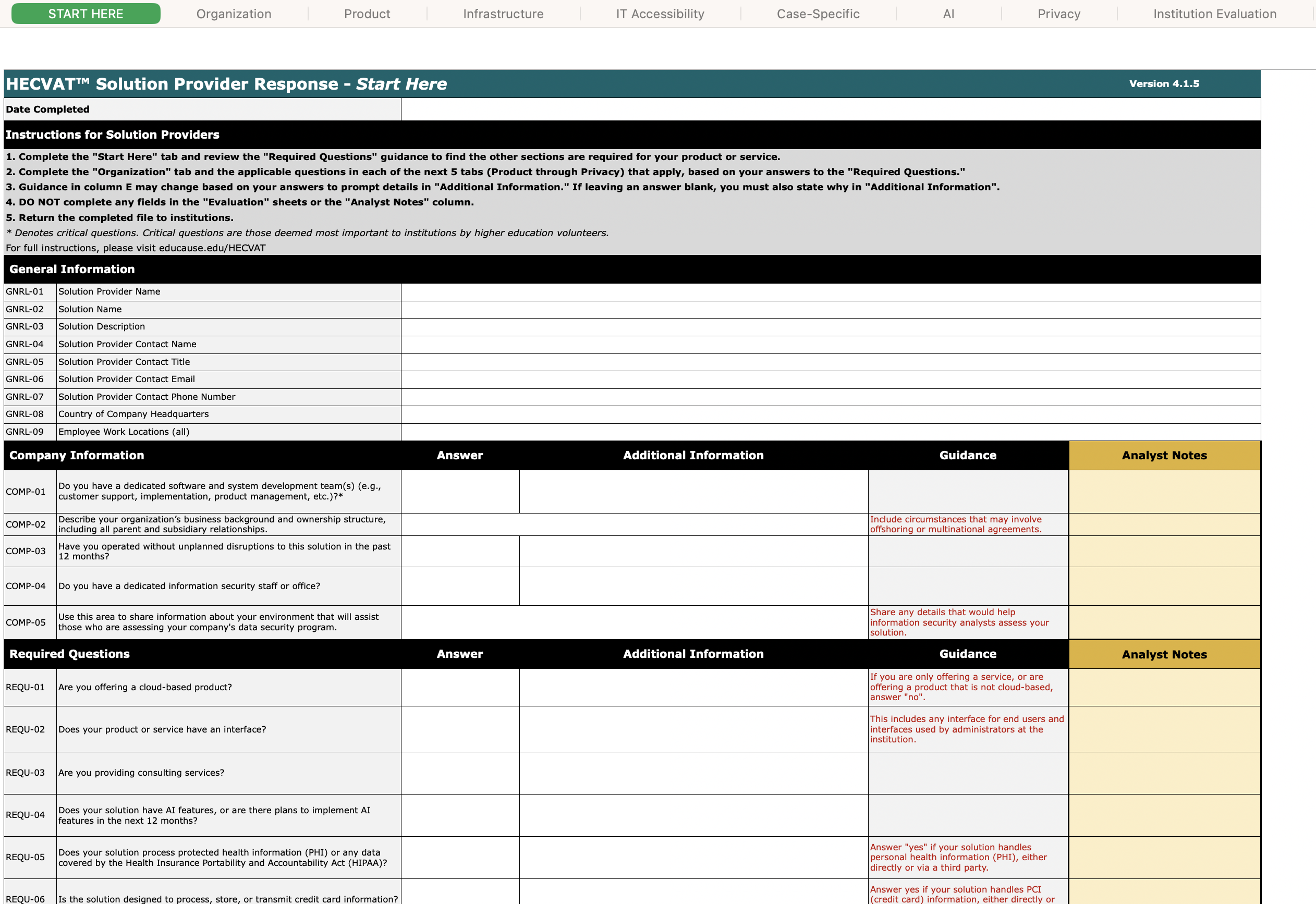
START HERE TAB, HECVAT 4.1 EDUCAUSE
HECVAT Questionnaire Completion Guidance
Vendors complete the workbook by working through the universal tabs first, then the conditional sections triggered by their Start Here responses. Four principles guide the process:
- Start Here and Organization are universal: Every vendor completes these two tabs regardless of solution type.
- Remaining sections are conditional: They activate based on the vendor’s solution type, deployment model, and data types handled.
- Perfect controls are not required: HECVAT captures maturity progression and gives institutions structured data to compare vendors.
- One workbook, multiple institutions: A completed workbook can be shared with multiple institutions without modification.
HECVAT 4 Assessment Sections
The seven primary sections plus the Start Here routing tab range from universal company and governance questions to conditional technical, privacy, and AI controls. Each section’s focus, applicability, and key topics appear below.
| Section | Focus Area | Universal vs. Conditional | Key Topics |
|---|---|---|---|
| Start Here (Required Questions) | Solution scoping and routing | Universal/Mandatory | Solution type, deployment model, data types, section applicability |
| Organization | Company profile and governance | Universal/Mandatory | Ownership, internal policy frameworks, risk management, compliance programs |
| Product | Operational resilience and technical safeguards | Conditional | Business continuity, disaster recovery, change management, identity/access management, application security |
| Infrastructure | Hosting environment and operations | Conditional | Data center security, network controls, encryption, monitoring, backup strategy |
| IT accessibility | User interface accessibility requirements | Conditional | WCAG alignment, VPAT/ACR documentation, assistive technology support, accessible interfaces |
| Case-Specific Questions | Regulatory and context-specific requirements | Conditional | HIPAA (HIPA-01–HIPA-29), PCI DSS (PCID-01–PCID-12), on-premises deployment |
| Artificial Intelligence | AI governance and model usage | Conditional | AI training data, model risk, automated decision-making, NIST AI RMF alignment (AIPL-05) |
| Privacy | Data stewardship and privacy practices | Conditional | Data lifecycle management, FERPA (PRGN-01), GDPR/PIPL (INTL-01–INTL-05), third-party privacy (PTHP-01) |
For a complete breakdown of how HECVAT 4 restructured the legacy Full, Lite, and On-Premise versions, see HECVAT 4: What’s New in the Latest Version.
How HECVAT Reviews Work
Institutions score completed HECVAT workbooks using three built-in evaluation tabs in HECVAT 4:
- Institution Evaluation: The primary review tab where analysts assess every vendor response, add notes, override answers, and adjust question importance based on their institution’s risk priorities. This tab drives the final compliance decision.
- High Risk Evaluation: A streamlined view used when institutions need to quickly identify critical or non-negotiable gaps in a vendor’s security posture. A single high-risk gap can be enough to reject a vendor.
- Privacy Analyst Evaluation: A dedicated tab used by privacy professionals to evaluate data protection and AI-specific questions without reviewing all technical infrastructure questions. Privacy findings from here influence the institution’s overall decision.
How Institutions Determine HECVAT Compliance
The requesting institution reviews HECVAT responses directly, and a vendor’s compliance outcome depends on how those responses score against each criterion.
- Analysts score each response against the compliant answer defined by HECVAT’s authors.
- Institutions override compliance determinations, adjust the importance of individual questions, and flag non-negotiable questions that automatically surface in the High Risk Evaluation tab.
- Analysts add notes directly in the workbook, which vendors see if the workbook is returned for clarification.
Because no universal standard exists, each institution applies its own risk tolerance and procurement requirements. For that reason, the same submission may be accepted by one institution and rejected by another.
Accurate HECVAT Terminology
Accurate HECVAT terminology centers on completion and submission rather than certification or accreditation. Vendors avoid the term “HECVAT certified” because no official HECVAT certification or accreditation exists. The following language better describes the assessment process:
| Recommended HECVAT Language | Avoid |
|---|---|
| “We completed a HECVAT assessment.” | “We are HECVAT certified.” |
| “We submitted a HECVAT workbook for institutional review.” | “We passed HECVAT.” |
| “Our HECVAT responses were accepted by the institution.” | “We received HECVAT accreditation.” |
How to Download the HECVAT
HECVAT 4 downloads directly from the official EDUCAUSE HECVAT page as a free Microsoft Excel workbook, with version 4.1.6 as the current release.
- Download location: HECVAT 4 is publicly available on the official EDUCAUSE HECVAT page. Click the Download HECVAT 4 link to access the current version.
- Current version: HECVAT 4.1.6. HECVAT 4 itself launched on February 10, 2025.
- Format: Microsoft Excel workbook (.xlsx). The format supports conditional logic, automated scoring, and built-in evaluation tabs.
- Cost: Free download.
- Older versions: Some institutions may still request HECVAT v3. Version 4 is the current standard.
Supporting Guidance
EDUCAUSE provides separate guidance for each audience:
- For institutions: How to use the evaluation tabs, interpret vendor responses, and integrate HECVAT into procurement workflows
- For vendors: How to complete the questionnaire accurately, share results with multiple institutions, and transition from HECVAT 3
Time to complete: Most organizations require 8 to 20 hours to complete HECVAT, and once completed, the workbook can be shared with multiple requesting institutions.
How HECVAT Aligns with Other Regulatory Frameworks
HECVAT aligns with regulatory frameworks by mapping their security, privacy, and case-specific control requirements into a single questionnaire institutions use for due diligence.
The toolkit functions as a structured due-diligence tool that consolidates security controls, privacy practices, governance, and case-specific requirements into one assessment. That structure helps institutions ask structured questions and compare vendors efficiently, but HECVAT does not replace the underlying legal or regulatory frameworks.
Completing a HECVAT indicates that a vendor has relevant controls in place. Completion does not establish legal compliance, certification, or conformance under any separate framework like HIPAA, FERPA, GDPR, or NIST. Some framework requirements appear directly through case-specific questions, while others appear indirectly through broader privacy, governance, and security prompts.
HECVAT 4 addresses the following regulatory frameworks across its workbook tabs.
| Framework | Type | HECVAT Location | Specific Coverage |
|---|---|---|---|
| HIPAA & HITECH | Regulatory mandate | Case-Specific tab: HIPA-01 through HIPA-29 | Business Associate Agreements, risk analysis, technical controls, audit logging for health records |
| PCI DSS | Industry standard | Case-Specific tab: PCID-01 through PCID-12 | Attestations of Compliance, cardholder data environments |
| FERPA | Regulatory mandate (US) | Privacy tab: PRGN-01; Case-Specific: OPEM-06 | FERPA-related data processing; on-premises FERPA-compliant handling |
| GDPR / PIPL | Regulatory mandate (EU/China) | Privacy tab: PRGN-02, PDOC-02, INTL-01 through INTL-05 | Data protection laws, third-party privacy obligations, processor terms aligned with GDPR Article 28 |
| NIST CSF / CIS Controls / ISO 27001 | Framework / compliance program | Organization tab: DOCU-04 | Vendors are asked whether they conform to a specific industry standard security framework such as NIST CSF, CIS Controls, or ISO 27001 |
| NIST AI RMF | Voluntary framework | Artificial Intelligence tab: AIPL-05 | Documented processes to address potential negative impacts of AI as described by the NIST AI Risk Management Framework |
HECVAT vs. GLBA and Vendor Assessment Obligations
HECVAT satisfies the vendor assessment obligation the Safeguards Rule places on Title IV colleges and universities under GLBA. The Safeguards Rule (16 CFR 314.4) requires Title IV institutions to oversee vendors by “periodically assessing service providers based on the risk they present”. It also requires them to select providers capable of maintaining appropriate safeguards. The rule does not name HECVAT directly, but HECVAT provides the structured assessment format higher education uses to satisfy this obligation.
A sponsored EDUCAUSE Review article on GLBA pitfalls in higher education recommends asking vendors for a SOC 2 report or a completed HECVAT to satisfy Safeguards Rule vendor oversight requirements. A Thompson Coburn GLBA FAQ for higher education further explains that the Department of Education enforces GLBA at Title IV institutions through annual compliance audits. Since May 2024, the Safeguards Rule has also required Title IV institutions to report qualifying data breaches to the FTC within 30 days. That requirement adds urgency to vendor assessment practices.
The Department of Education’s Federal Student Aid office reinforced these obligations in Electronic Announcement GENERAL-24-46 (April 2024), building on its February 2023 cybersecurity requirements update. That announcement restates the oversight duties in 16 CFR 314.4(f) and clarifies that the Department and FSA are not service providers under GLBA.
The FTC’s June 2025 Safeguards Rule FAQ for motor vehicle dealers restates the same service provider oversight duties. In December 2025, the FTC also brought an enforcement action against an education technology vendor, Illuminate Education. That case signals that inadequate vendor security controls now carry direct federal enforcement risk for the institutions that contract with them.
How to Simplify HECVAT Compliance
Centralizing HECVAT intake, scoring, and vendor records in a purpose-built GRC platform simplifies compliance at scale. Spreadsheets and email cannot keep pace with the coordination required across dozens of vendors. An EDUCAUSE QuickPoll on third-party risk management found that 63% of higher education institutions lack a formal TPRM process. The same poll found that only 22% regularly monitor third-party performance.
Isora GRC is the collaborative GRC Assessment Platform™ built for security teams to manage HECVAT assessments in one connected workspace. Its capabilities include:
- Assessment management: Organize assessments by compliance goal to streamline complex campaigns. The purpose-built HECVAT Uploader ingests completed vendor spreadsheets, maps answers, and auto-populates scores and evidence, eliminating manual entry and version drift.
- Questionnaires & surveys: Reduce time spent on assessment tasks with collaborative, structured questionnaires. Multiple contributors answer the questions closest to their area of responsibility, upload evidence inline, and route for approval without email back-and-forth.
- Inventory management: Reduce time spent managing vendor records across disconnected spreadsheets and procurement systems. A centralized vendor inventory links each vendor product, data classification, and owning unit directly to its assessment history and risk posture.
Streamline HECVAT compliance with Isora GRC →
Key Takeaways
EDUCAUSE develops and maintains HECVAT as a structured due-diligence tool that higher education institutions use to evaluate vendor security, privacy, accessibility, and operational practices. The GLBA Safeguards Rule requires Title IV institutions to assess service providers, and HECVAT is the tool higher education uses to meet that obligation.
But HECVAT is not a regulation, certification, or legal status. Instead, HECVAT compliance means a vendor has completed the HECVAT questionnaire and their responses satisfy the reviewing institution’s security, privacy, accessibility, and operational standards.
HECVAT 4 addresses HIPAA, PCI DSS, FERPA, and GDPR through dedicated question sets. It also aligns with NIST CSF, CIS Controls, and ISO 27001 through governance documentation. However, completing a HECVAT does not establish compliance with those frameworks.
For a full overview of the toolkit, including versions, scoring, the assessment process, and framework comparisons, see What Is HECVAT? The Complete Guide for Higher Education. To streamline HECVAT assessments at scale, explore Isora GRC.
HECVAT Compliance FAQs
Is HECVAT compliance mandatory?
No. HECVAT is a voluntary assessment tool with no regulatory mandate. Most colleges and universities require vendors to complete it as part of procurement, and skipping the assessment typically halts a vendor’s progress through institutional review.
Is HECVAT a certification?
No. HECVAT is not a certification. EDUCAUSE provides the workbook and guidance without certifying vendors. Institutions evaluate completed responses against their own risk tolerance and procurement standards, and no credential is issued.
Where can I download HECVAT?
HECVAT 4 (current version: 4.1.6) is available directly from EDUCAUSE as a free download. The Download HECVAT 4 button on the EDUCAUSE page provides the Microsoft Excel workbook (.xlsx).
How does HECVAT relate to FERPA?
HECVAT addresses FERPA through Privacy tab question PRGN-01 (whether the solution processes FERPA-related data) and Case-Specific question OPEM-06 (on-premises FERPA-compliant handling). FERPA itself is a federal law protecting student educational records. Completing HECVAT does not establish FERPA compliance, and the assessment helps institutions identify vendors with the right controls to protect student records.
What compliance frameworks does HECVAT align with?
HECVAT 4 includes specific question sets for HIPAA (HIPA-01–HIPA-29), PCI DSS (PCID-01–PCID-12), FERPA (PRGN-01), and GDPR/PIPL (INTL-01–INTL-05). For NIST CSF, DOCU-04 asks vendors whether they conform to a specific industry standard security framework such as NIST CSF, CIS Controls, or ISO 27001. AIPL-05 asks whether the vendor’s AI practices align with the NIST AI Risk Management Framework. GLBA has no dedicated question IDs in the workbook, and its broader security and privacy requirements appear indirectly across the Organization, Product, and Infrastructure tabs.
Do institutions need both HECVAT and SOC 2?
Many higher education institutions request both, since they serve different purposes. SOC 2 is an independent third-party audit that verifies a vendor’s controls. HECVAT, by contrast, is a self-assessment covering security, privacy, accessibility, and operations in the higher education context. A vendor’s SOC 2 report can support HECVAT review without replacing the questionnaire.

This content is for informational purposes only and does not constitute legal or compliance advice. See our full disclaimer.
