





 Table of Contents
GLBA Compliance Checklist: Everything You Need to Track
A GLBA compliance checklist is a structured tracking tool that helps financial institutions verify they meet requirements under the Gramm-Leach-Bliley Act. Organizations regulated by GLBA need a systematic way to track compliance across these areas. A well-organized GLBA checklist provides that structure. Most cover:
- The Financial Privacy Rule
- The Safeguards Rule
- Information security program (ISP) requirements
This guide provides a complete, organized checklist covering all three GLBA areas, plus guidance on how to use it effectively. For a closer look at the rules themselves, see our GLBA compliance requirements guide.
Who Needs a GLBA Compliance Checklist?
Any organization classified as a “financial institution” under the Gramm-Leach-Bliley Act (GLBA) needs a compliance checklist. But the definition extends well beyond traditional banks and credit unions.
Traditional Financial Institutions
Banks, credit unions, savings associations, broker-dealers, insurance companies, and investment advisers have long been subject to GLBA. Traditional financial institutions are regulated by the Office of the Comptroller of the Currency (OCC), the Federal Deposit Insurance Corporation (FDIC), the Federal Reserve, the Securities and Exchange Commission (SEC), and state insurance commissioners.
Non-Traditional Financial Institutions
Non-traditional financial organizations are any entity “significantly engaged” in financial activities. This includes:
- Higher education institutions that receive Title IV federal financial aid and handle student financial data
- Auto dealers that arrange consumer financing
- Tax preparers that handle sensitive financial information
- Mortgage brokers and real estate settlement services
- Payday lenders and check-cashing businesses
| Organization Type | Regulator(s) | GLBA Requirement |
| Banks and credit unions | OCC, FDIC, Federal Reserve, NCUA | All three rules |
| Insurance companies | State insurance regulators, FTC | Privacy Rule + Safeguards Rule |
| Higher education | FTC | Safeguards Rule, Privacy Rule |
| Broker-dealers | SEC | All three rules |
| Auto dealers (financing) | FTC | Safeguards Rule |
| Tax preparers | FTC | Safeguards Rule |
What Is a GLBA Compliance Checklist?
A complete GLBA compliance checklist consolidates every trackable requirement across the Financial Privacy Rule, the Safeguards Rule, and the supporting information security program into one reference.
A GLBA compliance checklist turns every requirement of the Gramm-Leach-Bliley Act’s Financial Privacy Rule and Safeguards Rule, along with the information security program that supports them, into actionable items. Organizations use it to verify compliance status, identify gaps, and prepare for regulatory examinations by the FTC, OCC, FDIC, or state regulators.
Covered organizations can work through each section of a GLBA compliance checklist to record compliance status, assign owners, and document evidence.
GLBA Financial Privacy Rule Checklist
The Financial Privacy Rule (Regulation P, 12 CFR Part 1016) governs how financial institutions collect and disclose consumer financial information. Track the following items to verify Privacy Rule compliance.
| Y/N | GLBA Checklist Item | Requirement Source |
| Initial privacy notice delivered to customers at relationship establishment | 12 CFR 1016.4 | |
| Annual privacy notice delivered to existing customers | 12 CFR 1016.5 | |
| Notice describes categories of nonpublic personal information (NPI) collected | 12 CFR 1016.6(a)(1) | |
| Notice describes categories of NPI disclosed to third parties | 12 CFR 1016.6(a)(2) | |
| Notice describes information-sharing practices with affiliates and non-affiliates | 12 CFR 1016.6(a)(3-5) | |
| Notice describes consumer opt-out rights | 12 CFR 1016.6(a)(6) | |
| Notice describes security and confidentiality policies | 12 CFR 1016.6(a)(8) | |
| Opt-out mechanism provided before sharing NPI with non-affiliates | 12 CFR 1016.7 | |
| Opt-out notice is clear, conspicuous, and provides reasonable means to opt out | 12 CFR 1016.7(a) |
GLBA Safeguards Rule Checklist
The Safeguards Rule (16 CFR Part 314) requires a written information security program with 9 specific elements. For detailed explanations of each element, see our GLBA Safeguards Rule guide, and map controls to requirements with our GLBA Safeguards Rule requirements crosswalk.
| Y/N | GLBA Checklist Item | Safeguards Rule Element |
| Qualified Individual designated to oversee ISP | Element 1: 16 CFR 314.4(a) | |
| Written risk assessment conducted and documented | Element 2: 16 CFR 314.4(b) | |
| Safeguards designed and implemented based on risk assessment | Element 3: 16 CFR 314.4(c) | |
| Safeguards regularly tested and monitored | Element 4: 16 CFR 314.4(d) | |
| Security awareness training provided to all personnel | Element 5: 16 CFR 314.4(e) | |
| Service providers evaluated and monitored for safeguards compliance | Element 6: 16 CFR 314.4(f) | |
| ISP kept current based on testing, monitoring, and operational changes | Element 7: 16 CFR 314.4(g) | |
| Written incident response plan established and documented | Element 8: 16 CFR 314.4(h) | |
| Qualified Individual reports in writing to board of directors annually | Element 9: 16 CFR 314.4(i) |
Information Security Program Checklist
An information security program (ISP) puts the Safeguards Rule into daily practice through technical, administrative, and physical controls. The following checklist items track that implementation. For detailed risk assessment methodology, see our GLBA risk assessment guide.
| Y/N | GLBA Checklist Item | Category |
| Access controls implemented (least-privilege, role-based access, MFA) | Technical Safeguards | |
| Customer data encrypted in transit over external networks and at rest | Technical Safeguards | |
| Secure development practices applied to customer-facing applications | Technical Safeguards | |
| Change management procedures documented and followed | Administrative Safeguards | |
| Data retention and secure disposal policy implemented (no later than 2 years after last use) | Administrative Safeguards | |
| Vendor/service provider contracts include safeguards requirements | Administrative Safeguards | |
| Annual penetration testing and semi-annual vulnerability assessments conducted | Testing and Monitoring | |
| Audit logs maintained and reviewed for unauthorized access or anomalies | Testing and Monitoring | |
| Physical security controls in place for systems containing NPI | Physical Safeguards |
How to Use a GLBA Checklist
Ongoing maintenance turns a GLBA compliance checklist into a working control, and a named owner keeps it current on a fixed review schedule. The following steps make it an active part of every compliance program.
Step 1: Assign Ownership
Designate the Qualified Individual (required under the Safeguards Rule) as the checklist owner. This person is responsible for ensuring each item is tracked, reviewed, and updated. Distribute responsibility for individual checklist sections to the appropriate department heads or unit owners.
Step 2: Establish a Review Cadence
Review the full checklist at minimum annually. Critical items have their own mandated schedules:
| Checklist Area | Minimum Review Frequency |
| Full checklist review | Annually |
| Risk assessment | Annually (or after significant changes) |
| Penetration testing | Annually |
| Vulnerability assessments | Semi-annually |
| Security awareness training | Annually (new hires within 30 days) |
| Vendor assessments | Per contract cycle (minimum annually) |
Step 3: Document Evidence
For each checklist item, maintain documentation that demonstrates compliance — written policies, test results, training records, vendor contracts, incident response plans, and board reports.
Step 4: Conduct a Gap Analysis
Compare the organization’s current compliance status against the checklist. Identify items that are incomplete or not started. Prioritize remediation based on risk severity and regulatory urgency.
Step 5: Report to Leadership
The Qualified Individual must report in writing to the board of directors at least annually. Use the completed checklist as the foundation for this report.
Access a Free GLBA Compliance Checklist
A free GLBA Compliance Checklist PDF is a printable tracking tool that covers every requirement across the Financial Privacy Rule, the Safeguards Rule, and the information security program.
What the GLBA checklist includes:
- Complete checklist organized by rule area with regulatory citations
- Status tracking columns (Compliant / In Progress / Not Started)
- Evidence documentation column for each item
- Assigned owner column for accountability
- Review frequency reference table
Access the free GLBA Compliance Checklist →
How to Simplify GLBA Compliance
A static checklist tracks GLBA requirements. Isora GRC, the GRC Assessment Platform™, automates the work behind it, replacing the manual effort of collecting evidence, chasing status updates, and compiling board reports with one connected workspace.
Assessment Management
Distribute checklist items as structured assessments to unit owners across departments, systems, and vendors, then track completion and scoring from a single dashboard. Grouping assessments by compliance goal keeps multi-framework programs such as GLBA, NIST, and HIPAA in one system instead of separate trackers, so a single checklist review can cover every requirement area at once.
Questionnaires & Surveys
Turn each checklist item into a framework-aligned questionnaire that the control owner closest to it completes. Multiple contributors can collaborate on one questionnaire and upload evidence inline, so privacy notices, safeguards documentation, and ISP controls arrive attached to the exact requirement they satisfy.
Reports & Scorecards
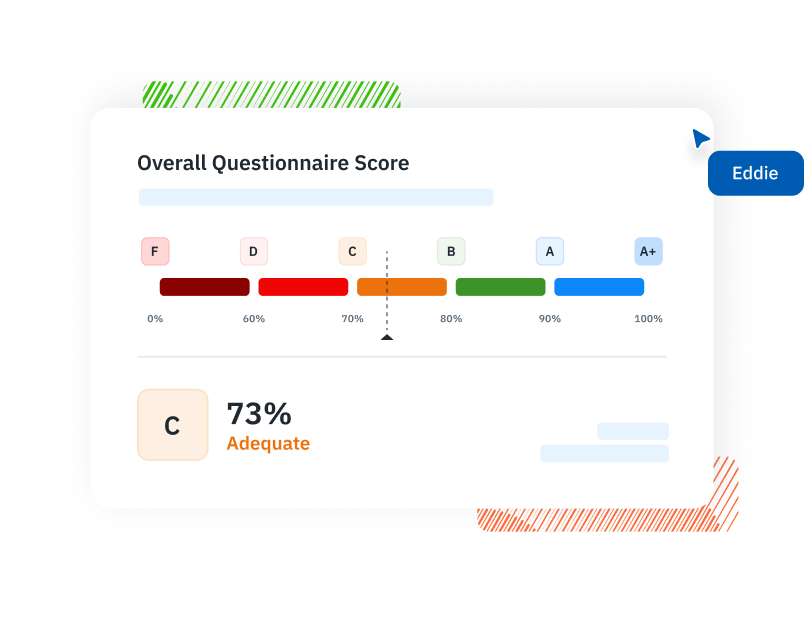
Generate the annual board report required under the Safeguards Rule directly from assessment data. Scorecards compare compliance status across departments, vendors, and rule areas in a single view, so gaps surface before an examination instead of during one.
See how Isora GRC simplifies GLBA compliance →
Key Takeaways
GLBA compliance comes down to organizing requirements across the Financial Privacy Rule, the Safeguards Rule, and its supporting information security program into trackable items with clear ownership and evidence documentation. Review the full checklist annually at minimum, and hold critical items to the Safeguards Rule’s mandated schedule.
For the full picture of GLBA compliance requirements and a step-by-step process, see our GLBA compliance guide. Or, access the free GLBA Compliance Checklist for a ready-to-use tracking tool.
See the GRC Assessment Platform™ in action →
GLBA Compliance Checklist FAQs
What should a GLBA compliance checklist include?
At minimum, the checklist should cover the Financial Privacy Rule (privacy notices and opt-out rights), the Safeguards Rule (the 9 required elements of an information security program), and the operational controls that put that program into practice (technical, administrative, and physical safeguards). Each item should record the regulatory source, compliance status, responsible owner, and evidence documentation.
How often should a GLBA compliance checklist be reviewed?
Review the full checklist at minimum annually. Critical items like risk assessments, penetration testing, and vendor assessments should follow the schedule mandated by the Safeguards Rule — annually for risk assessments and penetration testing, semi-annually for vulnerability assessments.
Who is responsible for GLBA compliance in an organization?
The Safeguards Rule requires organizations to designate a Qualified Individual to oversee the information security program. This person is responsible for implementing and maintaining compliance across all checklist items and must report in writing to the board of directors or governing body at least annually.
Does GLBA apply to higher education institutions?
Yes. Colleges and universities that participate in Title IV federal financial aid programs are classified as “financial institutions” under GLBA because they handle student financial data.
What are the penalties for GLBA non-compliance?
Financial institutions face penalties up to $100,000 per violation. Officers and directors can face individual fines up to $10,000 per violation and up to 5 years imprisonment for willful violations. See our GLBA penalties and enforcementguide for details.

This content is for informational purposes only and does not constitute legal or compliance advice. See our full disclaimer.
 Other Relevant Content