

Woot!
We got your request. Hang on tight and we'll get back to you!

 Assessment Management
Run structured security assessments across systems, teams, and vendors—all from one place.
Assessment Management
Run structured security assessments across systems, teams, and vendors—all from one place.
 Questionnaires & Surveys
Launch structured questionnaires and collect evidence from the people closest to each control.
Questionnaires & Surveys
Launch structured questionnaires and collect evidence from the people closest to each control.
 Reports & Scorecards
Turn assessments into audit-ready reports and actionable insights your team can actually use.
Reports & Scorecards
Turn assessments into audit-ready reports and actionable insights your team can actually use.
 Inventory Management
Maintain a connected inventory of vendors, assets, and systems linked to assessments and risks.
Inventory Management
Maintain a connected inventory of vendors, assets, and systems linked to assessments and risks.
 Exception Management
Log, track, and resolve policy exceptions so nothing falls through the cracks during audits.
Exception Management
Log, track, and resolve policy exceptions so nothing falls through the cracks during audits.
 Risk Management
Turn assessment findings into a living risk register with owners, remediation plans, and full lineage.
Risk Management
Turn assessment findings into a living risk register with owners, remediation plans, and full lineage.
 Information Security Risk Management (ISRM)
Run assessments across units and systems, maintain IT asset inventories, and collaborate on a shared risk register—all in one place.
Information Security Risk Management (ISRM)
Run assessments across units and systems, maintain IT asset inventories, and collaborate on a shared risk register—all in one place.
 Third-Party Security Risk Management (TPSRM)
Track vendors, send security questionnaires, and manage third-party risk with built-in workflows and a centralized inventory.
Third-Party Security Risk Management (TPSRM)
Track vendors, send security questionnaires, and manage third-party risk with built-in workflows and a centralized inventory.







































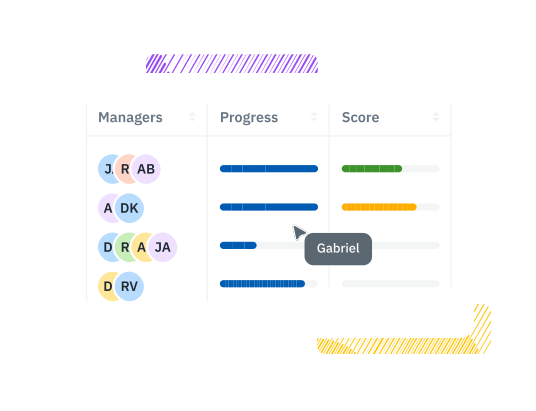
Group HIPAA assessments into a recurring series and target every department, system, and business associate that handles ePHI, covering §164.308 (administrative), §164.310 (physical), and §164.312 (technical). Completion and scoring update in one dashboard, reminders handle the follow-up, and findings reach the risk register with lineage back to the safeguard and the system.
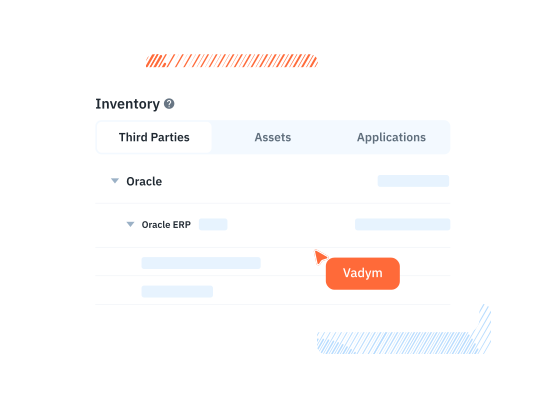
Track every system, application, and vendor that stores, processes, or transmits ePHI, with each record linked to its risk assessments, associated risks, data classification, and business associate relationships. When OCR asks which systems handle ePHI and what controls protect them, the answer is already in the inventory.
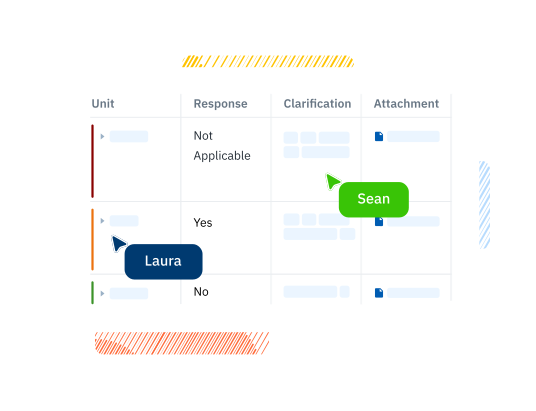
Distribute questionnaires from a prebuilt library that covers HIPAA alongside NIST, CIS, GLBA, and HECVAT, and link results to each vendor record alongside risk ratings and BAA documentation. Multiple contributors can answer a single questionnaire and attach evidence inline, so every relationship carries a documented assessment history rather than a signed agreement alone.
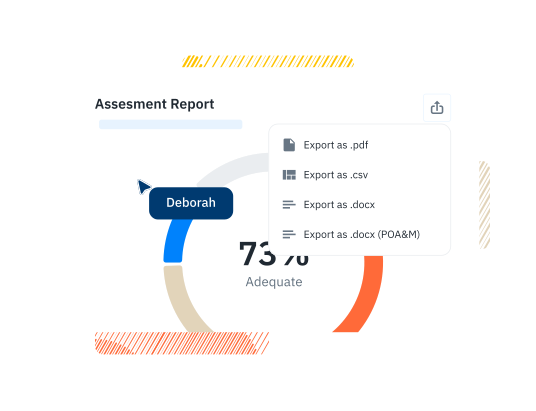
Scorecards pull from live assessment data, risk register entries, and vendor records to show assessment completion, safeguard implementation status, remediation progress, and ePHI inventory coverage. Drill down from any score to the individual response and the evidence behind it, and export to PDF or CSV. The risk register keeps an append-only audit log, so the record of what was found and fixed stays time-stamped.