Wisconsin IT Security Standards Compliance Software

Turn Wisconsin's IT Security Handbooks into a structured, audit-ready program

Isora GRC gives Wisconsin executive agencies a single platform to operationalize the IT Security Policy and Standards Handbooks. Run NIST-aligned assessments, track POA&Ms, and submit DET-ready reports—all in one workspace.

Trusted by established organizations & partners
https://vt.eduhttps://www.af.milhttps://utexas.eduhttps://yale.eduhttps://www.tdi.texas.govhttps://www.ttuhsc.eduhttps://aws.amazon.comhttps://www.osu.eduhttps://www.wilcotx.govhttps://www.utoronto.cahttps://www.tdcj.texas.govhttps://www.uchicago.edu/enhttps://www.utah.eduhttps://dir.texas.govhttps://www.dps.texas.govhttps://www.berkeley.eduhttps://www.techstars.comhttps://cccs.eduhttps://www.iwu.eduhttps://msu.eduhttps://www.auburn.eduhttps://www.stthomas.eduhttps://www.getezmoney.comhttps://www.sait.cahttps://www.ubc.cahttps://www.cuanschutz.eduhttps://www.tjc.eduhttps://marymount.eduhttps://www.umt.eduhttps://www.pdx.eduhttps://www.tccd.eduhttps://ltu.eduhttps://morantechnology.comhttps://www.merit.eduhttps://www.tccd.eduhttps://www.gonzaga.eduhttps://www.bhc.eduhttps://www.dallascollege.edu

Problem

Manual tracking makes bi-annual DET reporting difficult to sustain

Wisconsin’s 2025 IT Security Standards Handbook requires executive agencies to implement NIST SP 800-53 Rev. 5 controls, conduct regular risk assessments, and report compliance status to DOA/DET twice per year. Most agencies still track control implementation, POA&Ms, and vendor assessments in spreadsheets and shared drives.

Without centralized systems, evidence collection becomes fragmented. This slows remediation, creates gaps in audit documentation, and leaves agencies scrambling to compile reports when DET reporting cycles arrive.

Solution

A purpose-built GRC platform for Wisconsin's executive agencies

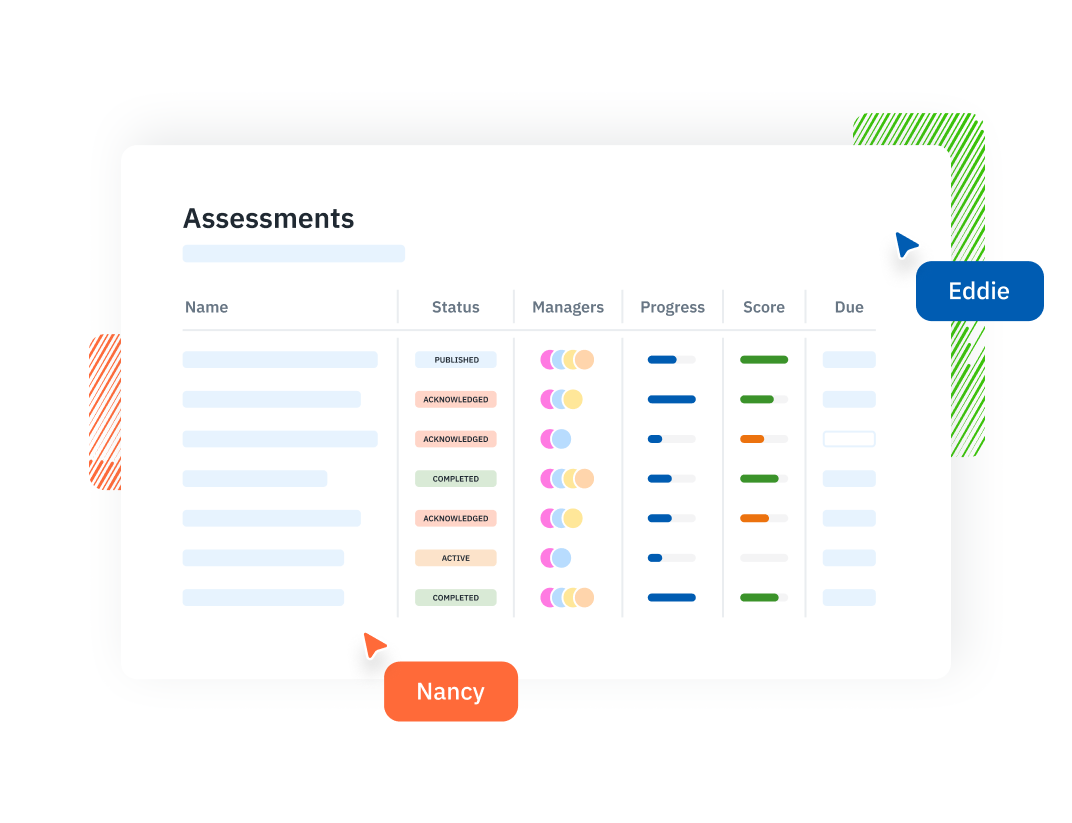
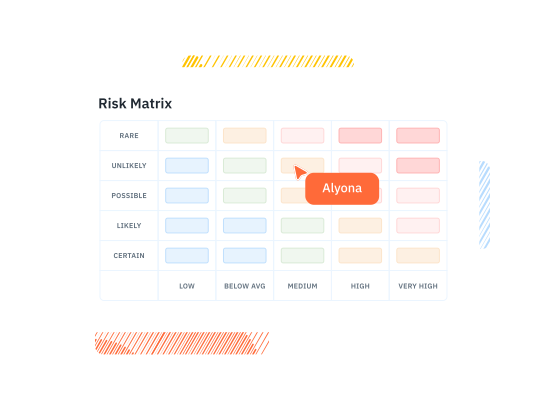
Isora GRC provides the structure to manage Wisconsin IT Security Standards with confidence. Built for security and compliance teams, it unifies assessments, POA&M tracking, and remediation evidence in one workspace aligned with DET's policy and standards handbooks. Instead of managing controls across disconnected tools, agencies use Isora to measure baseline compliance, document risk treatment, and generate DET-ready reports for bi-annual submissions. Every control, system, and vendor record stays connected, creating a verifiable audit trail from assessment to authorization.

Centralize control implementation

Track NIST SP 800-53 Rev. 5 baselines across agency systems

Wisconsin requires agencies to implement Low and Moderate NIST SP 800-53 Rev. 5 controls as the minimum baseline, with High controls added for regulated data like IRS 1075, HIPAA, and CJIS. Isora GRC supports these frameworks out of the box, letting agencies deploy standardized assessments across departments and systems. Findings automatically populate POA&Ms and the risk register, ensuring consistent evidence collection for DET's bi-annual compliance reviews.

Learn More

Streamline bi-annual DET reporting

Generate compliance reports on demand

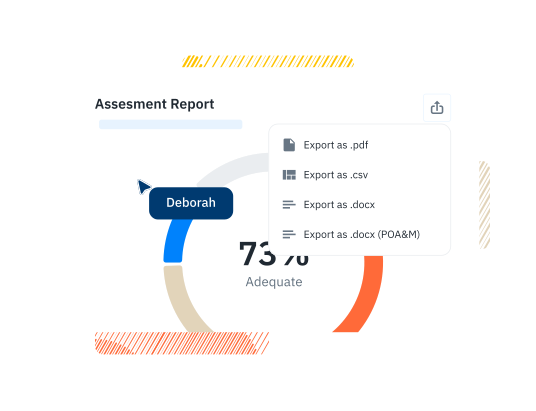
Isora's reporting tools consolidate data from assessments, risk registers, and system inventories into structured exports aligned with Wisconsin's 20 policy domains. Agencies produce audit-ready documentation that demonstrates control implementation status, remediation progress, and baseline coverage for DOA/DET oversight. Reports export in formats suitable for statewide submissions, turning scattered evidence into measurable proof of compliance.

Learn More

Manage vendor and supply-chain risk

Maintain oversight of third-party providers

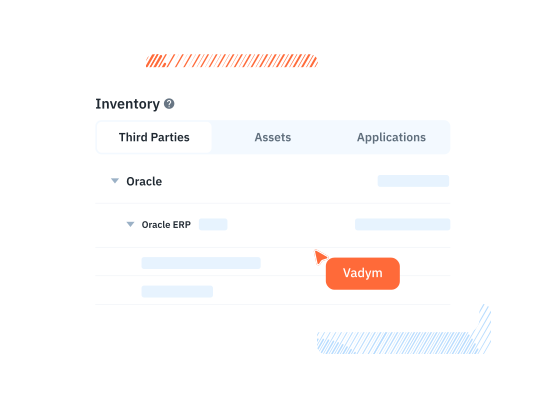
Standard 240 requires agencies to ensure every external service provider complies with statewide IT security policies, conduct formal risk assessments before outsourcing, and continuously monitor vendor controls. Isora centralizes vendor assessments, attestations, and contract documentation in one workspace. Each vendor record links to associated risks and systems, providing complete visibility into third-party compliance and supporting DET's expanded supply-chain requirements.

Learn More

Track remediation activities

Document POA&Ms with automated workflows

Wisconsin agencies must maintain Plans of Action and Milestones for every identified control deficiency, tracking remediation through closure. Isora automates POA&M creation from assessment findings, assigns owners, sets deadlines, and monitors progress in real time. Leadership gains transparent oversight of open items, overdue tasks, and completed mitigations, ensuring agencies stay audit-ready between DET reporting cycles.

Learn More
Latest Content
Our latest content
Stay ahead of the curve with our latest research on a diverse range of topics exploring the ever-changing world of governance, risk, and compliance.

State Information Security Regulations: Complete Guide Across the U.S., all fifty state governments have issued their own state information security...

Complete guide for Ohio ORC § 9.64 requirements including deadlines, program components, incident reporting, and compliance strategies.

Frequently Asked Questions
Wisconsin IT Security Standards Compliance FAQs
Find the answers you need here, or chat with us.
Contact Sales
What are Wisconsin's IT Security Policy and Standards Handbooks, and who must comply?

The IT Security Policy Handbook defines statewide cybersecurity policies all executive agencies must follow, while the IT Security Standards Handbook provides technical implementation guidance based on NIST SP 800-53 Rev. 5. Together, they establish Wisconsin’s information security framework under DOA/DET authority. All executive branch agencies must implement these requirements; the UW Board of Regents is explicitly exempt.


How does Isora GRC help agencies meet Wisconsin IT Security Standards?

Isora centralizes assessments, POA&M tracking, and compliance evidence so agencies can demonstrate alignment with DET’s policy and standards handbooks. It maps controls to NIST frameworks, automates remediation workflows, and produces DET-ready reports for bi-annual submissions. Agencies use Isora to operationalize the full Risk Management Framework: categorization, control selection, implementation, assessment, authorization, and continuous monitoring.

What frameworks does Wisconsin's IT Security Standards Handbook align with?

The Standards Handbook adopts NIST SP 800-53 Rev. 5 as the statewide control foundation, requiring all agencies to implement Low and Moderate baseline controls as minimum requirements. It also aligns with NIST CSF, NIST SP 800-37 (Risk Management Framework), and incorporates High controls where federal regulations like IRS 1075, HIPAA, CJIS, and MARS-E apply to Wisconsin systems.

What are the bi-annual DET reporting requirements?

Agencies must report control implementation status to DOA/DET twice per year, documenting baseline coverage, open POA&Ms, remediation progress, and overall risk posture. Isora streamlines this process by consolidating assessment results, risk data, and system inventories into automated reports that align with DET’s compliance expectations and submission timelines.

Can Isora support vendor risk management under Standard 240?

Yes. Isora tracks vendor risk assessments, security attestations, and continuous monitoring activities required under Policy SA-01 and Standard 240. Each vendor record links to associated systems and risks, providing complete visibility into third-party compliance. Agencies can document pre-contract reviews, enforce data handling restrictions, and maintain audit trails for all external service providers.

How does Isora help agencies manage multiple federal requirements like HIPAA, IRS 1075, and CJIS?

Wisconsin’s IT Security Standards harmonize state and federal requirements by aligning with NIST SP 800-53 Rev. 5, the same foundation used by HIPAA, IRS 1075, and CJIS. Isora includes these frameworks out of the box, letting agencies assess once and report across multiple compliance obligations. Shared controls map to corresponding federal requirements, reducing duplication and unifying documentation for state and federal audits.

Let’s Chat
See the GRC Assessment Platform in action
Book a Demo